

If you’re an HR leader, talent acquisition professional, or business owner searching for applicant tracking system (ATS) features that actually move the needle on recruiting performance, this guide delivers exactly what you need. You’ll discover the ATS key features that separate enterprise-grade solutions from basic software, understand what to look for in an ATS that aligns with your hiring goals, and gain access to a comprehensive ATS buyer guide based on real-world implementation data.
This isn’t another generic feature list. It’s a strategic framework for evaluating modern recruiting software based on what actually drives results: faster time-to-hire, higher-quality candidates, regulatory compliance, and measurable return on investment (ROI). Whether you’re replacing an outdated system or implementing your first ATS, you’ll walk away with clear criteria for making a confident decision.
We’ve structured this guide to address your most pressing questions: Which features directly impact hiring velocity? What capabilities ensure compliance without creating an administrative burden? How do leading organizations leverage ATS platforms to gain a competitive advantage in talent acquisition? By the end, you’ll have a complete evaluation framework and actionable next steps for selecting the right solution.
What Is an Applicant Tracking System?
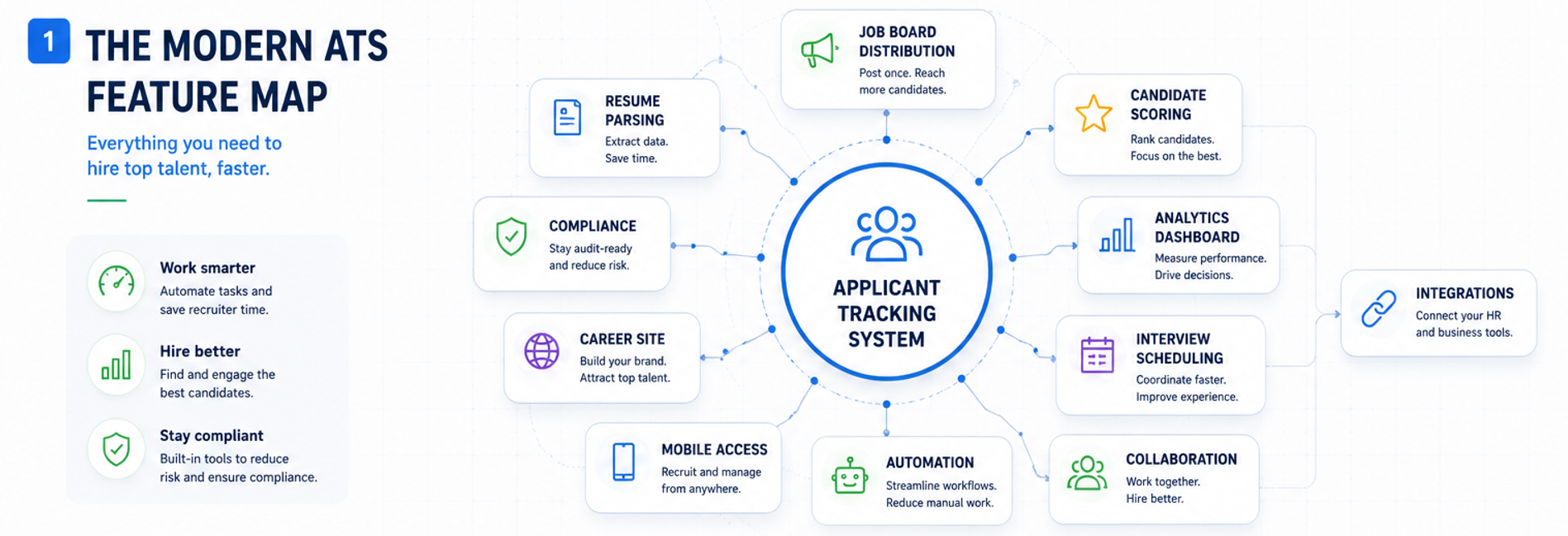
An applicant tracking system is centralized software that manages every aspect of recruiting, from initial job posting through final hiring decision. Originally developed in the 1990s to digitize paper resumes, today’s ATS platforms have evolved into sophisticated recruiting automation engines that handle job distribution, candidate screening, interview coordination, compliance tracking, and hiring analytics.
The core problem an ATS solves is simple yet critical: manual recruiting processes can’t scale. When hiring managers spend hours sorting resumes, scheduling interviews, and tracking candidates in spreadsheets, quality suffers, and top talent is hired by faster competitors. Modern hiring software eliminates these bottlenecks through intelligent automation and centralized data management.
Market adoption tells the story clearly. Most Fortune 500 companies rely on ATS platforms for their recruiting operations. This near-universal adoption among enterprise organizations reflects the fundamental shift in how successful companies approach talent acquisition. Mid-market and growing companies are following suit, recognizing that competing for talent requires the same technological advantages that larger competitors leverage.
The ATS’s meaning has expanded beyond simple application tracking. Today’s platforms serve as command centers for strategic talent acquisition, integrating with job boards, background check services, onboarding systems, and HR analytics tools. This hiring software overview sets the foundation for understanding which features truly matter when evaluating solutions.
Why Companies Rely on ATS Platforms
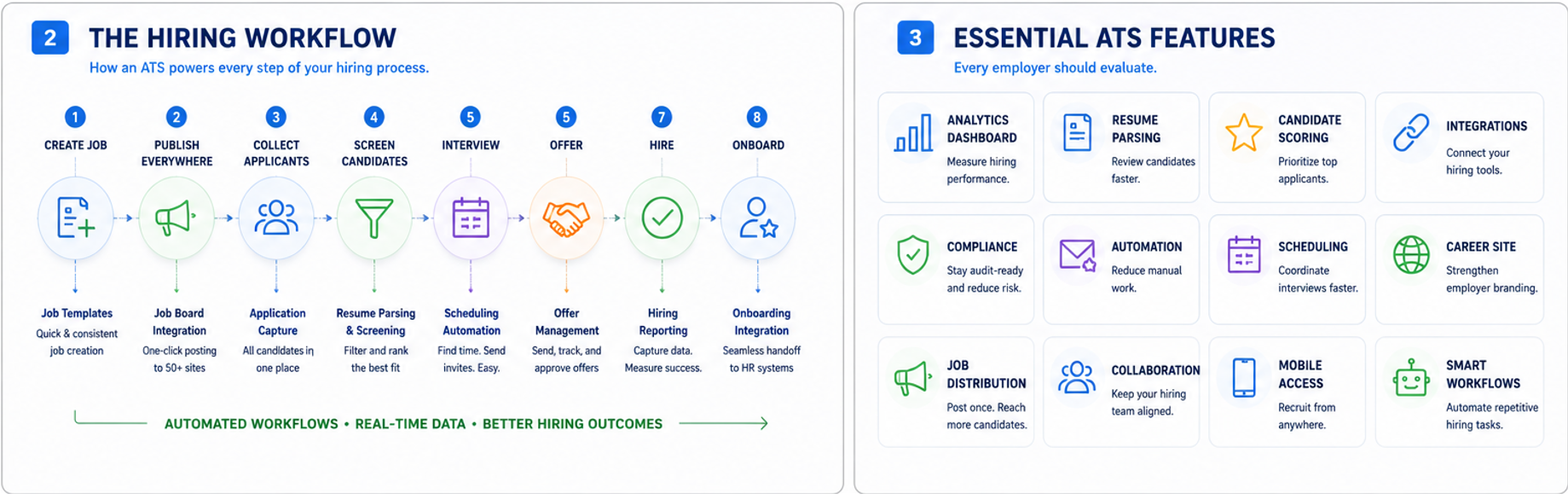
The ATS benefits that drive widespread adoption are backed by concrete performance improvements. Organizations report an average 50% reduction in time-to-hire after implementing robust applicant tracking systems. This acceleration comes from automating repetitive tasks that previously consumed recruiter bandwidth: posting jobs, screening resumes, scheduling interviews, and sending status updates.
Beyond faster hiring, companies see dramatic improvements in candidate quality. When recruiters can search thousands of resumes instantly, score applicants based on custom criteria, and maintain organized talent pipelines, they make better matches. One study found that 86% of recruiters reported finding higher-quality candidates after ATS implementation, directly impacting business performance through better hires.
Compliance represents another critical driver. With Equal Employment Opportunity Compliance (EEOC) reporting requirements, OFCCP audits, and state-specific regulations, manual tracking can lead to costly mistakes. Modern ATS platforms automatically capture required data, generate compliance reports, and maintain audit trails, transforming a high-risk administrative burden into a streamlined process.
The talent acquisition ROI extends to cost savings as well. By reducing agency fees, minimizing bad hires, and optimizing recruiter productivity, companies typically see payback within 6-12 months. When you factor in the opportunity cost of extended vacancies and the competitive advantage of quickly hiring top talent, the business case becomes even stronger. These quantifiable benefits explain why ATS adoption continues to accelerate across industries and company sizes.
Must-Have Applicant Tracking System Features
Job Board Integration
Job board integration transforms how companies reach candidates by enabling one-click posting to multiple platforms simultaneously. Instead of manually copying job descriptions across Indeed, ZipRecruiter, LinkedIn, Monster, and dozens of other sites, recruiters post once, and the ATS handles distribution automatically. This multi-posting software capability is designed to maximize candidate reach while maintaining consistency across all channels.
The mechanics work through API connections between your ATS and major job boards. When you create a posting, the system formats it according to each platform’s requirements and pushes it live across your selected channels. Advanced platforms even optimize posting times based on historical performance data, ensuring maximum visibility. The ability to post to Indeed and other top sites with a single action saves recruiters 3-5 hours per job opening while dramatically expanding the candidate pool.
Source effectiveness analytics represent the hidden value in job board integration. Your ATS should track which platforms generate applications, interviews, and hires for each role. This data reveals where to invest recruiting budget for maximum impact. For instance, you might discover that technical roles perform best on specialized boards while entry-level positions get better responses from general platforms.
The most sophisticated integration features include automated budget management, performance-based bid adjustments, and sponsored job optimization. When your ATS can automatically pause underperforming posts and reallocate budget to high-converting sources, you’re not just posting jobs, you’re running data-driven recruitment campaigns. This strategic approach to job distribution helps expand the talent pool’s reach while controlling costs.
Integration quality varies significantly between ATS providers. Look for platforms that maintain direct partnerships with major boards rather than third-party aggregators. Direct integrations provide real-time synchronization, better analytics, and priority support when issues arise. The difference between basic posting and strategic distribution often determines whether you’re competing effectively for top talent.
Resume & Document Management
Resume parsing technology serves as the foundation of effective document management within an ATS. Modern parsers use natural language processing to extract structured data from unstructured resumes, automatically populating candidate profiles with education, experience, skills, and contact information. This automation eliminates hours of manual data entry while ensuring consistency across your resume database.
The real power emerges when this parsed data becomes searchable. Advanced document management in ATS platforms indexes every piece of candidate information, creating a Google-like search experience for recruiters. Need a Java developer with AWS certification and startup experience? A properly configured system returns relevant matches in seconds, including candidates from previous searches who might be perfect for new openings.
Version control and centralized storage solve another critical challenge. When candidates update their resumes or submit additional documents, the system maintains a complete history while presenting the most current information. This eliminates confusion about which version is the latest and ensures all team members work from the same candidate data. Searchable resumes combined with version tracking create a single source of truth for all recruiting activities.
GDPR and CCPA compliance add complexity to document management. Your ATS must provide tools for data retention policies, candidate consent tracking, and right-to-deletion requests. Leading platforms automate these requirements by setting retention schedules, flagging expiring consents, and providing self-service portals for candidates to manage their data. This proactive approach to privacy compliance protects your organization from regulatory risk.
Look for systems that handle diverse document types beyond resumes, cover letters, portfolios, certifications, reference letters, and compliance documents. The ability to store, search, and share these materials within the platform streamlines evaluation and prevents anything from getting lost in email attachments. When every candidate document lives in a single, secure, searchable location, recruiting teams operate at maximum efficiency.
Candidate Ranking, Scoring & Tags
Candidate ranking capabilities separate modern ATS platforms from basic applicant databases. Today’s AI resume screening can analyze hundreds of applications in minutes, scoring each candidate based on job requirements, skills match, and predictive success factors. This technology doesn’t replace recruiter judgment; rather, it amplifies it by surfacing the most promising candidates first and ensuring qualified applicants don’t get buried in high-volume recruiting.
Custom scoring rules let you define what matters for each role. A sales position might prioritize industry experience and quota attainment, while a developer role weighs technical skills and portfolio projects. The ATS scoring engine applies these criteria consistently across all applicants, eliminating the inconsistency that creeps in when multiple recruiters screen manually. Studies show that algorithmic screening can reduce time-to-review by 75% while actually improving the quality of hire.
Talent pool tagging transforms your ATS from a transactional system into a strategic talent database. By tagging candidates with skills, certifications, clearances, interests, and other attributes, you build rich profiles that surface relevant talent for future openings. A candidate who wasn’t quite right for today’s senior role might be perfect for next quarter’s mid-level position, but only if you’ve tagged them appropriately for future retrieval.
Bias mitigation deserves special attention in ranking systems. Leading platforms offer blind screening options, diverse slate requirements, and audit tools to ensure fair evaluation. Some systems flag when scoring patterns might indicate bias and prompt recruiters to review their criteria. This proactive approach to fair hiring helps organizations build diverse teams while staying ahead of regulatory requirements.
The most effective ranking systems combine multiple inputs: resume parsing scores, assessment results, knockout question responses, and recruiter ratings. This multi-factor approach provides nuanced rankings that reflect real candidate potential rather than simple keyword matches. When implemented thoughtfully, these tools help recruiters focus their time on genuinely qualified candidates while ensuring no strong applicant gets overlooked.
Real-Time Analytics Dashboard
Recruiting analytics transform gut-feel hiring into data-driven talent acquisition. Modern ATS dashboard interfaces present key performance indicators in visual, actionable formats that enable quick decision-making. Instead of pulling reports manually, recruiters and hiring managers can see real-time metrics on open positions, pipeline health, source effectiveness, and team performance, all automatically updated as data flows through the system.
Critical hiring metrics to track include time-to-fill by position and department, conversion rates at each recruiting stage, source quality scores, cost-per-hire calculations, and diversity pipeline analytics. The best dashboards let you drill down from high-level trends to individual requisition performance, identifying bottlenecks before they impact hiring goals. For example, if engineering roles show increasing time-to-fill, you can investigate whether it’s due to sourcing challenges, interview delays, or offer decline rates.
Custom reporting capabilities separate enterprise-grade analytics from basic metrics. Your ATS should allow creation of role-specific dashboards for different stakeholders: executive summaries for leadership, tactical metrics for recruiters, and pipeline views for hiring managers. Time-to-fill reports broken down by recruiter, location, and job family reveal optimization opportunities that aggregate metrics hide.
Forecasting functionality helps recruiting teams plan proactively. By analyzing historical hiring patterns, seasonality, and business growth projections, advanced analytics predict future hiring needs and budget requirements. This forward-looking approach helps secure resources before they’re desperately needed and demonstrates recruiting’s strategic value to the organization. When you can show leadership exactly how recruiting investments translate to business outcomes, budget conversations become much easier.
Compliance & EEOC / OFCCP Tools
EEOC compliance features protect organizations from discrimination claims while promoting fair hiring practices. Your ATS must capture applicant demographic data through voluntary self-identification forms, maintaining strict separation between this information and hiring decisions. The system should automatically generate EEO-1 automation reports showing applicant flow data by job category, disposition reason, and protected class status, eliminating manual compilation that invites errors.
For federal contractors, OFCCP reporting requirements add another layer of complexity. The ATS needs to track detailed data on outreach efforts, disposition reasons at each stage, and compensation information for adverse impact analysis. Leading platforms pre-configure these reports according to OFCCP specifications, reducing audit preparation from weeks to hours. They also maintain rolling two-year data retention as required, with secure archival for historical records.
Audit trails represent a critical but often overlooked compliance feature. Every action taken on a candidate profile, from initial view to final disposition, should be logged with a timestamp and user identification. This comprehensive tracking proves fair treatment during investigations and helps identify process improvements. Fair hiring tools should also include automated alerts when patterns suggest potential adverse impact, allowing proactive correction before problems escalate.
Data retention policies require a careful balance between compliance needs and privacy regulations. Your ATS should automate retention schedules in accordance with federal, state, and local requirements, while respecting candidate deletion requests where legally permitted. Some jurisdictions require keeping application data for one year, others for two or more. Manual tracking of these varying requirements is virtually impossible at scale, making automated compliance tools essential for multi-state employers.
Branded Career Pages
A branded career site serves as your organization’s talent acquisition storefront, and modern ATS platforms should make creating one straightforward. Rather than sending candidates to generic job boards, you can direct them to a customized portal that reinforces your employer value proposition through design, content, and user experience. This employer branding ATS capability significantly impacts both candidate quality and application conversion rates.
Mobile optimization isn’t optional, as over 70% of job seekers use mobile devices during their search. Your mobile career page must load quickly, display perfectly on small screens, and enable easy application without desktop access. Leading ATS platforms provide responsive templates that automatically adjust to any device while maintaining your brand identity. The application process should be streamlined for mobile, with features such as resume parsing from LinkedIn profiles and cloud storage.
SEO value represents an often-missed benefit of ATS-powered career sites. When properly configured, your SEO job listings appear in Google’s job search results and rank well for relevant keywords. This organic traffic supplements paid job board spending and attracts passive candidates who might not visit traditional job sites. Technical optimizations like structured data markup, XML sitemaps, and clean URLs should be built into the platform.
Content management capabilities let you showcase company culture beyond job listings.
Employee testimonials, day-in-the-life videos, diversity statistics, and benefit highlights help candidates evaluate fit before applying. This rich content reduces unqualified applications while increasing engagement from target candidates. The ability to update this content without technical assistance keeps your career site fresh and relevant as your employer brand evolves.
Automated Candidate Communications
Recruiting email automation solves one of the biggest candidate experience failures: the application black hole. By configuring triggered messages at each stage, application received, under review, interview scheduled, decision made, you ensure every candidate knows their status. This consistent candidate communication dramatically improves your employer brand and increases the likelihood that rejected candidates will apply for future openings or refer others.
Template libraries accelerate implementation while maintaining personalization. Your ATS should include customizable templates for common scenarios: application confirmations, interview invitations, assessment instructions, reference requests, and offer letters. Smart templates automatically pull candidate and job data, creating personalized messages without manual editing. The best systems support dynamic content blocks that adjust based on role type, location, or other factors.
Interview scheduling software integration eliminates the back-and-forth that delays hiring. Candidates receive automated invitations with available time slots, select their preferred time slot, and receive calendar invitations, all without recruiter intervention. This self-service scheduling reduces time-to-interview by 3-5 days on average while freeing recruiters for higher-value activities. Integration with video interview platforms adds another layer of automation for remote hiring.
Nurture campaigns keep passive candidates engaged over time. When a strong candidate isn’t ready to move, automated workflows can send periodic updates about new opportunities, company news, and relevant content.
This systematic approach to talent relationship management ensures you maintain connections with high-potential candidates until the timing aligns. SMS capabilities add another communication channel, particularly effective for hourly and field-based roles where email engagement is lower.
Pre-Screening & Knock-Out Questions
Pre-screening questions act as your first line of defense against unqualified applicants. By requiring candidates to answer role-specific questions before submitting their applications, you ensure only those who meet the minimum requirements enter your pipeline. These knock-out questions might cover essential certifications, willingness to relocate, salary expectations, or availability for shift work, whatever factors would immediately disqualify a candidate.
The power lies in automatic disqualification logic. When candidates indicate they lack required licenses or can’t meet essential job requirements, the system can politely end the application process or route them to more suitable openings. This applicant filtering prevents wasted time on both sides while maintaining a positive candidate experience through clear communication about requirements.
Flexibility in customization ensures pre-screening fits your specific needs. Different roles require different questions, and your ATS should support unlimited question libraries with branching logic. For example, sales roles might ask about quota achievements and customer relationship management (CRM) experience, while technical positions probe specific programming languages and project types. The ability to require numeric answers, multiple choice, or short text responses gives you precise control over screening criteria.
Legal considerations require careful attention in pre-screening design. Questions must relate directly to bona fide occupational qualifications and avoid any hint of discriminatory intent. Leading ATS platforms include compliance guidance and flag potentially problematic questions. They also maintain records of all screening questions and candidate responses, providing documentation if hiring decisions are later challenged.
Multi-Language Support
A multi-language ATS opens doors to diverse talent pools that English-only systems miss. In markets with significant Spanish-speaking populations, for example, offering bilingual job postings can double your applicant flow while demonstrating commitment to inclusive hiring. This capability becomes essential for organizations operating across borders or serving multicultural communities.
Translation features should work seamlessly for both candidates and recruiters. One-click translation of job postings ensures consistent messaging across languages while maintaining SEO optimization for each language version. The candidate interface, from career site navigation to application forms, should detect browser language preferences and display accordingly. This localized experience removes barriers that might discourage qualified candidates from applying.
Global recruitment software capabilities extend beyond simple translation. Date formats, address fields, and phone number validation must adapt to local conventions. Privacy notices and consent forms need jurisdiction-specific versions to meet varying regulatory requirements. Currency localization for salary discussions and timezone handling for interview scheduling add layers of complexity that true international platforms handle automatically.
The business case for inclusive hiring through language support is compelling. Organizations report finding highly qualified candidates who were previously invisible due to language barriers, skilled technicians, experienced managers, and specialized professionals who simply weren’t comfortable applying in English. By removing this artificial barrier, you access talent pools your competitors ignore, often finding exceptional candidates with less competition.
Emerging Features to Future-Proof Your ATS
The next generation of AI recruiting tools goes beyond keyword matching to understand context, potential, and fit. Natural language processing can now evaluate writing quality in cover letters, assess communication skills from email exchanges, and even predict cultural fit based on response patterns. While these capabilities require careful implementation to avoid bias, they represent the future of ATS technology that early adopters are already leveraging.
Predictive hiring analytics use machine learning to forecast outcomes before they happen. By analyzing historical data on successful hires, these systems can predict which candidates are most likely to accept offers, perform well, and remain long-term. Some platforms even forecast optimal salary ranges and start dates based on market conditions and candidate profiles. This predictive intelligence helps recruiters focus their efforts where they’re most likely to yield results.
Video interview integration has evolved from simple recording tools to sophisticated assessment platforms. Modern integrations support live interviews, asynchronous recordings, and AI-powered analysis of candidate responses. Some systems evaluate presentation skills, assess technical knowledge through coding challenges, and even flag potential concerns for human review. As remote hiring becomes permanent, these capabilities transition from nice-to-have to essential.
Integration ecosystems determine long-term platform value. Your ATS should connect seamlessly with HRIS for employee onboarding, background check providers for screening, assessment platforms for skills testing, and business intelligence tools for enterprise reporting. Open APIs and pre-built connectors future-proof your investment by ensuring new tools can plug into your recruiting infrastructure as needs evolve. The most forward-thinking vendors maintain partner networks and regularly add new integrations in response to customer demand.
How to Evaluate & Shortlist ATS Vendors
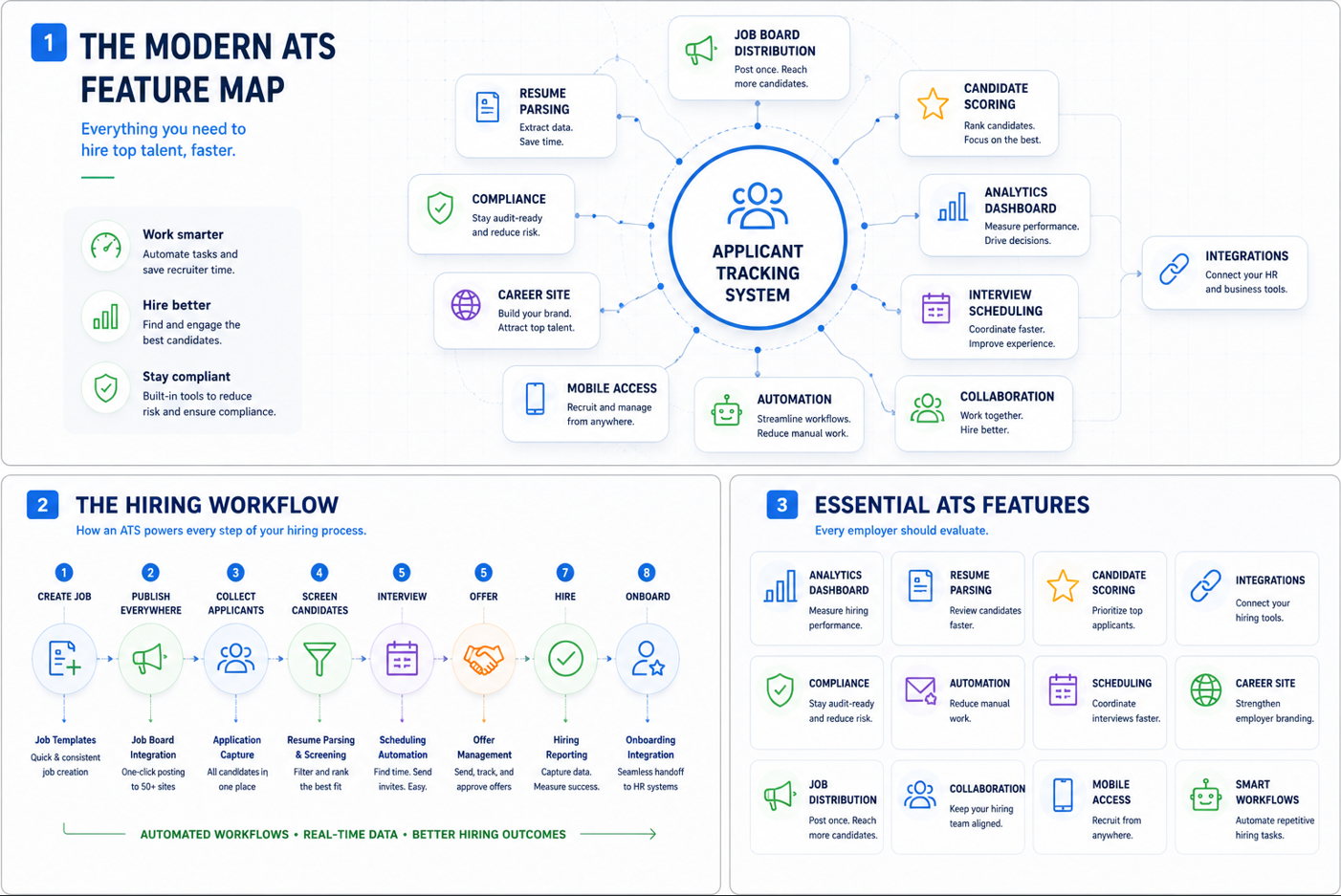
Start your ATS comparison with a structured scorecard that weights features based on your specific needs. Essential capabilities for a 50-person startup differ dramatically from those required by a 5,000-employee enterprise. Create evaluation criteria across functional requirements (must-have features), technical requirements (integration needs, security standards), and business requirements (pricing model, support levels). This framework ensures you choose ATS solutions based on strategic fit rather than feature lists.
The ATS RFP process should focus on real-world scenarios rather than abstract capabilities. Instead of asking “Do you support compliance reporting?”, present specific situations: “Show how your system generates OFCCP reports for our 200-person government contract division.” This approach reveals whether vendors truly understand your needs and have experience with similar implementations.
Budget considerations extend beyond license fees. Factor in implementation costs, training requirements, integration expenses, and ongoing support. Some vendors offer attractive entry prices but charge heavily for essential add-ons. Others include comprehensive features but require significant setup investment. Your recruiting software checklist should capture the total cost of ownership over 3-5 years, not just initial pricing.
Stakeholder alignment prevents costly mistakes. Include recruiters, hiring managers, IT, and HR leadership in vendor demonstrations. Each group has different priorities: recruiters want usability, IT cares about security and integration, and hiring managers need simplicity.
Successful implementations require buy-in from all stakeholders, so involve them early in the evaluation process. Document their feedback systematically and weigh it appropriately in your final decision.
Implementation Best Practices
Successful ATS implementation starts with realistic timeline expectations. Plan for 60-90 days from contract signing to full deployment, with larger organizations potentially requiring 4-6 months. This timeline includes technical setup, data migration, integration configuration, user training, and gradual rollout. Rushing implementation to meet arbitrary deadlines invariably leads to adoption challenges and suboptimal configuration.
Data migration represents the highest-risk implementation phase. Clean your existing candidate data before migration, remove duplicates, standardize formats, and archive outdated records. Work with your vendor to map fields correctly and run test migrations before committing. Plan for manual cleanup post-migration, as no automated process achieves perfect results. Maintaining parallel systems during transition ensures no active candidates fall through the cracks.
Recruiter training determines adoption success more than any technical factor. Schedule role-based training sessions that focus on daily workflows rather than comprehensive feature tours. Record these sessions for future reference and new hire onboarding. Identify power users who can serve as internal champions and provide peer support. Regular refresher training ensures teams leverage new features as they’re released.
Change management HR requires proactive communication and a gradual transition. Start with pilot groups who test the system and provide feedback before full rollout. Address resistance by demonstrating how the ATS makes jobs easier, not more complicated. Celebrate early wins, like reduced time-to-fill or improved candidate feedback, to build momentum. Most importantly, maintain old process documentation temporarily so teams can reference familiar workflows while adapting to new ones.
Real-World Success Snapshot
A 500-employee healthcare organization struggled with a 45-day average time-to-fill for clinical positions, resulting in dangerous staffing gaps and costly overtime. Manual processes meant recruiters spent 60% of their time on administrative tasks rather than candidate engagement. After implementing a comprehensive ATS, they achieved a remarkable transformation.
Within six months, their time-to-fill improved by 50%, dropping from 45 to 22 days on average. The key drivers included automated job distribution, which increased applicant flow by 3x; pre-screening questions that automatically eliminated 40% of unqualified applicants; and integrated scheduling, which reduced interview coordination from days to hours. Compliance reporting that previously required weekly manual compilation is now generated automatically.
This recruiting case study demonstrates the compound effect of proper ATS utilization.
Beyond raw speed improvements, the organization reported higher-quality hires (measured by 90-day retention), improved candidate satisfaction scores, and $200,000 in annual savings on agency fees. Recruiters redirected saved time toward building talent pipelines and improving employer brand, creating a virtuous cycle of continuous improvement.
Conclusion
The right modern ATS transforms recruiting from reactive administration into strategic talent acquisition. By automating repetitive tasks, providing data-driven insights, and creating exceptional candidate experiences, these platforms enable organizations to compete effectively for top talent regardless of size or industry.
The features outlined in this guide, from job board integration through emerging AI capabilities, represent the baseline for effective recruiting in today’s market. Organizations that invest in comprehensive ATS platforms gain a sustainable competitive advantage through faster hiring, higher-quality candidates, and improved compliance. The question isn’t whether to adopt an ATS, but how quickly you can implement one before competitors gain a further advantage.
Your next steps in recruiting software evaluation should begin immediately. Use this guide’s framework to assess your current processes, identify critical gaps, and build consensus around required capabilities. The sooner you modernize your recruiting infrastructure, the sooner you’ll realize the transformative benefits that leading organizations already enjoy.
Ready to see these features in action? Book a free 30-minute demo with our ATS experts and discover how you can cut your hiring time in half while improving candidate quality. Our team will show you exactly how modern recruiting technology addresses your specific challenges. Schedule your personalized demonstration today and take the first step toward transforming your talent acquisition process.
To see how these features look in a system built for small businesses, take a look at what NinjaGig includes.