

Every year, recruiters process over 250 million job applications globally, with the average corporate job opening attracting 250 resumes. Without technology, managing this volume would be impossible.
Enter the Applicant Tracking System (ATS), the digital backbone that powers almost all Fortune 500 hiring operations and increasingly drives recruitment at companies of all sizes. ATS applicant tracking systems are now the backbone of modern recruiting operations, enabling organizations to efficiently handle high volumes of candidates.
HR departments use ATS systems to manage hiring activities, ensure data security, and support compliance, integrating them with broader HR functions to streamline the recruitment process.
The Recruitment Process Before ATS
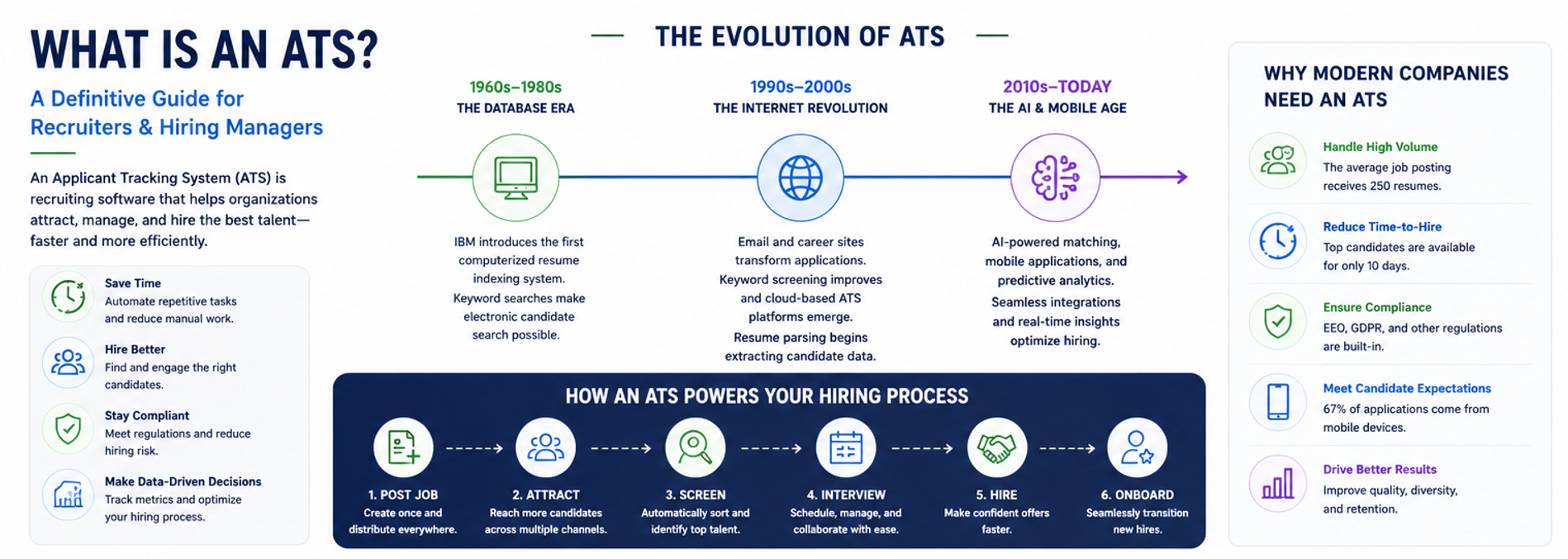
The history of ATS begins in the 1960s when IBM introduced the first computerized resume indexing system. Before this innovation, manual recruiting meant stacks of paper resumes, filing cabinets, and hours spent reading each application; these manual processes were extremely time-consuming.
The recruiting evolution accelerated through three distinct phases:
1960s-1980s: The Database Era. IBM’s keyword indexing allowed organizations to search resumes electronically for the first time. While revolutionary, these systems required manual data entry and lacked sophisticated parsing. Companies could search for keywords, but still processed most hiring tasks manually.
1990s-2000s: The Internet Revolution. Email transformed application submission, while early web-based career portals emerged. Keyword screening became more sophisticated, and the first cloud-based ATS platforms appeared.
Resume parsing technology began extracting structured data from unstructured documents, though accuracy remained limited. During this period, and continuing today, both early and modern ATS systems often process resumes submitted as Word documents, as this file format is widely recognized for compatibility and reliable parsing.
2010s-Today: The AI and Mobile Age. Modern ATS leverages artificial intelligence for intelligent candidate matching, offers mobile-first application experiences, and provides predictive analytics. Cloud infrastructure enables instant updates and seamless integrations. Today’s systems don’t just store data. They actively recommend top candidates and optimize the entire hiring funnel.
Why Modern Companies Need an ATS for Applicant Data
The need for ATS has never been more critical. Today’s high-volume recruiting environment presents unprecedented challenges in hiring that manual processes simply cannot address. Managing large-scale hiring efforts requires advanced tools to efficiently coordinate recruitment activities, track applicants, and ensure a seamless process.
Consider the numbers: The average job posting receives 250 resumes, with popular roles at well-known companies attracting thousands. Meanwhile, top candidates remain available for just 10 days before accepting offers elsewhere. This compressed timeline means recruiters must move faster than ever while maintaining quality.
Beyond speed, modern hiring faces stringent compliance requirements. Companies must navigate EEO regulations, maintain GDPR-compliant data practices, and provide audit trails for every hiring decision.
Manual tracking exposes organizations to legal risk and potential discrimination claims, but an ATS helps streamline recruitment and support recruitment efforts by automating compliance and tracking.
An ATS is essential for organizations looking to streamline recruitment and stay competitive in today’s environment. It automates and streamlines the entire recruiting and hiring process, from sourcing candidates to final selection.
Modernizing Recruiting Software and the Hiring Process
Candidate expectations have also evolved dramatically. Today’s job seekers demand mobile-friendly applications, instant acknowledgments, and transparent communication throughout the process. A streamlined application process is critical to attracting top talent, as it ensures candidates can easily complete their applications without unnecessary hurdles.
According to Recruiter Daily, 67% of applications now come from mobile devices, and candidates will abandon lengthy or confusing application processes. Without an ATS providing seamless digital experiences, companies lose top talent to more tech-savvy competitors.
The benefits of ATS directly address these challenges: automated resume screening handles volume, integrated communication tools ensure consistent candidate engagement, and built-in compliance features protect against legal exposure.
Automated messages keep candidates informed at every stage, enhancing the candidate journey from application submission to interview scheduling. For modern recruiters, an ATS is essential infrastructure for competitive hiring.
Core Components of a Best-in-Class ATS
Job Posting & Distribution
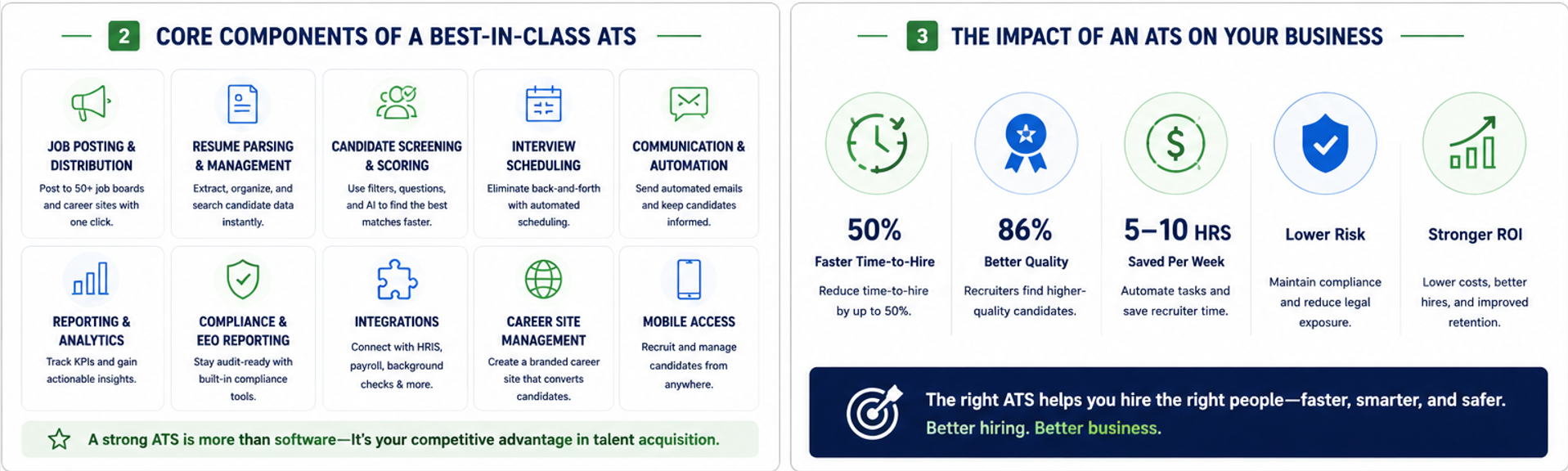
Modern ATS features begin with powerful job board integration capabilities. Instead of manually posting to Indeed, LinkedIn, and dozens of niche boards, recruiters create one listing that automatically syndicates everywhere.
ATS software simplifies recruitment by automatically posting jobs to multiple job boards and career sites, streamlining the entire hiring process. Best-in-class systems maintain real-time synchronization, updating all platforms when positions fill or requirements change.
Leading platforms include one-click posting to 50+ job boards, automated refresh schedules to maintain visibility, and performance tracking by source. This automation saves recruiters 5-10 hours per week while expanding reach by 3x.
Smart distribution also includes posting to multiple job boards and career sites, social media scheduling, employee referral portals, and integration with university career sites. ATS platforms also help manage job openings efficiently, ensuring that each opportunity is tracked and updated across all channels.
Resume Parsing & Candidate Information Screening
Resume parsing technology has evolved from simple keyword matching to sophisticated AI-driven analysis. Modern parsers extract not just contact information and work history, but also infer skills, assess experience levels, and identify industry-specific qualifications.
Accuracy rates now exceed 95% for standard formats. Many applicant tracking systems can read PDFs and process incoming resumes in various formats, ensuring they are properly evaluated regardless of file type.
Automated screening goes beyond keywords. Advanced ATS uses natural language processing to understand context, semantic search to find related skills, and predictive scoring to rank candidates.
Candidate tracking features monitor applicants throughout the process, ensuring no one is overlooked. Comprehensive screening helps ensure that good candidates are not missed due to limited keyword searches. This intelligence means recruiters spend 70% less time on initial resume review.
Candidate Pipeline Management
The talent pipeline represents the heart of any ATS. Visual workflows show exactly where each candidate stands, from initial application through phone screen, interviews, and offers. Modern ATS platforms help manage both active and passive candidates by integrating candidate relationship management features and social media sourcing.
Pipeline features include customizable stages matching your unique process, automated email/SMS templates for each transition, and collaborative evaluation tools for hiring teams.
ATS platforms enable the recruiting team to improve communication, collaboration, and workflow efficiency throughout the hiring process by centralizing feedback and streamlining candidate management.
Advanced systems also maintain talent pools of silver-medal candidates for future opportunities. Companies using structured pipelines report 40% faster hiring and 25% higher candidate experience scores, according to JobsPIKR.
Communication & Interview Process Scheduling Tools
Interview scheduling traditionally consumes hours of back-and-forth emails. Modern ATS eliminates this friction through calendar integration, automated scheduling links, and self-service booking.
Scheduling interviews is a key feature of ATS platforms, improving efficiency for both recruiters and candidates. Self-service interview scheduling allows candidates to choose their preferred interview times, enhancing flexibility and streamlining the process.
Communication features extend beyond scheduling: bulk messaging for status updates, SMS integration for time-sensitive communications, and branded email templates maintaining professional appearance.
ATS platforms also help conduct interviews and manage feedback at each interview stage, ensuring a smooth flow of information between hiring managers and candidates. Two-way texting increases response rates by 45%, while automated nurture campaigns keep passive candidates engaged over months or years.
Reporting, Analytics & Compliance Dashboards
ATS analytics transform recruiting from guesswork to a data-driven strategy. Real-time dashboards display key metrics: time-to-fill, cost-per-hire, source effectiveness, and pipeline conversion rates.
Recruiters identify bottlenecks instantly; perhaps phone screens take too long, or certain interviewers consistently delay feedback. ATS analytics also reveal cost savings by highlighting areas where SaaS solutions reduce expenses and by providing detailed data on your hires, including metrics for candidate selection and future re-hiring potential.
Compliance reporting includes EEO statistics, OFCCP audit trails, and diversity analytics, while ATS platforms help protect sensitive data through secure, centralized record-keeping.
How an ATS Works: From Job Post to Hire
Step-by-Step Flow
Understanding how ATS works demystifies the applicant tracking process. Here’s the typical ATS workflow that powers modern hiring automation:
Job Creation & Multi-Channel Posting: Hiring managers submit job requisitions through the ATS, which manages and routes them for approval.
Creating structured, keyword-rich job descriptions is essential at this stage, as they improve applicant tracking and candidate matching by enabling the ATS to filter and identify the best-fit applicants.
Once approved, the job description populates templates and posts simultaneously to your career site, major job boards, and social channels. Smart posting schedules optimize visibility based on candidate behavior data.
Application Intake & Resume Parsing: Job applicants apply through any channel—mobile, desktop, or job board. The applicant tracking software instantly parses their submissions, extracting structured data and creating searchable profiles.
Duplicate detection prevents the same candidate from clogging your pipeline, while knockout questions automatically filter unqualified applicants.
Auto-Screening & Recruiter Review: Recruiters see a prioritized list with match percentages, not random resume piles. Collaborative features let hiring teams review, comment on, and rate candidates within the system, keeping all feedback in one place.
Interview Coordination & Offer Management: When ready to hire, offer letters are generated from templates with approved compensation data, tracking acceptance electronically. The onboarding process is then streamlined through ATS integration, ensuring a seamless transition for new hires.
Candidate & Recruiter Experience Highlights
For candidates, a modern ATS means mobile-optimized applications taking under 5 minutes, instant acknowledgment emails, and transparent status updates. They can track their application progress, reschedule interviews easily, and receive timely decisions, even rejections, including personalized feedback.
Recruiters benefit from 360-degree candidate views, automated routine tasks, and intelligent recommendations. Instead of manual data entry, they focus on relationship building and strategic hiring decisions.
ATS platforms also help HR teams by automating administrative tasks and reducing repetitive tasks, saving the HR team time and allowing them to concentrate on more strategic activities. The result: recruiters using modern ATS report 50% higher job satisfaction and handle 40% more requisitions.
Tangible Benefits & ROI of Implementing an ATS
The ATS benefits extend far beyond basic efficiency gains. Organizations implementing modern applicant tracking systems report measurable ATS ROI across multiple dimensions:
Time-to-Hire Reduction: Companies using ATSs fill positions faster on average, with some reporting improvements in high-volume roles. Automated screening and communication eliminate days from each stage. For a company hiring 100 people annually, this translates to 420 saved recruiter days.
Cost-per-Hire Optimization: Beyond time savings, ATS users report lower cost-per-hire through reduced agency fees, optimized job board spend, and improved retention. Analytics identify the most cost-effective sources, while pipeline efficiency reduces re-posting needs. One mid-size company saved $240,000 annually after implementing ATS-driven source optimization.
Quality & Retention Improvements: Perhaps most importantly, structured hiring processes lead to better hiring decisions. ATS platforms help organizations quickly identify the right candidates and the best candidates for each role, while also enabling the creation of an ideal candidate profile using AI and data analysis.
Enhanced Candidate Experience: Modern ATS improves Net Promoter Scores by 35 points on average. Candidates appreciate mobile applications, prompt communication, and transparent processes. This improved experience strengthens the employer brand, increasing referrals and repeat applications.
Centralized Data & Collaboration: Teams work from a single source of truth, eliminating version confusion and dropped handoffs. Hiring managers stay informed without constant meetings. Compliance teams access complete audit trails instantly. This collaboration reduces hiring errors and accelerates decision-making, while supporting proper hiring practices.
ATS Adoption Statistics & Future Trends
The ATS market size reflects explosive growth in the adoption of recruitment technology. Currently valued at $2.47 billion globally, analysts project the market reaching $3.84 billion by 2030, representing a 7.4% compound annual growth rate.
This growth stems from digital transformation initiatives and increasing SMB ATS adoption. As more organizations consider implementing an ATS, choosing the right ATS vendor becomes crucial to ensure the system aligns with your organization’s needs and supports successful integration and training.
ATS trends 2024 and beyond focus on intelligence and experience:
- AI in recruiting advances from basic keyword matching to predictive analytics, identifying candidates likely to succeed and stay
- Conversational AI chatbots handle initial screening, answer candidate questions, and schedule interviews 24/7
- Video interviewing integration becomes standard, with AI-assisted evaluation of communication skills
- Text messaging and WhatsApp integration cater to mobile-first candidates
- Diversity analytics and bias reduction tools help organizations build inclusive workforces
The rise of remote work accelerates these trends. ATS platforms now include remote-specific features such as time zone coordination, digital onboarding workflows, and distributed team collaboration tools.
These platforms enable the hiring team to collaborate efficiently, regardless of location, by centralizing communication and decision-making. As hybrid work becomes permanent, ATS technology adapts to support location-agnostic hiring at scale.
Common ATS Myths Debunked
“ATS Kills Good Resumes”
The persistent myth of the ATS black hole claims that 3 out of 4 resumes never reach human eyes. This misunderstands how modern ATS works. Today’s systems don’t randomly reject resumes; they organize and prioritize them based on job requirements.
When configured properly, ATS actually ensures more qualified candidates get reviewed by surfacing strong matches recruiters might otherwise miss in resume piles.
“Only Enterprises Need ATS”
Another ATS myth suggests these systems only benefit large corporations. In truth, small business ATS adoption delivers even higher ROI percentages. Small teams gain the most from automation since they lack dedicated recruiting staff. A 50-person company hiring 10 people annually saves 200+ hours with basic ATS features.
Modern ATS providers offer scaled solutions: free tiers for occasional hiring, pay-per-job models for growing companies, and enterprise features for complex needs. The question isn’t company size but hiring volume and complexity. Any organization hiring more than 5 people annually benefits from implementing an ATS.
“Implementation Is Too Complex/Expensive”
Legacy ATS required IT teams, server rooms, and six-figure investments. Today’s cloud-based solutions launch in hours, not months. Most offer intuitive setup wizards, pre-built templates, and included support. Total implementation for small companies averages 2-3 days and delivers immediate productivity gains.
Cost concerns also prove unfounded. Entry-level ATS starts at $99/month, with robust mid-market solutions under $500/month. Considering a single bad hire costs $15,000 on average, preventing just one poor hiring decision annually delivers positive ROI. Add time savings and improved quality, and ATS investment pays for itself within 60-90 days.
How to Choose the Right ATS for Your Organization
Feature Checklist & Prioritization Matrix
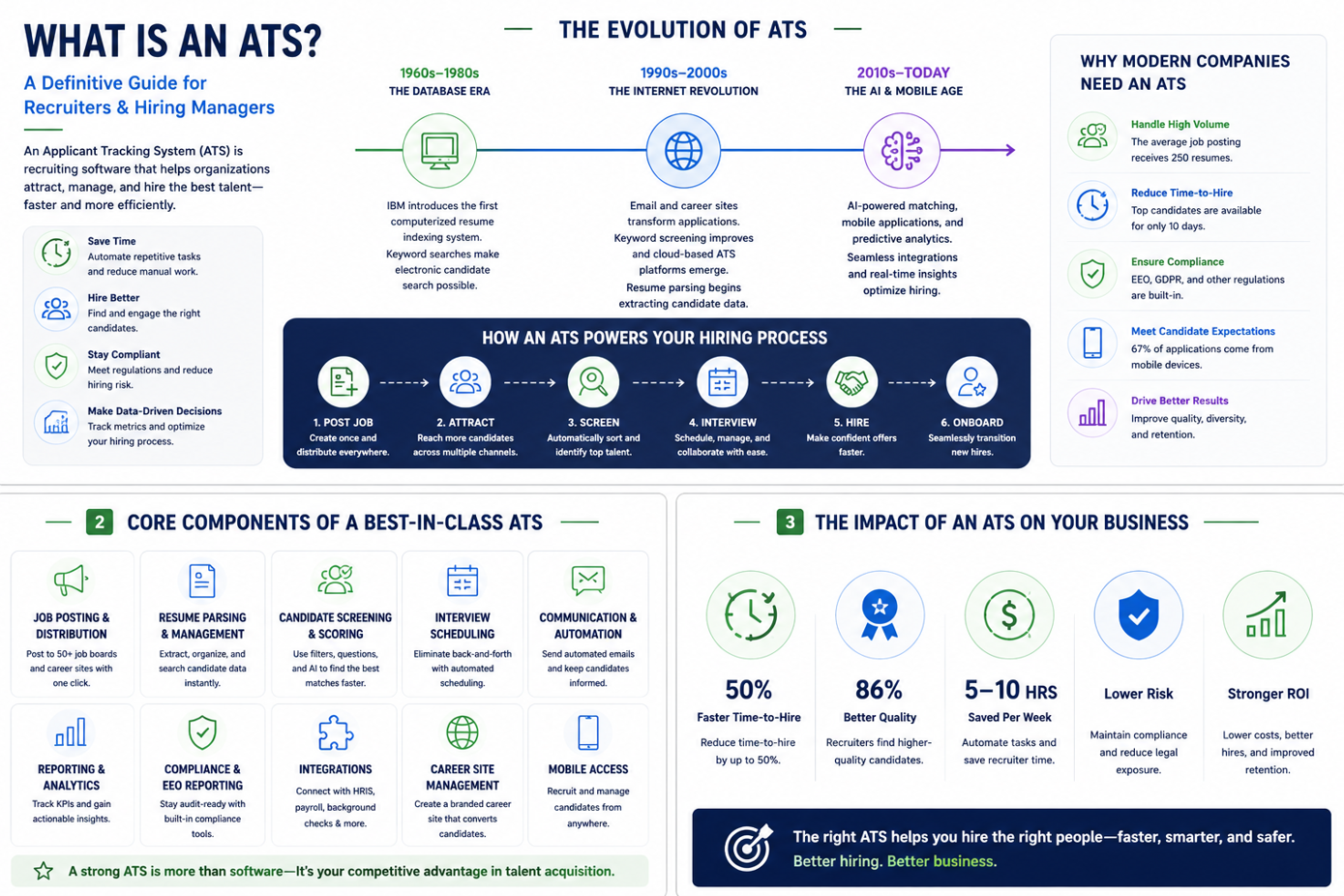
Selecting the best ATS software starts with understanding your specific needs. Create a prioritization matrix ranking must-have versus nice-to-have features.
Essential capabilities for most organizations include: resume parsing accuracy above 90%, multi-channel job posting, collaborative evaluation tools, mobile candidate experience, and basic analytics dashboards.
Advanced teams might prioritize: AI-powered candidate matching, CRM capabilities for passive candidates, assessment tool integration, employee referral portals, and predictive analytics. Avoid feature bloat; focus on capabilities you’ll actually use within 12 months.
Integration & Tech-Stack Alignment
Your ATS comparison must consider existing technology infrastructure. Seamless integration with current tools multiplies value. Priority integrations typically include: HRIS for employee data sync, calendar systems for interview scheduling, email/communication platforms, background check providers, and assessment tools.
Evaluate API flexibility for custom integrations. Modern ATS should connect with your tech stack, not force wholesale replacement. Request integration demonstrations during vendor evaluations to confirm real-time data flow, not just “checkbox” compatibility.
Pricing Models & Total Cost of Ownership
ATS pricing varies dramatically. Common models include per-user monthly subscriptions, pay-per-job-posting fees, annual licenses based on company size, and usage-based pricing for enterprises. Beware hidden costs: implementation fees, integration charges, support packages, and overage penalties.
Calculate the total cost of ownership, including staff time savings. A system costing $500/month but saving 50 hours/month delivers a stronger ROI than a $200/month system that requires manual workarounds.
Vendor Vetting Questions
Your ATS buyer guide should include these critical vendor questions: What’s your average implementation timeline? How do you handle data migration? What training do you provide? What’s your uptime guarantee? How often do you release updates? Can we customize workflows? What’s your mobile candidate experience like?
Request customer references in your industry and company size. Ask about support responsiveness, product evolution, and unexpected challenges. The best vendors provide transparent answers and realistic expectations.
Key Takeaways: Simplify your Recruiting Process
A modern ATS transforms recruiting from reactive task management to strategic talent acquisition. By automating routine processes, providing data-driven insights, and delivering superior candidate experiences, the right applicant tracking system becomes your competitive advantage in the war for talent.
The key to success lies in selecting and implementing an ATS aligned with your specific needs. Whether you’re a growing startup ready to streamline hiring or an enterprise optimizing existing processes, the principles remain consistent: prioritize user experience, demand seamless integrations, and focus on measurable ROI.
Your next steps: Download our comprehensive ATS Buyer’s Checklist below, assess your current hiring challenges, and explore how modern ATS technology can accelerate your recruiting success.
See NinjaGig’s ATS in Action
Ready to cut your time-to-hire and wow candidates? Book a 15-minute live demo of NinjaGig’s ATS and discover how easy hiring can be.
Sign up today and get started! Still have some questions? Book a demo.