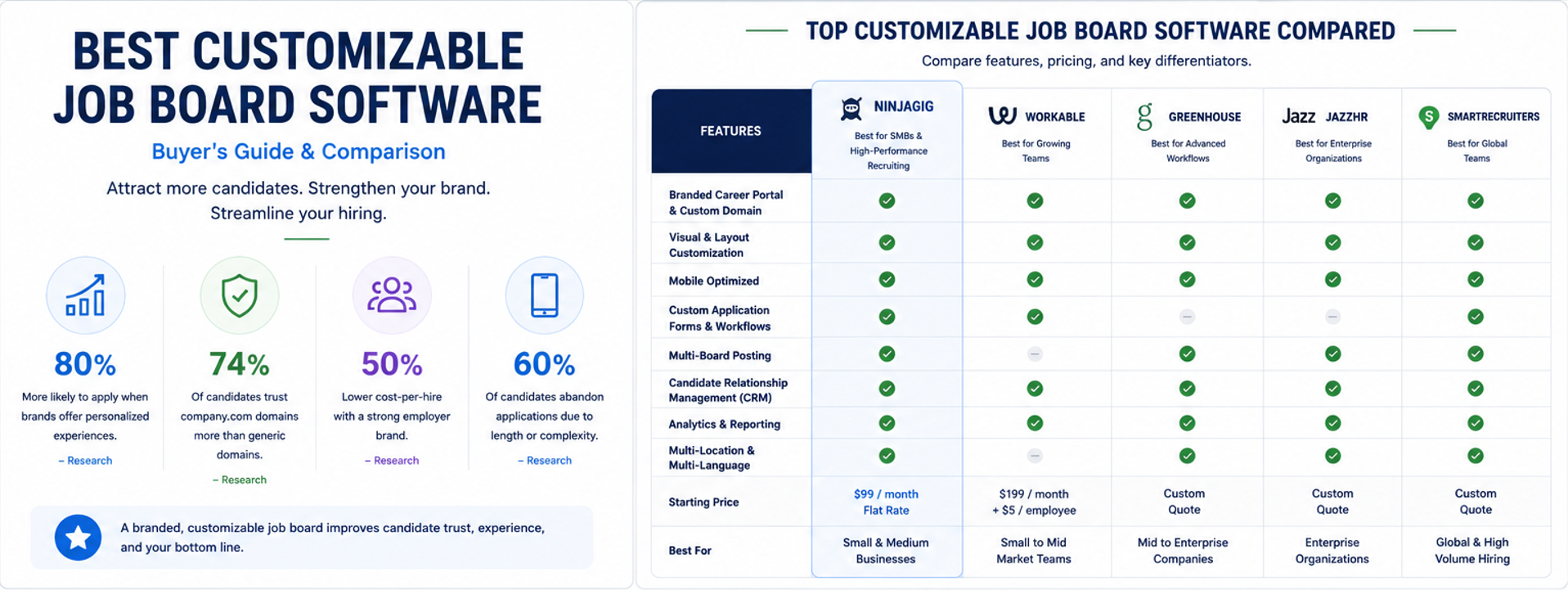

Running a small business means wearing multiple hats, and hiring shouldn’t consume all your time. If you’re still posting jobs manually across different boards and tracking applicants in spreadsheets, you’re working harder, not smarter. An integrated Applicant Tracking System (ATS) changes that completely.

This guide shows you exactly how ATS integration transforms your hiring process from chaotic to streamlined. You’ll learn how to connect your applicant tracking system to job boards, HRIS platforms, and other essential tools, turning days of work into minutes. We’ll walk through the mechanics of centralized hiring data, demonstrate real implementation steps, and show you how to measure success.
What Is ATS Integration?
An ATS serves as your recruitment command center, automating the entire hiring workflow from job posting to onboarding. But here’s where it gets powerful: ATS integration connects your ATS to external platforms via ATS APIs and connectors, creating a unified system rather than a dozen disconnected tools.
Think of your ATS as the hub and integrations as spokes connecting to job boards, payroll systems, calendars, and communication tools. This isn’t just about convenience; it’s about fundamentally changing how ATS works for your business.
Here’s the typical data flow:
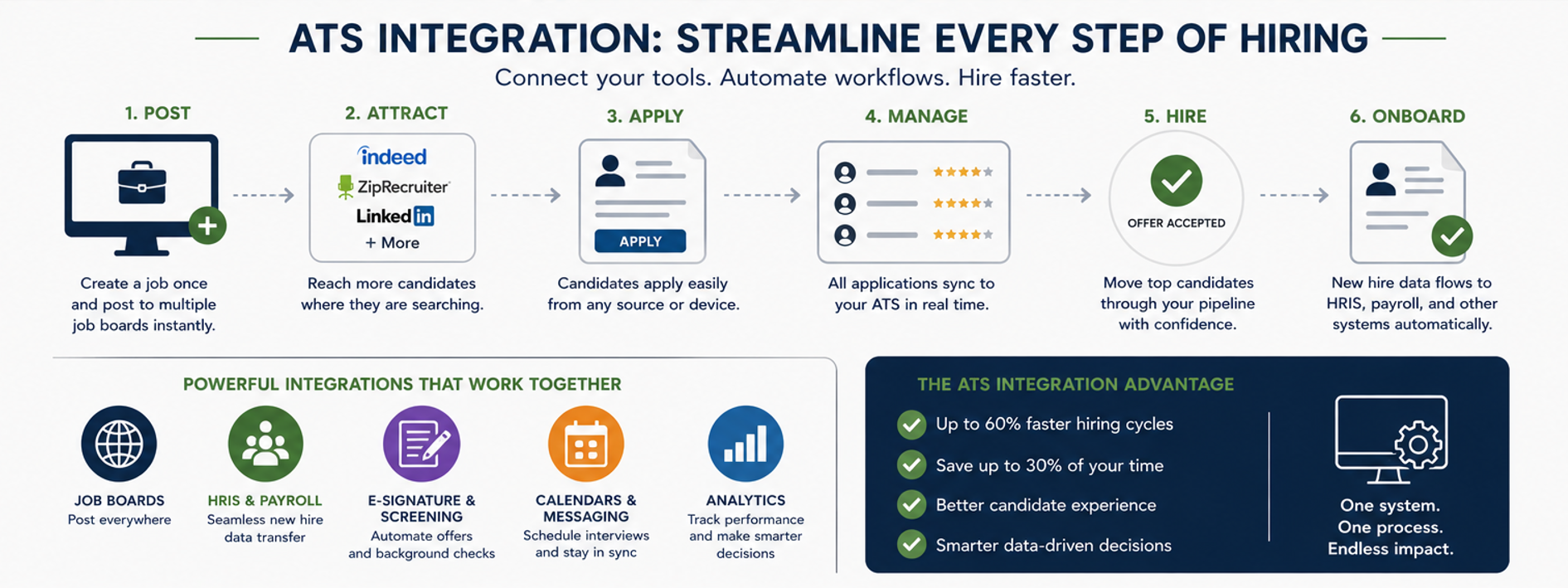
Create a job in your ATS → The system pushes it to multiple job boards simultaneously → Candidates apply through any channel, and candidate data is captured→ Applications flow back into your ATS dashboard → Qualified candidates move through your pipeline → New hire data transfers automatically to your human resource management system (HRIS) for onboarding.
No more copying and pasting. No more logging into five different platforms to perform manual data entry. No more losing track of candidates. Everything happens in one place, with data flowing seamlessly between systems without manual data transfers.
Why ATS Integration Matters for Small Businesses
Centralized ATS Data & Visibility
The biggest benefit of ATS integration is eliminating data fragmentation. Without integration, your candidate information lives in email inboxes, spreadsheets, job board dashboards, and sticky notes. This chaos leads to missed opportunities and duplicated efforts.
Integration creates a single source of truth. Every resume, every communication, every interview note all live in one searchable database. When your hiring manager asks about a candidate who applied last month, you’ll have the answer in seconds, not hours.
Time & Cost Efficiency
Let’s talk numbers. According to SelectSoftwareReviews, businesses using integrated ATS platforms see up to 60% faster hiring cycles. Industry-specific research shows recruiters can save up to 30% of their time through automation.
For a small business, this translates directly to your bottom line. If your HR manager spends 20 hours per week on the recruiting process, integration gives them back 6 hours, which is nearly a full day to focus on other critical tasks. Cost-reduction hiring becomes automatic when you’re not paying for overtime or missing great candidates because of slow processes.
Enhanced Candidate Experience
Your application process is often a candidate’s first real interaction with your company. Integration enables branded career portals, automated confirmation emails, and real-time status updates. No more black holes where applications disappear.
When candidates apply through any job board, they receive immediate confirmation. As a candidate progresses, automated emails keep them informed. Interview scheduling happens with a few clicks. This professional experience matters as 66% of candidates said a positive experience influenced their decision to accept a job offer.
Scalable Analytics
Without integration, measuring recruitment effectiveness means manually compiling data from multiple sources. Data-driven recruiting requires integrated systems that automatically track metrics like source effectiveness, time-to-fill by position, and diversity statistics.
Integrated dashboards show you exactly which job boards deliver quality candidates, which positions take the longest to fill, and where your process has bottlenecks. This insight drives smarter decisions as you grow.
Core ATS Integrations You Need
Job Board Syndication
Job board integration is the foundation of ATS efficiency. Instead of logging into Indeed, ZipRecruiter, LinkedIn, and Monster, you post once and publish everywhere.
One-click posting sends your job to:
- Indeed (with automatic candidate sync)
- ZipRecruiter (including their 100+ partner sites)
- Google for Jobs (properly formatted for maximum visibility)
- LinkedIn (direct posting or share links)
- Monster and other major boards
All applications flow back into your ATS, tagged by source, and ready for review in a single unified dashboard.
HRIS & Payroll Integration
The hiring process doesn’t end with an accepted offer. HRIS sync eliminates the painful re-entry of new hire data. Once a candidate accepts, their information flows directly into systems like:
- ADP for payroll setup
- QuickBooks for accounting
- Gusto for benefits enrollment
This automation prevents errors and ensures new employees get paid correctly from day one.
E-Signature & Background Screening
E-signature integration with DocuSign or Adobe Sign means offer letters get signed in hours, not days. Background check APIs from Checkr or GoodHire trigger automatically when candidates reach the appropriate stage.
No more chasing documents or manually initiating checks. The system handles it based on your workflow rules.
Calendars & Messaging
Calendar integration with Google Calendar or Outlook eliminates the back-and-forth of interview scheduling. Candidates see available slots and book directly. Interview invites automatically appear on everyone’s calendar with all necessary details.
Slack or MS Teams integration keeps your hiring team in sync with real-time notifications when candidates advance in the process or require action.
Career Site & Social Media
Your ATS should power your careers page, delivering a branded experience that aligns with your website. Social media integration enables instant sharing of new openings to Facebook, LinkedIn, and X (Twitter), expanding your reach without extra effort.
Step-by-Step: Connecting Your ATS to Job Boards
Let’s walk through the actual process of connecting ATS to Indeed, ZipRecruiter integration, and other major boards. This example uses Ninja Gig’s interface, but the principles apply to most modern ATS platforms.
Step 1 – Prep Your Employer Accounts
Before integration, ensure you have active employer accounts on your target job boards. Some require verification or payment information even for free postings. Log in to each platform once to confirm your credentials work and your company profile is complete.
Step 2 – Create the Job in Your ATS
Navigate to your ATS job creation interface. Fill in all fields completely:
- Job title (use standard titles for better Google for Jobs schema recognition)
- Location (specific city/state for local searches)
- Salary range (increasingly required by job boards)
- Full job description with requirements and benefits
Pro tip: Create templates for common positions to speed future postings.
Step 3 – Enable & Select Boards
Look for a “publish” toggle or checkbox to activate the job. Then find the job board selection. Select all relevant boards: Indeed, ZipRecruiter, Monster, Google for Jobs, etc.
Some ATS platforms show which boards require additional setup. The job board API handles the technical connection, but you might need to enter employer IDs or budget caps for sponsored posts.
Step 4 – Publish & Monitor
Click publish. Your ATS sends the job data to each selected board via its API. Most integrations work within minutes, though some boards have processing delays.
Watch your ATS dashboard for incoming applications. They’ll appear in real-time, labeled by source board. Enable email or Slack notifications to stay on top of new candidates.
Step 5 – Optimize Listings
After a week, review your source analytics. Which boards deliver the most qualified candidates? Adjust your strategy accordingly. A/B test job titles or descriptions to improve performance. The beauty of integration is that once you make these changes in your ATS, they propagate everywhere automatically.
Best Practices & Pro Tips
ATS best practices separate amateur hour from professional recruiting. Here’s what actually moves the needle:
- Consistent job titles matter. Use industry-standard titles to improve search visibility. “Customer Success Ninja” might sound fun, but “Customer Service Representative” is easier to find.
- Include salary ranges. More states require it, Google for Jobs prioritizes it, and candidates expect it. Jobs with listed salaries get 30% more applications.
- Automate rejection emails. It takes 30 seconds to set up templates that protect your employer brand. Ghosting candidates damages your reputation.
- Use UTM parameters on career site links for granular tracking beyond basic source data.
- Review integration logs weekly. Catch sync errors before they cost you candidates. Most issues are simple fixes, like expired API tokens.
- Set up team notifications. Recruiting automation tips always emphasize communication and ensure hiring managers know when top candidates apply.
For legal compliance hiring, configure your ATS to capture EEO data properly and maintain audit trails of all candidate communications.
Ninja Gig Spotlight: One-Click Job Board Integration
Let’s examine how Ninja Gig ATS exemplifies modern integration done right. Their Ninja Gig job board integration demonstrates what small businesses should expect from their ATS.
Key Features
Ninja Gig’s standout feature is truly unlimited job posting to all major boards for one flat fee. No per-post charges, no surprise bills. Their centralized dashboard shows every applicant, regardless of source, with powerful filtering and collaboration tools.
The branded career portal (YourCompany.ninjagig.com) gives even tiny startups a professional presence. Team collaboration happens in-platform with comments, tags, and automated stage progression. SOC 2 security certification means your candidate data stays protected.
Customer Snapshot
“We cut our hiring cycle by 42% after switching to Ninja Gig. What used to take hours of posting and tracking now happens automatically. Our hiring manager actually has time to talk to candidates instead of wrestling with spreadsheets.” – Sarah Chen, Operations Director at a 50-person logistics firm
Why It’s Ideal for SMBs
The flat-fee ATS model at $49/month removes budget uncertainty. No contracts, no per-user fees, no posting limits. A live demo shows you the full system in action with real jobs and candidates. Setup takes under an hour with their guided workflow.
Most importantly, Ninja Gig built its platform specifically for small businesses, not scaled-down enterprise software. Every feature focuses on simplicity without sacrificing power.
ROI: Measuring Success After Integration
Critical KPIs
Track these recruiting ROI metrics to prove integration value:
- Time-to-fill: Days from job posting to accepted offer
- Cost-per-hire: Total recruiting spend divided by hires made
- Quality-of-hire: New hire performance ratings after 90 days
- Offer-acceptance rate: Percentage of offers accepted versus extended
Your integrated ATS should automatically display these time-to-hire metrics. If it doesn’t, find a better system.
Reporting & Dashboards
Modern ATS platforms include visual dashboards that display source-of-hire analytics, pipeline velocity, and bottleneck identification. Export capabilities let you share data with leadership or feed it into BI tools for deeper analysis.
Set monthly reviews to spot trends. Are certain job types taking longer to fill? Is one source producing better long-term employees? Data drives improvement.
Common Obstacles & How to Overcome Them
ATS integration challenges are real but manageable:
- Data Clean-Up: Before migration, audit your existing candidate data. Remove duplicates, standardize formats, and archive old records. Clean data in equals clean data out.
- Change Management: Some hiring managers resist new systems. Combat this with hands-on training and by showing them time savings within the first week.
- API Limitations: Occasionally, job boards change their APIs or have service interruptions. Choose an ATS vendor that monitors these issues and provides updates.
- Compliance: Ensure your integrated system maintains GDPR compliance and EEO data collection. Configure field mappings correctly during setup to avoid regulatory issues.
FAQ
How much does ATS integration cost?
Pricing varies widely. Traditional SaaS models charge $200- $ 500/month plus per-posting fees. However, modern flat-fee solutions like Ninja Gig offer unlimited everything for $49/month. Factor in time savings as well. If integration saves 10 hours monthly, even $500/month provides a positive ROI.
How long does implementation take?
For small businesses using pre-built connectors, expect 2-7 days from signup to full operation. Day 1: account setup and job board connections. Days 2-3: data migration and testing. Days 4-7: team training and process refinement. Custom integrations take longer.
Can I keep my existing HRIS?
Yes. Most modern ATS solutions offer plug-and-play HRIS connectors for popular platforms like ADP, Gusto, and QuickBooks. During vendor selection, confirm compatibility with your specific HRIS version. Some vendors, like Ninja Gig, maintain updated connector libraries for seamless integration.
What about job board sync issues?
Sync problems occasionally occur when job boards update their APIs. Quality ATS vendors monitor for issues and push fixes quickly. If applications stop flowing, check the integration logs first, as it’s often just an expired credential that takes minutes to fix.
Book Your Free ATS Integration Demo
Ready to see one-click job board posting in action? Stop wasting hours on manual posting and candidate tracking. A 20-minute demo shows you exactly how Ninja Gig transforms your hiring process.
During your personalized demo, you’ll see:
- Live job posting to multiple boards simultaneously
- Real-time application tracking from all sources
- Automated candidate communication workflows
- Team collaboration features in action
Book your demo now and discover how integrated hiring cuts your time-to-hire in half.
Take Control of Your Hiring Process
ATS integration isn’t just another tech upgrade; rather, it’s a competitive advantage. While your competitors waste time juggling multiple systems, you’ll be having meaningful conversations with top candidates. While they’re drowning in spreadsheets, you’ll have clear visibility into what’s working.
The right integrated ATS transforms hiring from your biggest headache into a smooth, predictable process. Whether you choose Ninja Gig or another solution, the key is starting now. Every day you delay is another day of inefficient hiring.
Ready to streamline your recruitment? Take the first step with a demo. Your future hires and your sanity will thank you. Consistent color coding and clean typography.
Related guides
- How to Post Jobs to Indeed and Turn On Indeed Apply in NinjaGig
- Job Board Syndication: What It Is, How It Works & Why It Matters
- Online Applicant Tracking System: Automate Hiring & Grow Your Team Faster
The takeaway: integrations shouldn’t require an IT department. NinjaGig is a small business applicant tracking system that connects to the major job boards out of the box.