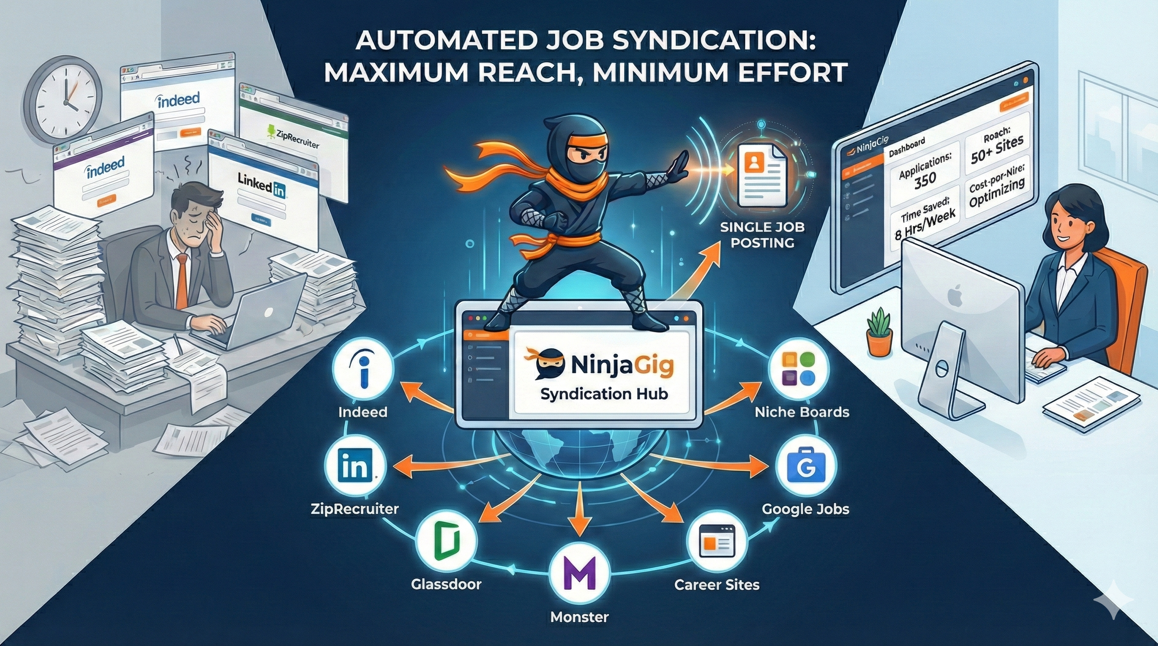


The talent war is real. Top candidates disappear from the market in just 10 days, leaving hiring managers scrambling to keep pace. Meanwhile, you’re drowning in spreadsheets, chasing email threads, and manually updating candidate statuses across multiple platforms. Sound familiar?
Here’s the reality: while you’re managing hiring chaos in Excel, your competitors are using applicant tracking systems (ATS) to automate 80% of their recruiting tasks. They’re making offers while you’re still sorting resumes. The opportunity cost of sticking with manual processes is time and the potential loss of exceptional talent to faster-moving companies.
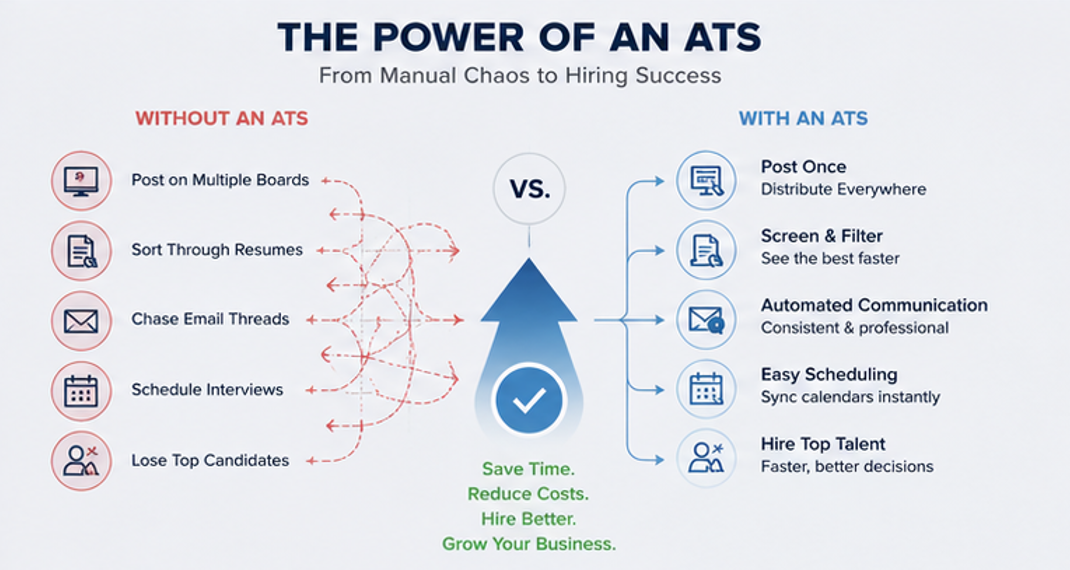
An ATS automates your hiring and recruitment process, moving it from reactive to strategic. Instead of administrative busywork, you focus on what matters: evaluating talent, building relationships, and making smart hiring decisions to hit recruitment goals. The promise is straightforward: cut your time-to-hire in half, deliver a professional candidate experience for job seekers, and base decisions on data rather than gut feelings.
Market Trends & Adoption Statistics
The numbers tell a compelling story about the adoption of applicant tracking systems. Nearly 99% of Fortune 500 companies use an ATS, with 70% of large firms following suit. This isn’t just enterprise territory anymore because small and mid-sized businesses are rapidly closing the gap.
The ATS market size reflects this momentum. Currently valued at $2.8 billion in 2025, the company is projected to double to $5.7 billion by 2034. This explosive growth stems from AI-driven features that deliver measurable results: 86.1% of recruiters report “significant acceleration” in hiring after ATS adoption, while 78.3% see improved hire quality.
The ROI data is equally impressive. Organizations typically see:
- 30-40% reduction in cost-per-hire
- 20% time savings for recruiters (worth $12,000+ annually)
- 75-94% of users reporting positive impact on hiring processes
One company cut monthly recruiting costs from $3,800 to $2,710, which is a third of their budget, simply by eliminating manual administrative tasks. These aren’t incremental improvements; they’re transformative shifts in hiring process automation.
The urgency becomes clear when you consider candidate availability. With top talent staying on the market for only 10 days, every hour spent on manual processes is an hour your ideal candidate might accept another offer. Fortune 500 recruiting tech adoption isn’t about following trends but it’s about survival in competitive talent markets.
Core Benefits of an ATS for Hiring Managers
Automating Candidate Communication
Manual communication is a hiring manager’s biggest time sink. Consider this: sending individual acknowledgment emails, interview invitations, and status updates can take hours each week. An ATS email automation system eliminates this burden entirely.
Modern applicant tracking systems trigger candidate notifications based on application status changes. When someone applies, they receive a branded acknowledgment instantly. Move specific candidates to a phone screen? The system sends your pre-written invitation with calendar links. This isn’t just about managing potential talent efficiently. It’s about consistent employer branding at every touchpoint.
The practical benefits include:
- Template libraries for common scenarios (thank you notes, rejections, offer letters)
- Triggered workflows that send the right message at the right time
- Brand consistency across all candidate communications
- Instant alerts for hiring teams when key actions occur
By automating routine messages, you free yourself to focus on strategic communication, personalized outreach to passive job applicants, and thoughtful feedback that builds your employer’s reputation. As one study noted, automated recruiting email templates “eliminate manual data entry,” allowing recruiters to concentrate on candidate evaluation rather than administrative tasks.
Pre-Screening & Filtering Applicants
Picture this: 200 applications for one role, but only 20 meet your basic requirements. Without an ATS, you’d review all 200. With knock-out questions and resume filtering, those 180 unqualified candidates never hit your desk.
Pre-screening works through customizable application questions. Need someone willing to relocate? Add it as a yes/no question. Require specific certifications? Make it a checkbox. The system automatically filters out non-matches, dramatically reducing your review pile.
The power extends beyond basic requirements. You can:
- Set minimum experience thresholds
- Require specific skills or software knowledge
- Filter by availability or start date preferences
- Screen for cultural fit indicators
Screening automation delivers documented results. HR professionals report it helps “uncover hidden details” not typically found on resumes while funneling only best-fit talent into the review process. This explains why 78% of ATS users report higher quality hires, as they start with a pre-qualified candidate pool.
The time savings are substantial. Instead of spending days on irrelevant resumes, you invest hours evaluating genuinely qualified candidates. This shift from quantity to quality accelerates the transition of qualifying candidates from aspiration to standard operating procedure.
Centralized Candidate Database & Search
Scattered resumes across email folders, shared drives, and personal computers create a data disaster. An ATS provides a single source of truth for all candidate information, with every resume, note, and interaction stored in a single searchable system.
The power of centralization becomes clear through full-text resume search. Need a Java developer who knows Scrum? Type those terms and instantly see matching candidates, including those from previous searches. This talent pipeline visibility turns your past recruiting efforts into a renewable resource.
Advanced search capabilities include:
- Keyword searches across all candidate data
- Filter panels for experience level, location, or custom fields
- Tag systems for categorizing candidates based on job requirements (“Strong technical,” “Great culture fit”)
- Boolean search for complex queries
Beyond search, centralization enables true candidate relationship management. When a similar role opens months later, you’re not starting from scratch. Your centralized database contains pre-vetted candidates who might be perfect for the new position. One recruiter noted that instead of juggling multiple portals, you can “find everything related to your candidates in one place.”
This approach transforms reactive hiring into strategic talent pooling. Build relationships with silver medalists from previous searches. Maintain connections with passive candidates. When needs arise, your talent pipeline is ready.
Real-Time Dashboards & Hiring Analytics
Flying blind in hiring leads to poor decisions and missed opportunities. Hiring funnel analytics illuminate every stage of your process, transforming guesswork into data-driven recruiting decisions.
Modern ATS platforms display time-to-hire metrics and other recruiting KPIs through visual dashboards. Log in to see:
- How many candidates sit at each stage
- Average days between application and offer
- Source effectiveness (which job boards deliver quality)
- Bottlenecks are slowing your process
Real-world impact: 86% of recruiters report reduced time-to-hire after implementing analytics-driven ATS systems. The dashboards reveal patterns invisible in spreadsheets. Maybe phone screens take twice as long for technical roles. Perhaps certain interviewers consistently delay feedback. These insights drive process improvements.
Analytics also validate quality improvements. When 79% of employers report better hires post-ATS implementation, they’re not guessing but rather, they’re tracking metrics like:
- Offer acceptance rates
- New hire performance ratings
- Retention rates by source
- Cost per quality hire
One expert noted that robust analytics provide “deep insights through trend analyses on historical hiring decisions and a dashboard on pipeline performances.”
Collaboration Tools: Notes, Tags & Team Feedback
Hiring decisions shouldn’t happen in isolation. Yet traditional processes often silo feedback across emails, sticky notes, and memory. An ATS creates collaborative hiring through integrated communication tools that keep everyone aligned.
The interviewer feedback loop starts with shared candidate notes visible to all stakeholders. After each interview, recruiting team members add observations directly to the candidate profile. No more “What did Sarah think?” emails; instead, the feedback is right there.
Key collaboration features transform hiring team alignment:
- @mentions alert specific team members (“@TechLead, please review this coding test”)
- Comment threads capture discussions in context
- Task assignments delegate specific actions with deadlines
- Status tags communicate candidate standing (“Ready for final round”)
Consider a typical scenario: The hiring manager tags the tech lead on a promising developer’s profile. The tech lead reviews, adds technical assessment notes, and tags the cultural fit interviewer. Each person’s input builds a complete picture, accessible to all decision-makers.
This transparency delivers measurable benefits. Teams make faster decisions when information flows freely. Diverse perspectives improve hiring quality. Most importantly, nothing falls through the cracks as every opinion, concern, and piece of enthusiasm gets documented where it matters.
Research confirms that collaboration between recruiters and hiring managers predicts hiring success. ATS tools make this collaboration effortless, transforming hiring from a relay race of forwarded emails into a synchronized team effort.
Step-by-Step ATS Workflow Example
Let’s walk through a real ATS workflow to see these features in action. You’re hiring a marketing specialist, and your recruiting process automation begins the moment you finalize the job description.
You enter the job posting details once in your ATS, which automatically posts to 10+ job boards simultaneously. Within days, 47 applications arrive. Your pre-screening questions immediately filter out 31 candidates who lack the required experience or are unwilling to relocate. The remaining 16 qualified applicants appear in your review queue for the given job opening.
You select all 16 and trigger an automated email sequence inviting them to schedule phone screens via integrated calendar links. Five respond immediately, booking themselves into your available slots. No back-and-forth emails, no manual calendar juggling, no bottlenecks when tracking candidates.
During reviews, you tag three candidates as “Strong Fit” and @mention your CMO for priority review. She adds comments directly on their profiles overnight. The next morning, you see her feedback and move those candidates forward.
Your dashboard shows this role’s time-to-hire trending higher than average. Drilling down, you discover phone screens are the bottleneck. You adjust by batching them into a single afternoon, immediately improving efficiency.
Throughout the candidate journey, every participant receives timely updates. Rejected candidates get thoughtful, branded decline messages. Advancing candidates receive prep materials and clear next steps. Your employer brand strengthens with each interaction.
This seamless orchestration, from posting to offer, demonstrates how an ATS transforms chaotic hiring into a predictable, efficient system.
How to Evaluate & Select the Right ATS
Choosing an ATS requires strategic thinking beyond feature checklists. Start your vendor evaluation by mapping your specific pain points. Are you drowning in volume? Prioritize filtering and automation. Struggling with collaboration? Focus on team features.
Essential evaluation criteria for your buying guide recruiting software:
- User experience: Can your team adopt it without extensive training?
- Integration capabilities: Does it connect with your existing HR tools?
- Scalability: Will it grow with your hiring needs?
- Mobile accessibility: Can you review candidates on the go?
- Customer support: What help is available during implementation?
When you choose an ATS, insist on a hands-on demo. Upload real job descriptions, process actual candidates, and involve your hiring team. Theory differs from practice.
During your ATS comparison, look beyond sales demos. Ask for:
- References from similar-sized companies
- Typical implementation timelines
- Data migration capabilities
- Customization options for your workflow
- Total cost of ownership, not just licensing
Red flags include vendors pushing unnecessary features, unclear pricing models, or limited integration options. The right ATS should solve your problems, not create new ones.
Implementation Best Practices

Successful ATS rollout hinges on preparation and change management. Start with a clear implementation timeline of 30-60 days for most organizations. Front-load the heavy lifting: data migration, integration setup, and workflow configuration.
Your data migration strategy determines early success. Clean your existing data first. To do this, remove duplicates, standardize formats, and archive outdated information. Most vendors provide migration support, but garbage-in still means garbage-out.
Focus user training on practical scenarios, not features. Show hiring managers how to review candidates, not every button’s function. Create quick reference guides for common tasks. Record short videos demonstrating key workflows. Make adoption easy, and resistance melts away.
Stakeholder adoption requires clear communication about “what’s in it for me.” For hiring managers: less administrative work. For candidates: better experience. For leadership: faster, data-driven hiring. Connect features to individual benefits.
Common implementation stages:
- Week 1-2: System setup and configuration
- Week 3-4: Data migration and testing
- Week 5-6: User training and pilot roles
- Week 7-8: Full rollout and optimization
Start with a pilot group. Perhaps one department or role type. Iron out issues before organization-wide deployment. This staged approach builds confidence and creates internal champions who assist broader adoption.
Measuring & Reporting ROI
Demonstrating ATS ROI requires tracking both hard metrics and soft benefits. Start with baseline measurements before implementation: current time-to-hire, cost-per-hire, and quality indicators. Without baselines, you can’t prove improvement.
Key metrics to monitor through your hiring analytics dashboard:
- Time-to-hire reduction: Most see 30-50% improvement
- Cost-per-hire reduction: Typically 20-40% savings
- Candidate quality scores: Often improve 15-25%
- Hiring manager satisfaction: Usually jumps 40-60%
Calculate hard dollar savings from reduced agency usage, fewer overtime hours, and lower job board spending. One company saved $12,000 annually by automating administrative tasks, and that’s before considering faster revenue from quicker hires.
Track quality improvements through:
- First-year retention rates
- Performance review scores
- Time-to-productivity metrics
- Hiring manager feedback scores
Remember: cost-per-hire reduction is just one piece. Factor in opportunity costs of vacant roles, productivity gains from better hires, and reduced turnover expenses. The full ROI picture often surprises even skeptics.
Common Mistakes to Avoid
Even the best ATS implementation can stumble. Avoid these frequent pitfalls that create hiring process bottlenecks:
Over-customization ranks as the top mistake. Yes, your process is unique, but starting with standard workflows and adapting gradually prevents analysis paralysis.
Ignoring candidate experience defeats the purpose. Complex application processes or generic communications damage your employer brand. Test your application flow personally. If it frustrates you, candidates hate it.
Under-training users guarantees resistance. Invest in proper onboarding. Create role-specific training because recruiters need different skills than hiring managers. Ongoing support matters more than initial training.
Data neglect wastes your ATS investment. If you’re not reviewing analytics monthly and adjusting accordingly, you’re missing the transformational power of data-driven recruiting.
Finally, choosing on price alone often backfires. The cheapest ATS might lack critical features or support. Calculate total value: time saved, quality improved, and stress reduced. The right system pays for itself quickly.
The Future of ATS: AI & Beyond
The future of applicant tracking systems centers on intelligent automation. AI in recruiting already powers resume parsing and job matching, but emerging capabilities promise even greater transformation.
Predictive hiring algorithms analyze historical data to forecast candidate success. Imagine knowing a candidate’s likely tenure or performance rating before the first interview. These insights don’t replace human judgment, but they enhance it with data-backed predictions.
Candidate-matching algorithms grow more sophisticated by the day. Beyond keyword matching, AI understands context, identifies transferable skills, and recognizes potential. The best candidates might not have obvious qualifications, but AI spots hidden gems.
Emerging capabilities include:
- Conversational AI for initial candidate screening
- Bias detection and mitigation in job descriptions
- Automated interview scheduling with conflict resolution
- Predictive analytics for offer acceptance likelihood
Natural language processing will soon enable true semantic search, finding candidates based on meaning rather than just keywords. Video interview analysis can objectively assess communication skills. The possibilities expand constantly.
Yet the human element remains irreplaceable. AI handles routine tasks and surface-level analysis. Humans provide judgment, cultural assessment, and relationship building. The future combines AI efficiency with human insight for unprecedented hiring success.
Conclusion
An applicant tracking system isn’t just software; it’s your competitive edge in the talent war. By automating routine tasks, providing data-driven insights, and enabling seamless collaboration, an ATS transforms hiring from a necessary evil into a strategic advantage.
The benefits are clear and measurable: 30-40% cost reduction, 86% of users reporting faster hiring, and 78% seeing quality improvements. These aren’t marginal gains; they’re game-changers that separate talent leaders from those struggling to fill roles.
Modern hiring tools, such as ATS platforms, level the playing field. You don’t need enterprise resources to hire like a Fortune 500 company. With the right system, even small teams can implement sophisticated recruiting processes that attract and secure top talent.
Your next steps are straightforward: assess your current pain points, evaluate ATS options through hands-on demos, and implement systematically. The recruiting tech exists, and your competition is already using it. The question isn’t whether to adopt an ATS, but how quickly you can start reaping the benefits.
Ready to Transform Your Hiring?
See how an easy-to-use ATS can cut your time-to-hire in half. Experience firsthand how automated workflows, intelligent filtering, and real-time analytics transform chaotic hiring into a smooth, predictable process. Book a free 15-minute demo and watch your pipeline transform.
Join thousands of hiring managers who’ve already made the switch. Stop drowning in spreadsheets and start making faster, smarter hiring decisions. Your next great hire is waiting.
Related guides
- What Is an ATS? A Definitive Guide for Recruiters & Hiring Managers
- Applicant Tracking System Best Practices: Expert Guide for Faster, Fairer Hiring
- Managing Your ATS in Small Teams: Best Practices for Pipelines, Statuses, Tagging, and Dashboard Tracking
Next step for hiring managers: see how NinjaGig’s applicant tracking features handle posting, screening, and applicant management in one place.