

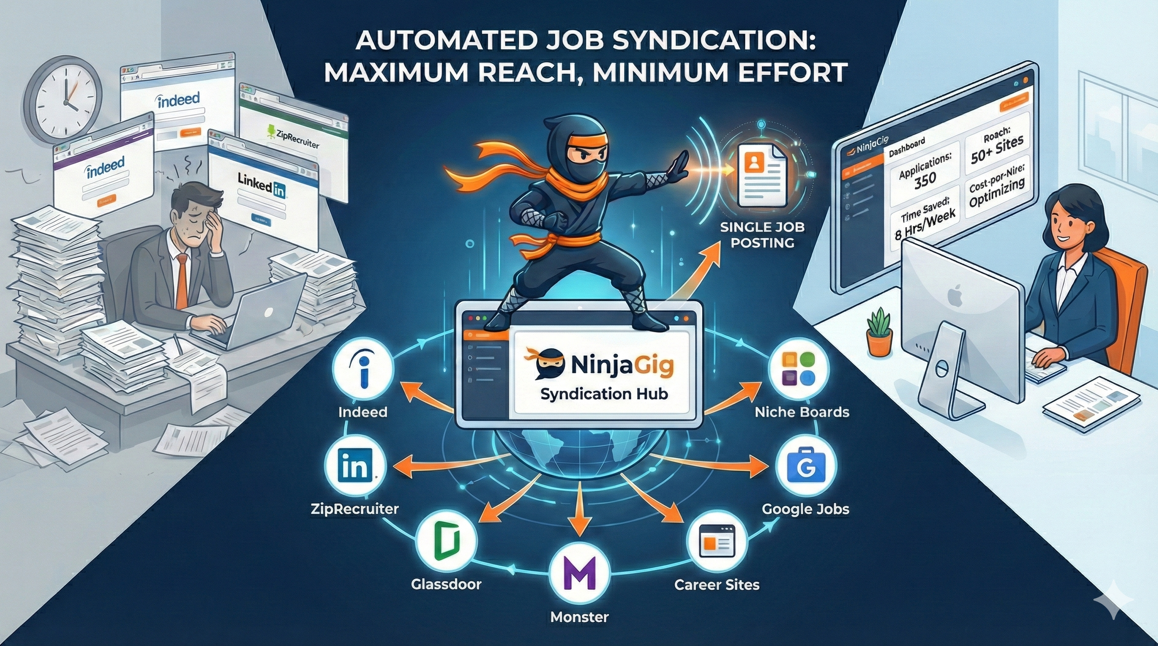
Manually posting the same job opening across multiple job boards is a time-consuming nightmare that most recruiters know all too well.
You log into Indeed, copy your job description, paste it, format it, then repeat the process for ZipRecruiter, Monster, LinkedIn, and a dozen other sites. By the time you’re done, half your day is gone, and you haven’t even started reviewing applications.
Job board syndication handles the heavy lifting of distributing your posts to top job boards, saving recruiters significant time and effort.
By automating tedious workflows across multiple platforms with a single click, you can free up hours per week and focus on the more crucial aspects of the hiring process.
This guide breaks down exactly how job distribution technology works, when to use it, and how to maximize your hiring reach while maintaining control over your talent acquisition process.
What Is Job Board Syndication?
Job board syndication is the automated distribution of a single job posting across a network of job boards, career sites, and search platforms.
With job board syndication, you can manage all your job listings from one platform, streamlining the process and reducing manual effort.
Think of it like a news wire service for job postings: you submit once, and your listing appears on dozens or even hundreds of sites simultaneously through automated job posting technology.
Posting jobs through syndication automatically distributes your listings to multiple boards, maximizing your reach and efficiency.
Definition & Quick Analogy
At its core, job syndication means your job listing is automatically shared through partnerships and technology feeds.
It’s similar to how a TV show gets syndicated to multiple networks; one piece of content, multiple distribution channels. For example, a single job listing posted on your company’s career page can appear on multiple job boards like Indeed, Glassdoor, and LinkedIn through syndication.
Your ATS syndication system handles all the technical details, pushing your job to partner sites without manual intervention.
How Syndication Differs from RSS Feeds & APIs
While RSS feeds and APIs are technical methods for sharing job data, syndication encompasses the entire ecosystem of distribution partnerships.
RSS feeds simply broadcast your jobs for others to consume. APIs enable direct connections between systems.
Syndication, however, combines these technologies with business relationships that ensure your jobs actually appear where candidates are searching, not just in a data feed somewhere, and ensures your jobs have access to a broader pool of candidates.
Syndication vs. Multi-Posting: Key Differences
Understanding the distinction between syndication vs multi-posting helps you choose the right job posting software for your needs.
While both aim to expand your reach, they work through fundamentally different mechanisms. Key aspects that differentiate syndication from multi-posting include how job postings are distributed, the level of automation, and the control you have over where your jobs appear.
Workflow Comparison Chart
Multi-posting requires you to maintain accounts on each job board and typically involves semi-automated copying of your listing to selected sites. This process often means you must navigate multiple job board accounts to post and manage your listings.
You choose specific boards, manage individual accounts, and often pay separate fees. Syndication leverages partner networks, with your job flowing through aggregators to sites you may not even know about, maximizing reach through network effects.
Cost & Time Considerations
Multi-posting tools save time compared to manual posting but still require managing multiple vendor relationships. Syndication typically offers better economics through bundled distribution; one fee covers a broad reach.
A recent article from Inherent showed that syndication can reduce posting costs by 35-40%, compared to purchasing individual board listings, particularly for high-volume hiring.
Reach & Control Trade-offs
Multi-posting gives you precise control over where your jobs appear, but limits reach to your selected boards. Syndication dramatically expands visibility but reduces your direct control over individual placements.
The best job distribution tools balance these factors by offering both targeted posting options and broad syndication capabilities.
How Job Board Syndication Works: Technology + Partnerships
Job syndication technology combines software automation with strategic partnerships to create a distribution network.
Syndication software serves as the backbone of automated job distribution, enabling job listings to be posted efficiently across multiple job boards, social media platforms, and aggregators. Here’s how the pieces fit together to amplify your job postings.
Some platforms also offer real-time tracking of job posting performance, providing live data insights and enabling automated optimization.
Applicant Tracking System Plug-ins & APIs
Modern ATS integration makes syndication seamless. Your applicant tracking system connects to syndication networks through plug-ins or APIs, automatically formatting and transmitting job data.
When you post a job in your ATS, the system handles all the technical requirements for distribution without manual data entry.
Aggregator & Partner Networks
Syndication networks maintain relationships with hundreds of job sites, from major boards to niche industry platforms, including both niche job boards and free job boards, to maximize reach.
These partnerships ensure your jobs appear not just on primary sites but also on specialized channels that reach specific candidate pools.
Programmatic Bidding Models (CPC, CPA)
Programmatic job advertising adds intelligence to syndication by automatically adjusting distribution based on performance. Cost-per-click (CPC) and cost-per-applicant (CPA) models let you pay only for results while algorithms optimize placement for maximum ROI.
Advanced platforms even use AI to determine which channels yield the best candidates for specific roles, optimizing job distribution based on current market trends.
Role of Google for Jobs & Search Engines
Search engines have become critical syndication partners. By providing structured XML job feeds to Google for Jobs and other search platforms, your listings appear directly in search results, where, according to Zippia.com, 70% of passive candidates begin their job search.
This search visibility amplifies the impact of traditional board syndication, making your job listings visible to candidates worldwide.
Pros & Cons of Job Board Syndication
Like any recruitment strategy, job board syndication offers significant advantages but also presents certain challenges. Understanding both helps you implement syndication effectively.
Pros: Reach, Speed, Centralized Tracking, Brand Visibility, Candidate Quality
Broader reach stands as syndication’s primary benefit. One posting can appear on dozens of general and niche boards, dramatically expanding your candidate pipeline. Targeted syndication helps attract more relevant candidates for each position by displaying your jobs to audiences with specific industry experience.
This wide distribution typically generates 200-500 more applications per role in the first month compared to single-board posting.
Speed and efficiency transform your posting workflow. Instead of spending hours on manual distribution, syndication happens instantly. This time savings compounds, with recruiters reporting saving 5-10 hours per week on posting tasks alone, time better spent on candidate evaluation and engagement.
Syndication platforms can also boost candidate engagement by increasing the visibility and attractiveness of your job postings, leading to more active participation from relevant candidates.
Centralized tracking keeps all applications flowing into a single system, regardless of source. Modern syndication platforms funnel every candidate into your ATS, eliminating the chaos of checking multiple board dashboards. You maintain complete visibility over your pipeline while leveraging maximum distribution.
Brand visibility gets an automatic boost when your company name appears across multiple platforms simultaneously. This repeated exposure builds employer brand recognition, particularly valuable for smaller companies competing against well-known brands. Candidates see you’re actively hiring across their preferred channels.
Cons: Volume Overload, Reduced Control, Cost Creep, Attribution Gaps
Application volume can overwhelm unprepared teams. Broad syndication sometimes triggers a flood of unqualified applicants, especially for entry-level positions. Without proper screening tools, recruiters may spend more time filtering candidates than they save on posting.
Reduced control over individual placements means you can’t customize messaging for each platform. Your job appears through partner networks where formatting and presentation vary. Some employers find this lack of direct oversight concerning brand consistency.
Cost considerations require careful monitoring. While syndication often reduces per-posting costs, pay-per-click models can accumulate expenses quickly on popular roles. Without budget controls, costs can spiral beyond traditional posting fees.
Mitigation Strategies for Each Con
Smart implementation addresses these challenges effectively. Use screening questions and automated filters to manage volume and let technology handle initial qualification. Set clear distribution parameters to maintain some control over placement.
Implement budget caps and monitor cost-per-hire metrics closely. Most importantly, use source tracking to identify which syndication channels deliver quality candidates, then focus spending there.
When to Use Job Board Syndication (and When Not To)
Job syndication strategy depends heavily on your hiring context. The right approach varies based on volume, role type, and organizational needs. Syndication is especially effective for reaching active job seekers who are searching across multiple platforms.
High-volume vs. Niche Hiring Scenarios
Syndication excels for high-volume hiring where you need maximum reach quickly, especially when you need to fill the same position across multiple locations or departments. Retail, hospitality, and seasonal hiring benefit enormously from broad distribution.
For specialized technical or executive roles, targeted posting to specific professional boards often yields better results than mass syndication. Consider your hiring volume thresholds. Most companies find syndication valuable when hiring for 5+ similar positions monthly.
SMB vs. Enterprise Considerations
Small businesses gain disproportionate value from syndication by accessing the same distribution channels as larger competitors, without having to maintain numerous vendor relationships. Enterprises with established recruitment marketing teams might prefer more granular control over individual board relationships, allowing their recruitment teams to manage and coordinate syndication efforts according to specific team needs while still using syndication for efficiency on standard roles.
Budget & Compliance Checkpoints
Evaluate syndication when your job advertising budget exceeds $2,000 monthly. Below this threshold, selective posting might prove more cost-effective. Ensure any syndication platform maintains EEOC compliance and provides necessary documentation for audit trails.
Government contractors, in particular, need verification that syndicated postings meet regulatory requirements.
Best Practices for Maximizing ROI
Strategic implementation of job syndication best practices can dramatically improve cost per hire while building a stronger talent pipeline.
Optimizing your job content is essential to maximizing syndication effectiveness, ensuring your listings are relevant and appealing to local candidates. These proven tactics help you extract maximum value from syndication investments.
Crafting SEO-rich Job Descriptions
Well-optimized job descriptions perform exponentially better in syndicated environments. Include relevant keywords naturally throughout your posting: job title variations, required skills, and industry terms. Structure content with clear headers and bullet points that parse well across different platforms. Avoid internal jargon that won’t resonate with external candidates.
Selective Channel Targeting & Exclusion Lists
Not every job belongs on every board. Create role-specific distribution strategies: tech positions might skip general boards in favor of Stack Overflow and Dice, while customer service roles benefit from broad syndication. Build exclusion lists for sites that consistently deliver poor candidates. This targeted approach improves quality while reducing wasted spend.
Using Screening Questions & Automation Filters
Pre-qualification questions filter unqualified applicants before they reach your review queue. Ask role-specific questions that immediately reveal deal-breakers: required certifications, willingness to relocate, or minimum experience levels. Combine these with automated keyword filtering to surface the most promising candidates first.
Analyzing Source Tracking & Performance Metrics
Track which syndication sources deliver not just applicants but actual hires. Monitor metrics like source-to-hire ratio, time-to-fill by source, and cost-per-hire by channel. Analyzing candidate data alongside these metrics helps refine your syndication strategy, increasing investment in high-performing channels while cutting underperformers.
A/B Testing Job Titles & Compensation Visibility
Test different job titles to see which generate better response rates; “Customer Success Manager” might outperform “Client Services Representative” for the same role.
Experiment with showing salary ranges, which can increase application quality by 40% or more, according to publications like Matsh.co. Run these tests systematically to optimize job ads based on real performance data.
Choosing the Right Syndication Platform or ATS
Selecting the best job syndication platform requires evaluating your specific needs against available features and pricing models. Look for efficient posting job functionality, as this is a key feature for streamlining recruitment and reaching more candidates.
The right ATS with job distribution capabilities can transform your hiring process, especially if it integrates seamlessly with your company website for job posting and applicant management.
Critical Feature Checklist
Essential features include one-click posting to major boards, centralized applicant tracking, and robust analytics. Look for platforms offering customizable distribution rules, budget controls, and integration with your existing HR tech stack. Mobile optimization matters too, ensuring candidates can easily apply from any device.
Pricing Models: Flat vs. Pay-per-Performance
Flat-rate syndication pricing provides budget predictability but may include platforms you don’t need. Pay-per-performance models (CPC or CPA) align costs with results but require careful monitoring. Many platforms offer hybrid models and recommend starting with performance-based pricing to identify valuable channels, then negotiating flat rates for proven sources.
Integration & Data Security Questions
Verify how the platform integrates with your current ATS or HRIS. Ask about data ownership, backup procedures, and compliance certifications. Ensure the vendor maintains SOC 2 compliance and follows data privacy regulations. Test the integration thoroughly before committing to avoid workflow disruptions.
Vendor Comparison Table
NinjaGig stands out for small businesses with its simple one-click posting to all major boards and centralized applicant management. The platform excels at balancing broad reach with easy control. JazzHR offers robust syndication plus advanced collaboration features ideal for growing teams.
Workable provides sophisticated sourcing tools alongside syndication, better suited for companies with dedicated recruitment teams. BreezyHR focuses on candidate experience with visual pipeline management and automated communications.
Frequently Asked Questions
Understanding common concerns about job syndication helps you implement it successfully. Here are answers to frequent questions from hiring teams.
How do I know if my job is live on all job boards?
After syndicating your job, you can check whether your job has been posted successfully to each board by reviewing the status in your recruitment platform or on the job boards themselves.
Why isn’t my job appearing on a specific job board?
If your job isn’t showing up, double-check that all required fields, such as location and job title, are filled out. You may receive a notice from your platform if a job posting is not appearing due to missing information or changes in posting requirements.
Will my jobs appear on Google for Jobs automatically?
Most quality syndication platforms include Google for Jobs in their distribution network. However, your jobs must meet Google’s structured data requirements. Confirm your platform provides properly formatted job schema markup and monitor Google Search Console to verify indexing.
How do I stop my ad from showing on certain sites?
Reputable syndication platforms offer exclusion lists or selective distribution options. You can typically block specific sites at the platform level or choose targeted distribution that only includes pre-approved channels. Review distribution reports regularly to identify any problematic sources.
Does syndication hurt employer branding?
When implemented properly, syndication enhances your employer brand rather than hurting it by increasing visibility across relevant channels. The key is maintaining consistency in job descriptions and ensuring your careers page provides a professional candidate experience regardless of traffic source.
What metrics should I track first?
Start with source-to-applicant ratio, cost-per-applicant by channel, and applicant quality scores. These foundational metrics reveal which syndication channels deliver value. Add time-to-hire and source-to-hire conversion rates as you accumulate more data.
Is syndication GDPR/EEO compliant?
Compliance depends on your platform choice and implementation. Verify your syndication provider maintains appropriate data processing agreements and provides necessary compliance documentation. Most established platforms build compliance into their systems, but always confirm before proceeding.
Next Steps: Amplify Your Hiring Reach Today
Job syndication transforms recruitment from a manual, time-consuming process into an efficient talent acquisition machine.
The right platform multiplies your reach while maintaining control over candidate flow and hiring costs. Syndication can also extend your reach to social media platforms for even broader visibility.
Ready to revolutionize your hiring process? Start your free 14-day NinjaGig trial today, no credit card required. Post to every major job board with one click and manage all applicants in a single, powerful dashboard.
Visit NinjaGig to begin amplifying your hiring reach immediately.
