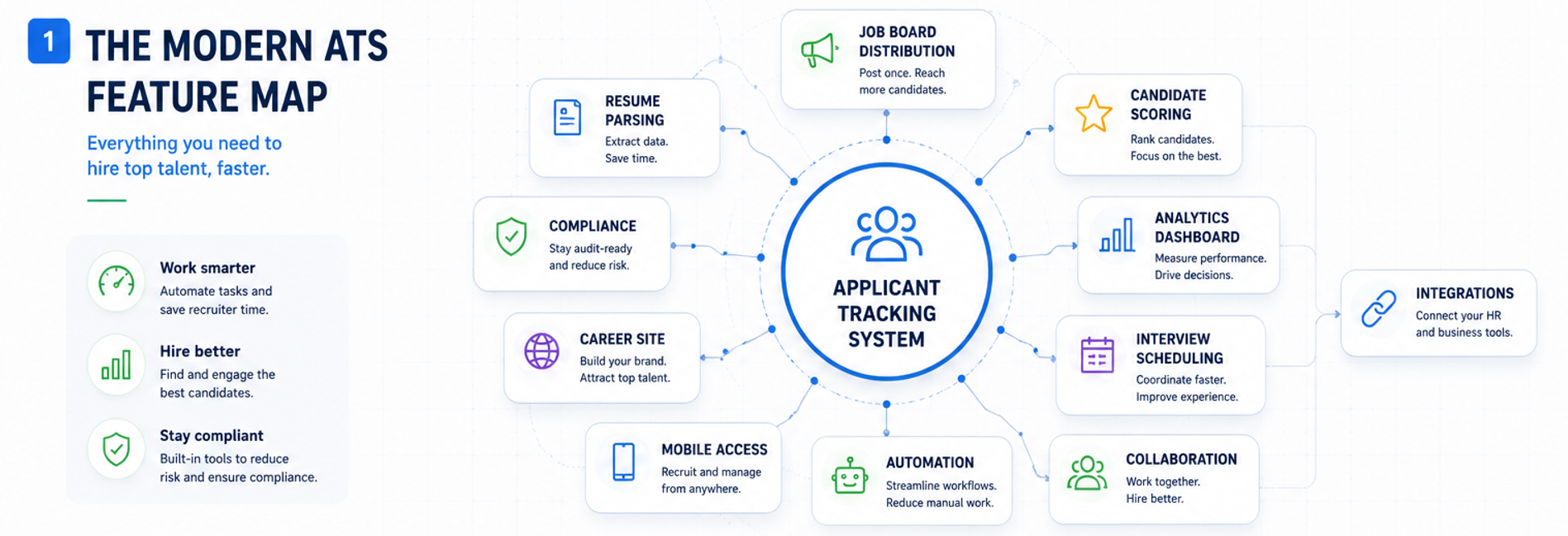

An Applicant Tracking System (ATS) transforms how HR directors, talent acquisition leads, HR professionals, HR teams, and small-business owners manage hiring.

With 99% of Fortune 500 companies using ATS technology and 94% of recruiters reporting improved hiring processes, these platforms deliver measurable gains in efficiency, quality, and cost savings.
ATS solutions help organizations save time by automating manual tasks, enabling HR teams to spend time on more strategic activities rather than repetitive administrative work.
Whether you’re scaling a startup or streamlining enterprise recruitment, an ATS provides the foundation for strategic talent acquisition, and that’s what this guide will help you with.
Why Modern Hiring Needs an ATS Software
The data speaks volumes: 99% of Fortune 500 companies rely on applicant tracking systems, and recruiter adoption continues to surge across organizations of all sizes.
Why? Because traditional hiring methods simply can’t keep pace with today’s recruitment challenges.
Companies receive an average of 250+ applications per online posting, while 92% of candidates never complete their applications due to friction-filled processes. Reviewing multiple applications manually is extremely time-consuming, making the recruiting process inefficient and prone to errors.
An ATS streamlines the recruiting process by automating the screening and management of multiple applications, saving valuable time and increasing overall efficiency.
Modern recruitment demands speed, precision, and scalability. An ATS addresses these needs by automating repetitive tasks, centralizing data management, and providing real-time insights.
The result? Companies using ATS technology find 62% more high-quality candidates compared to traditional methods, while cutting their hiring cycle by up to 60%.
For organizations serious about competing for top talent, an ATS isn’t optional; it’s essential. By automating labor-intensive steps, an ATS optimizes recruitment efforts and improves the efficiency of the entire hiring workflow.
Top 10 Benefits of an Applicant Tracking System
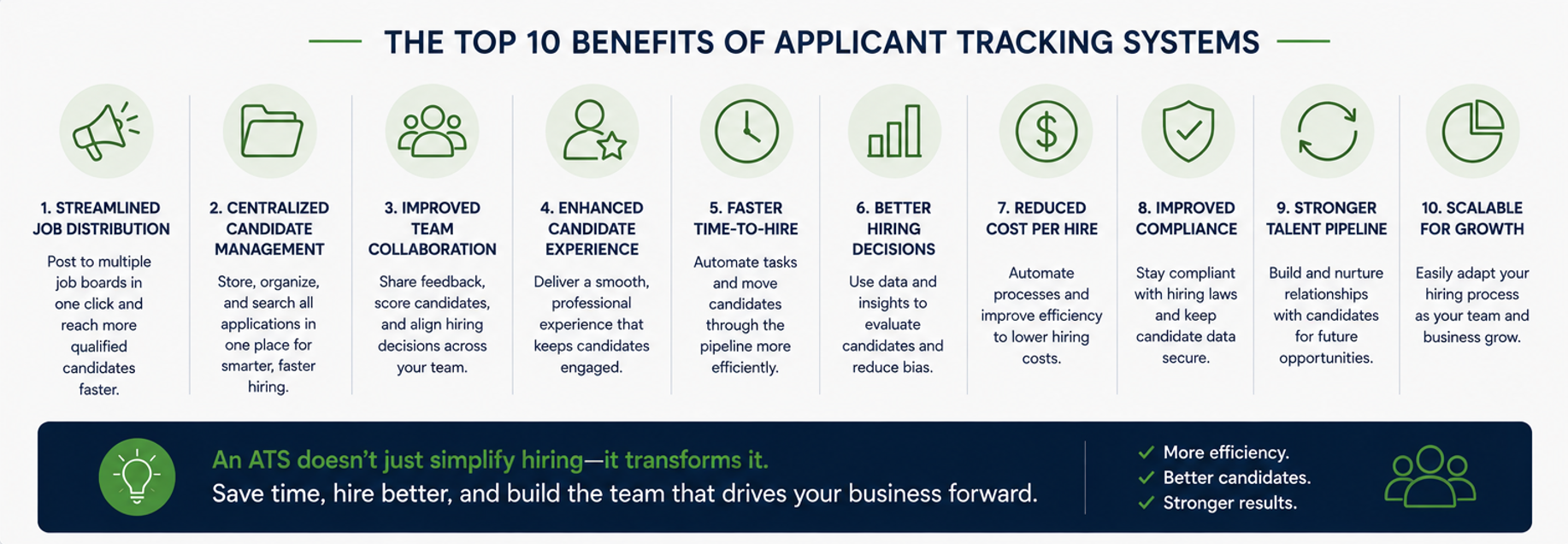 1. Streamlined Job Distribution
One-click posting to multiple job boards revolutionizes how companies advertise openings. Instead of manually copying listings across platforms, ATS technology syndicates postings instantly to dozens of sites, including Indeed, ZipRecruiter, Monster, and Google Jobs. This multi-posting capability ensures maximum visibility while maintaining consistent branding across all channels.
With an ATS, organizations can post job ads to multiple job posting sites with proper tags on social media platforms at once, significantly increasing the reach and visibility of each job posting.
The impact on reach and speed is immediate. Automated distribution puts your openings in front of millions of daily job seekers, capturing candidates at every career stage. Plus, centralized posting management means updates propagate instantly across all platforms, eliminating version control headaches and ensuring accuracy.
2. Centralized Candidate Management
A single repository for all resumes and applications transforms chaotic hiring into organized workflows. Every candidate profile lives in one searchable database, with parsed data standardized for easy filtering by skills, education, location, or any custom criteria.
An ATS stores and manages both candidate information and applicant information, making it easy to track candidates as they move through each stage of the hiring pipeline. No more lost emails or spreadsheet juggling.
With an ATS, recruiters can also build a pool of potential candidates for future hiring needs, ensuring a steady pipeline of qualified talent.
They even provide pipeline analytics, showing exactly where candidates stand and which sources deliver the best applicants.
The result?
Teams find qualified candidates faster while maintaining complete data security.
3. Improved Hiring Team Collaboration
Shared workflows and team scorecards eliminate the communication gaps that plague traditional hiring. Multiple stakeholders (recruiters, hiring managers, executives) access the same candidate profiles simultaneously, leaving timestamped feedback and ratings visible to all.
This transparency prevents duplicate efforts and ensures consistent evaluation criteria. An applicant tracking system enhances collaboration and communication within and across recruiting teams, making it easier to coordinate efforts and share insights throughout the hiring process.
Hiring teams benefit from improved visibility and coordination through ATS, ensuring everyone stays aligned and informed. When everyone operates from the same playbook, decisions happen faster and with greater confidence.
4. Enhanced Candidate Experience
Today’s candidates expect mobile-optimized applications and instant communication.
An ATS delivers both through streamlined application flows that auto-populate from resumes or LinkedIn profiles, eliminating tedious form-filling. Since 49% of candidates cite lengthy applications as a major frustration, this simplification directly impacts completion rates.
Automated acknowledgments and status updates keep candidates engaged throughout the process. ATS platforms support candidate engagement by providing timely updates and critical information at every stage of the hiring process, ensuring candidates feel informed and valued.
Self-service scheduled interviews eliminate back-and-forth emails, while branded career portals create professional first impressions.
Candidate relationship management features within ATS help nurture relationships with both active and passive candidates, fostering long-term connections and improving the overall recruitment experience.
Remember: 69% of candidates will reject offers from companies that respond too slowly, adding to already high drop-off rates. An ATS ensures timely, consistent communication that protects your employer brand.
5. Faster Hiring Decisions & Real-Time Analytics
Hiring dashboards and recruitment KPIs provide instant visibility into your talent pipeline. ATS dashboards highlight key performance indicators and generate ATS reports, helping recruiters measure and improve hiring outcomes.
See at a glance how many candidate sources are at each stage, identify bottlenecks, and track key metrics such as time-to-fill and source effectiveness. This data-driven approach enables proactive adjustments rather than reactive scrambling.
Key features of an ATS related to analytics and reporting include customizable dashboards, real-time ATS reports, and tracking of key performance indicators such as time-to-hire and retention rates. These functionalities empower HR teams to identify inefficiencies and optimize recruitment strategies.
6. Cost & Resource Savings
Flat-rate ATS pricing with unlimited postings transforms the economics of recruitment. Instead of paying per-post fees across multiple job boards, organizations enjoy predictable monthly costs regardless of hiring volume.
Modern applicant tracking systems centralize and streamline the management of job requisitions and job openings, making it easier to post, manage, and distribute positions efficiently. For companies posting multiple openings, savings accumulate quickly, often covering the entire ATS investment through the elimination of posting fees alone.
Beyond direct savings, faster hiring reduces vacancy costs and productivity losses. Securely managing recruitment data within the ATS is essential, as it includes sensitive personal information that must be protected and compliant with privacy laws.
Studies show ATS-enabled companies experience 40% lower employee turnover, likely due to better candidate matching and experience. Since replacing an employee can cost up to nine months’ salary, improved retention delivers a massive financial impact.
7. Compliance & Risk Mitigation
Automated EEO reporting and audit trails simplify regulatory compliance. Every hiring action, from initial posting to final decision, is logged with timestamps and user attribution. Standardized processes and scoring criteria ensure fair, consistent evaluation, while automated data retention ensures compliance with legal requirements.
Applicant tracking software also provides robust compliance features for organizations, automating background checks and protecting sensitive data throughout the hiring process.
Built-in EEO modules capture voluntary self-identification data and automatically generate required reports.
Document storage eliminates the compliance nightmare of scattered paper files or emails. When audits arrive, comprehensive records are instantly accessible, turning potential headaches into straightforward demonstrations of compliant practices.
8. Stronger Employer Branding
A branded career site powered by your ATS showcases your company culture and values. Custom career portals match your visual identity while incorporating rich content like employee testimonials, office videos, and social media feeds. This professional presence attracts higher-quality candidates who research employers before applying.
ATS platforms also streamline job offer management and keep candidates updated on their application status, ensuring a smooth, transparent experience throughout the recruitment process.
Consistent, on-brand communication extends throughout the candidate journey. Customized email templates, professionally formatted job descriptions, and polished interview scheduling interfaces reinforce your employer value proposition at every touchpoint.
Strong employer branding through an ATS helps smaller companies compete effectively for top talent.
9. Integration & Tech Ecosystem Fit
HRIS integration and API connections create seamless workflows across your entire HR technology stack.
Candidate data automatically flows into employee records upon hiring, eliminating duplicate entries.
Background check providers, assessment tools, and onboarding platforms integrate directly, creating efficient end-to-end processes. ATS integration with onboarding platforms streamlines the onboarding process for new hires, ensuring a smooth transition and faster productivity.
Modern ATS platforms function as recruiting hubs, connecting with LinkedIn, job aggregators, and even AI-powered sourcing tools. This interconnected approach maximizes the value of your existing tech investments while providing flexibility to adopt new innovations as they emerge.
10. Scalability & Future-Proofing
Growth-ready hiring infrastructure adapts as your organization evolves. Whether you’re hiring 10 or 10,000 people annually, a quality ATS scales without requiring process overhauls.
ATS enables seamless collaboration among hiring teams and supports organizational growth by providing a unified platform for communication and decision-making.
Automation capabilities expand to handle volume surges, while AI-powered features like predictive analytics and intelligent candidate matching prepare you for recruitment’s future.
ATS software and ATS solutions streamline the entire recruitment process from applicant review and screening to analytics and reporting, ensuring efficiency at every stage.
Cloud-based architecture ensures you always access the latest features without IT headaches. As new regulations emerge or candidate expectations shift, your ATS provider handles updates seamlessly.
Implementation Tips: Getting the Most from Your ATS
Successful ATS implementation requires strategic planning and change management. Start with these essential steps:
- Define clear objectives: Identify specific pain points your ATS should solve and establish measurable success criteria. Automating hiring tasks with your ATS frees up your team’s time to focus on their core responsibilities.
- Plan data migration carefully: Clean existing candidate databases before import to maximize ATS effectiveness
- Invest in user training: Schedule hands-on sessions for all team members, focusing on their specific workflows
- Start with pilot projects: Test the system with select positions before full rollout
- Configure thoughtfully: Customize workflows, templates, and permissions to match your processes
- Monitor adoption metrics: Track user engagement and address resistance quickly
- Optimize continuously: Regular reviews of analytics help refine processes and maximize ROI
Remember: an ATS is only as effective as its implementation. Organizations that invest in proper setup and training see dramatically better results than those who simply activate the software and hope for the best.
A well-implemented ATS streamlines hiring tasks, allowing teams to focus on core responsibilities and helping organizations identify and attract the best candidates.
ATS ROI Calculator (Gated Lead Magnet)
Wondering exactly how much an ATS could save your organization? Our interactive ATS ROI Calculator provides personalized projections based on your specific hiring volumes and costs.
This comprehensive spreadsheet tool calculates projected cost-per-hire savings, time-to-hire reductions, and break-even timelines when adopting an ATS.
Input your current metrics, posting costs, time-to-fill, team hours per hire, and see detailed projections of efficiency gains and dollar savings.
The calculator also factors in soft benefits, such as reduced turnover and improved candidate quality, giving you a complete picture of ATS value.
It estimates the impact of finding qualified candidates with relevant skills and engaging active candidates through ATS, helping you understand how these factors contribute to overall hiring efficiency.
Unlock the ATS ROI Calculator – Get the Free Template
Frequently Asked Questions
How much does an applicant tracking system cost?
ATS pricing varies widely based on company size and features. Entry-level systems start at $50-100 per month for small businesses with unlimited job postings.
Mid-market solutions typically range from $300 to $ 800 monthly, while enterprise platforms with advanced analytics and integrations can exceed $1,500 monthly. Most vendors offer tiered pricing based on the number of active jobs or users.
Is an ATS difficult to implement?
Modern cloud-based ATS platforms can be operational within days for basic functionality. Full implementation, including data migration, custom workflows, and team training, typically takes 2-4 weeks. The key is choosing a vendor with strong onboarding support and starting with core features before adding complexity.
Can an ATS integrate with our existing HR systems?
Yes, most contemporary ATS solutions offer pre-built integrations with popular HRIS platforms, payroll systems, and productivity tools. Look for systems with open APIs that enable custom connections.
Common integrations include employee databases, background check providers, and communication platforms like Slack or Microsoft Teams.
How does an ATS protect candidate data?
Reputable ATS providers implement enterprise-grade security, including encryption, secure data centers, and regular security audits.
These platforms are designed to protect sensitive data related to job candidates, ensuring that confidential information is securely stored, processed, and digitized to prevent data breaches.
Features such as role-based access controls, audit logs, and automated data retention policies ensure compliance with privacy regulations such as GDPR and CCPA. Always verify a vendor’s security certifications before committing.
Will an ATS eliminate human judgment in hiring?
No, an ATS enhances rather than replaces human decision-making. While automation handles repetitive tasks like resume parsing and interview scheduling, all evaluation and hiring decisions remain with your team. The system simply provides better information and more time for meaningful candidate interactions.
What if our hiring needs are seasonal or variable?
Many ATS platforms offer flexible pricing to accommodate variable hiring volumes. Look for systems with monthly contracts rather than annual commitments, or those offering usage-based pricing. Some providers allow you to scale features up or down based on seasonal needs.
How quickly can we expect to see ROI from an ATS?
Most organizations see immediate efficiency gains, with measurable ROI typically achieved within 3-6 months. Cost savings from posting often provide immediate returns, while improvements in time-to-hire and quality accumulate over several hiring cycles. Organizations making 10+ hires annually generally recoup their investment within the first year.
Conclusion & Next Steps

The benefits of an applicant tracking system extend far beyond simple resume storage. From streamlined job distribution and centralized candidate management to enhanced compliance and stronger employer branding, an ATS transforms every aspect of talent acquisition.
By integrating with multiple job boards and social media platforms, an ATS helps organizations attract more candidates, identify suitable candidates through AI-driven matching, and streamline recruiting processes for greater efficiency.
These platforms also manage every job application, automatically filter out irrelevant applications, and reduce the time spent on manual recruitment tasks.
Organizations using these platforms report faster hiring, lower costs, better candidate experiences, and improved quality of hire, advantages that compound into significant competitive advantages.
Ready to experience these benefits firsthand? Take the next step in modernizing your recruitment process.
Book a Free ATS ROI Consultation
See how much time and money you could save in 30 minutes with one of our hiring experts.
Want to see these benefits in practice? Read what small business owners say in our customer reviews.