
Choosing the right hiring tools is mission-critical for small businesses competing in today’s talent market. Without proper technology, you’re fighting with outdated spreadsheets while your competition leverages automated systems that slash time-to-hire and improve candidate quality.
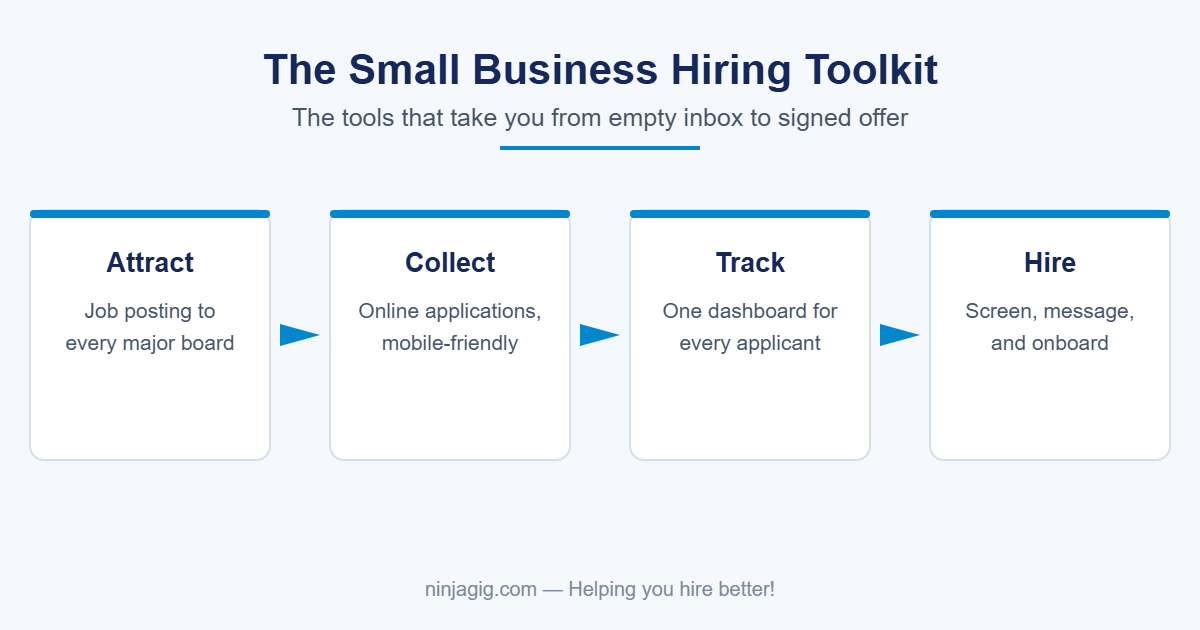
This comprehensive guide covers five core tool categories that transform small business recruiting: Applicant tracking systems (ATS), job boards and syndication tools, background check services, video interviewing platforms, and digital onboarding software. Each tool addresses specific pain points in the hiring process, from losing track of applicants to onboarding failures that drive early turnover.
This expert-driven, research-backed resource provides actionable insights for owners and HR teams ready to reduce time-to-hire, cut costs, and build stronger teams. You’ll discover real market data, vendor comparisons, integration strategies, and implementation roadmaps tailored to the constraints and budgets of small businesses.
Why Digital Hiring Tools Matter for Small Businesses
Small businesses face unique hiring challenges in the current labor market. With 57% of leaders indicating that attracting and retaining talent is a top priority and more open positions than unemployed workers, the competition for quality candidates has never been fiercer. Small business HR teams, often just one or two people wearing multiple hats, must compete with larger companies that have dedicated recruiting departments and larger budgets.
The top hiring pain points for small businesses include:
- Managing high volumes of applications across multiple channels without losing candidates
- Maintaining compliance with employment laws while juggling other responsibilities
- Providing a professional candidate experience that matches larger competitors
- Reducing the lengthy hiring cycles that cause top candidates to accept other offers
Digital recruiting tools deliver measurable benefits that directly address these challenges. 86% of hiring managers report that an ATS reduced their time-to-hire, resulting in significant cost savings and better candidate capture. When you consider that the global ATS market reached $3.28 billion in 2025, it’s clear that businesses of all sizes recognize the ROI of hiring technology.
The data proves that technology adoption drives real results:
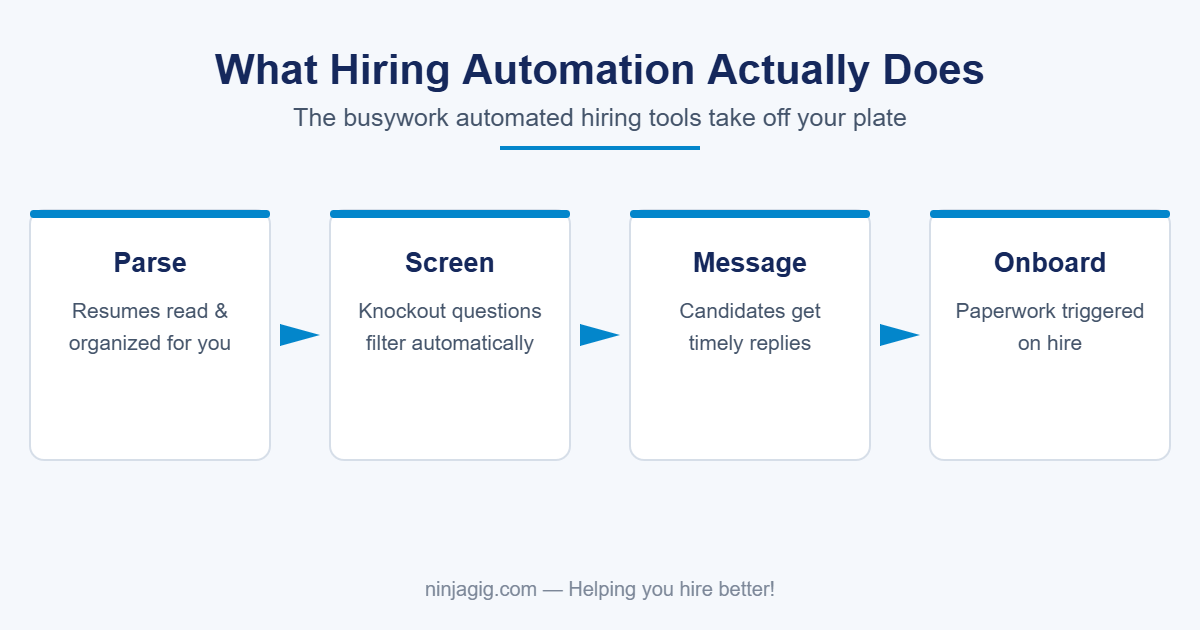
- Automated resume parsing and ranking eliminate hours of manual screening
- Integrated job board posting expands your reach to millions of candidates with one click
- Digital onboarding drives 89% higher engagement among new hires when onboarding is strong
- Background screening helps 73% of recruiters avoid bad hires that could damage your business
For small businesses, these tools level the playing field, allowing lean teams to operate with the efficiency and professionalism of much larger organizations.
Essential Hiring Toolkit & Deep-Dive Reviews
Applicant Tracking Systems (ATS)
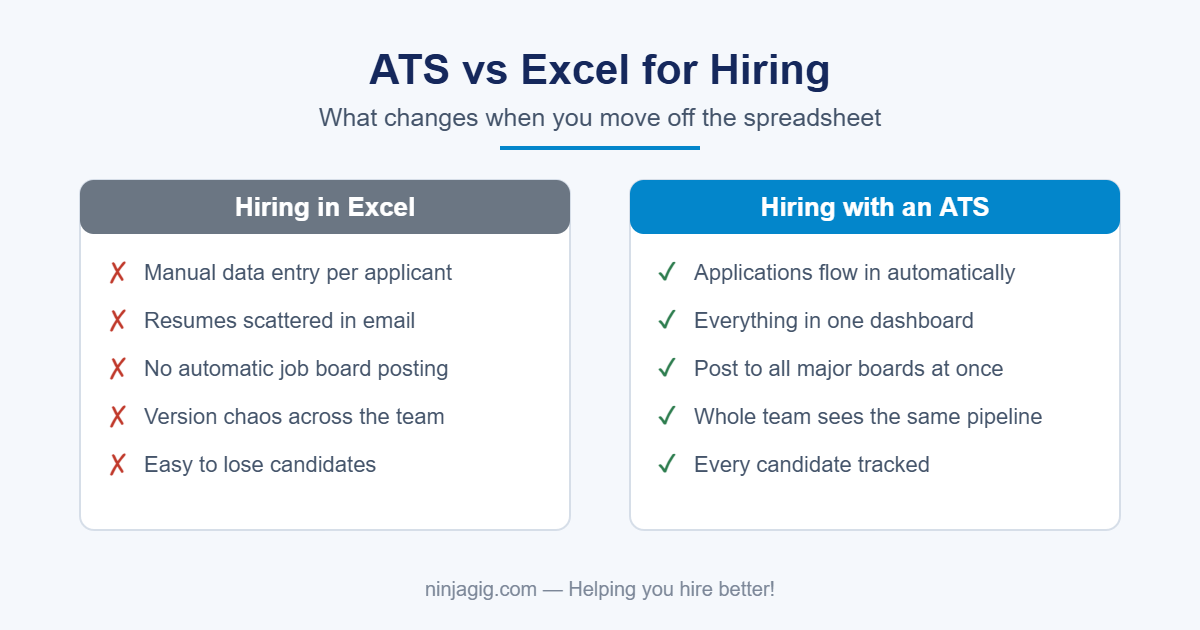
An applicant tracking system serves as the command center for your entire hiring process, replacing chaotic spreadsheets and overflowing email inboxes with a centralized, automated workflow. Without an ATS, small companies easily lose track of candidates and critical paperwork, leading to missed opportunities and compliance risks.
Modern ATS platforms transform how small businesses manage recruiting by providing:
- Automated resume parsing that extracts and organizes candidate data instantly
- Intelligent ranking algorithms that surface the best-fit candidates first
- Analytics dashboards tracking time-to-hire, source effectiveness, and bottlenecks
- EEOC compliance tools ensure fair hiring practices and proper documentation
- AI-powered screening capabilities that improve match quality while maintaining transparency
The ATS market statistics tell a compelling story. 35% of U.S. small businesses now use an ATS, contributing to a global market valued at approximately $3.28 billion in 2025. This explosive growth reflects clear ROI: businesses using an ATS report significant reductions in time-to-hire and significant improvements in candidate quality.
Top 5 ATS Solutions for Small Businesses:
- NinjaGig: Free tier available, posts to major job boards with one click, trusted by over 22,000 small businesses with 1.4 million applications processed
- JazzHR: Starting at $49/month, strong reporting features, unlimited users on all plans
- Workable: From $149/month, includes AI-powered sourcing, mobile app for on-the-go recruiting
- Breezy HR: $157/month starting price, visual pipeline management, built-in video interviewing
- BambooHR: Custom pricing, combines ATS with full HRIS capabilities, excellent for growing teams
When selecting an ATS, prioritize these decision factors:
- Integration capabilities with your existing tools (payroll, HRIS, job boards)
- User experience for both recruiters and candidates
- Mobile responsiveness for candidates applying on smartphones
- Support quality and implementation assistance
- Scalability to grow with your business needs
Job Boards & Syndication Tools
Multi-channel visibility drives successful recruiting. Job boards remain essential for reaching active job seekers, with professional networks like LinkedIn cited by 58% of North American hiring managers as top sources for quality hires.
Small businesses should leverage multiple board categories to maximize reach:
- General boards: Indeed, Monster, CareerBuilder for broad visibility
- Professional networks: LinkedIn for skilled positions, specialized talent
- Niche/industry boards: Industry-specific sites for targeted recruiting
- Local/community boards: Craigslist, local job sites, ZipRecruiter for location-specific roles
One-click syndication transforms how small businesses post jobs. Instead of manually reposting to each board, syndication tools or ATS-integrated posting lets you write once and distribute everywhere. For example, NinjaGig’s ATS can “post to top job boards like Indeed, ZipRecruiter, and Monster with one click,” dramatically expanding your candidate pool without extra effort.
To optimize job ad performance across different boards:
- Customize titles to match each platform’s search behavior
- Include salary ranges where required (transparency laws)
- Use board-specific keywords and formatting
- Monitor source effectiveness through your ATS analytics
Background Check Services
Background screening protects your business from negligent hiring risks while ensuring workplace safety. 92% of U.S. employers conduct criminal checks during the hiring process, and 95% use some form of pre-employment screening. These statistics reflect both legal requirements and practical risk management.
Background checks deliver proven results: 73% of recruiters report that screening helped them avoid a bad hire, while 91% say it uncovered issues they wouldn’t have found otherwise. For small businesses in regulated industries (healthcare, childcare, finance, transportation), proper screening isn’t optional; it’s legally mandated.
Standard background check types include:
- Criminal record searches at the county, state, and federal levels
- Education verification confirming degrees and certifications
- Employment history validation of past positions and dates
- Motor vehicle records for driving-related positions
- Credit checks for financial responsibility roles
Top Background Check Vendors for Small Business:
- Checkr: API-first design, starting at $29/check, fast turnaround times
- GoodHire: User-friendly interface, from $29.99/check, excellent candidate experience
- HireRight: Enterprise-grade accuracy, custom pricing, global screening capabilities
Integration with your ATS streamlines the screening workflow, automatically advancing candidates, triggering background checks, eliminating duplicate data entry, and ensuring FCRA compliance throughout the process.
Video Interviewing Platforms
The video interviewing market has grown substantially, with the market valued at $250 million in 2022 and projected to reach $892 million by 2030, reflecting the permanent shift toward flexible, location-independent recruiting. Today, the majority of recruiters conduct video interviews, making this technology essential rather than optional.
Video interviewing offers two primary formats, each with distinct advantages:
- Live interviews: Real-time conversations via Zoom, Teams, or Google Meet, best for final rounds and culture fit assessment
- On-demand interviews: Candidates record responses on their schedule, ideal for initial screening at scale
The efficiency gains are substantial: recruiters can screen significantly more candidates in the same amount of time using on-demand video than with phone screens. Structured video interviews also improve hiring fairness by asking all candidates identical questions.
Recommended Video Interview Tools:
- Budget options: Zoom ($14.99/user/month), Microsoft Teams (included with Office), Google Meet (free tier available)
- SparkHire: From $119/month, on-demand and live options, ATS integrations
- HireVue: Enterprise pricing, AI-powered insights, proven to improve hiring efficiency
- VidCruiter: Custom pricing, highly customizable, strong accessibility features
Digital Onboarding Platforms
First impressions determine retention. 70% of employees decide whether to stay within their first month, and poor onboarding ranks as the top reason for early departures. Conversely, strong onboarding drives 89% higher engagement among new hires, directly impacting productivity and retention.
Digital onboarding platforms replace paper packets and disjointed emails with streamlined, professional experiences. Core modules include:
- Electronic forms: I-9, W-4, state tax forms, benefits enrollment
- Task checklists: Automated workflows ensuring nothing falls through the cracks
- E-signatures: Legally binding document completion from anywhere
- Self-service portals: New hires access information on demand
- Training videos: Consistent delivery of company culture and role-specific content
The importance of professional onboarding is reflected in market growth and business impact. For small businesses, this investment pays immediate dividends through reduced HR workload and improved retention.
Best-Fit Onboarding Tools:
- BambooHR: Combines ATS and onboarding, custom pricing, excellent for growing teams
- WorkBright: Mobile-first design, from $5/employee, ideal for distributed teams
- Sapling: From $5/user/month, strong workflow automation, integrates with major HRIS platforms
- Zenefits: Free core platform, onboarding included, best for benefits-heavy organizations
Tool Integration & Workflow Automation
Disconnected hiring tools create data silos and inefficiencies. An integrated hiring tech stack eliminates duplicate entry, reduces errors, and provides a single source of truth for all recruiting data. The most effective approach positions your ATS as the central hub connecting all other tools.
A properly integrated workflow might look like this: NinjaGig ATS posts your job to multiple boards → Applications flow into one dashboard → Top candidates advance to Checkr background screening → Approved candidates receive SparkHire video interview invitations → Hired candidates seamlessly transfer to BambooHR for onboarding.
When evaluating integration capabilities, examine these technical factors:
- Native API connections: Direct, real-time data synchronization
- Webhook support: Instant notifications when events occur
- Zapier availability: Connects tools without custom development
- Data mapping flexibility: Customize which fields sync between systems
- Error handling: Clear reporting when integrations fail
This level of integration determines whether your tools truly work together or merely coexist. Prioritize vendors offering pre-built connections to your existing systems.
Cost-Benefit & ROI Calculator
Understanding the financial impact of hiring tools requires comparing current costs against technology investments. The average cost-per-hire for small businesses ranges from $3,000 to $5,000 when factoring in advertising, staff time, and the opportunity costs of vacant positions.
Calculate your hiring ROI using this formula:
Annual Savings = (Manual hours saved × Average hourly wage) + (Reduced time-to-hire × Daily position value) – Annual tool costs
For example, If an ATS saves 10 hours per hire on administrative tasks, you conduct 20 hires annually, and your HR manager earns $30/hour:
- Time savings: 10 hours × 20 hires × $30 = $6,000
- Faster hiring: 7 days saved × $200 daily productivity = $1,400 per hire × 20 = $28,000
- Total benefit: $34,000 annually
- Less ATS cost: $1,800 ($150/month)
- Net ROI: $32,200 or 1,789% return
Access our downloadable Hiring Tech ROI Calculator (Excel and Google Sheets formats) to model your specific savings based on current metrics and tool costs. This gated resource includes vendor comparison templates and implementation timelines.
Implementation Roadmap for Small Teams
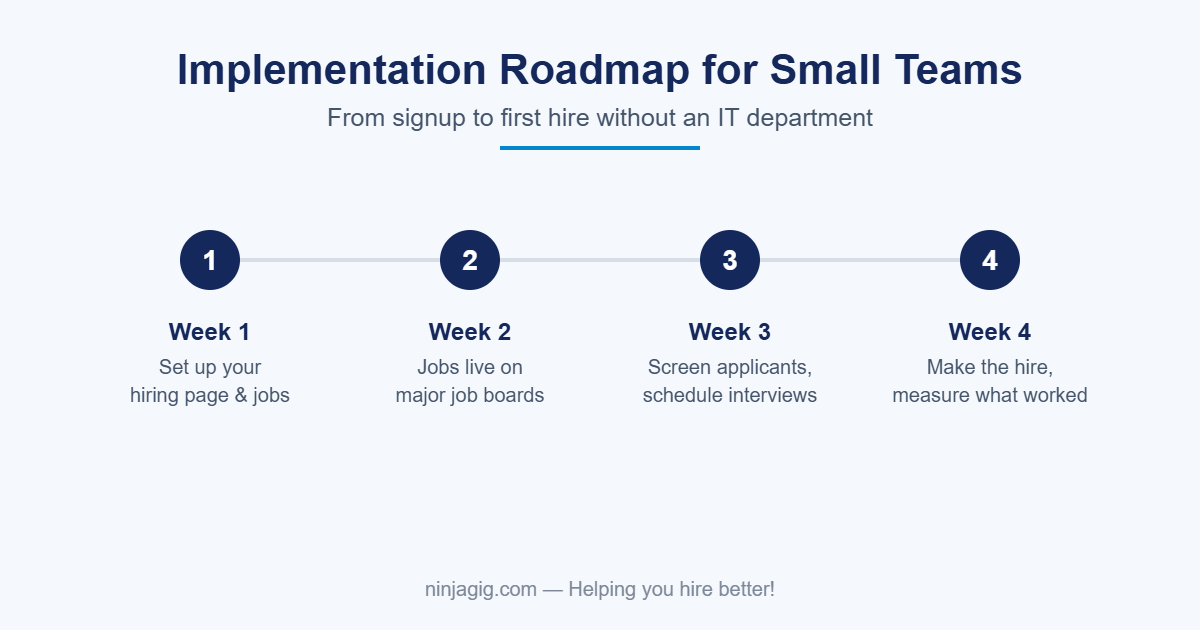
Successfully deploying hiring technology requires methodical planning and change management. Follow this proven four-phase approach:
Phase 1: Audit Current Process & Pain Points
- Document your existing hiring workflow from job posting to first day
- Survey stakeholders (hiring managers, HR, recent hires) for frustrations
- Measure baseline metrics: time-to-hire, cost-per-hire, source effectiveness
- Identify compliance gaps and manual bottlenecks
Phase 2: Vendor Shortlist & Demo Checklist
- Define must-have features versus nice-to-haves
- Request demos from 3-5 vendors maximum
- Include end users in demo sessions
- Test candidate experience by applying to your own job
Phase 3: Pilot Launch, KPIs, Feedback Loop
- Start with one department or location
- Set 30/60/90-day success metrics
- Schedule weekly check-ins during the first month
- Document workarounds and integration issues
Phase 4: Full Rollout & Continuous Optimization
- Expand systematically based on pilot learnings
- Provide role-specific training materials
- Establish a monthly reporting cadence
- Plan quarterly reviews for process refinement
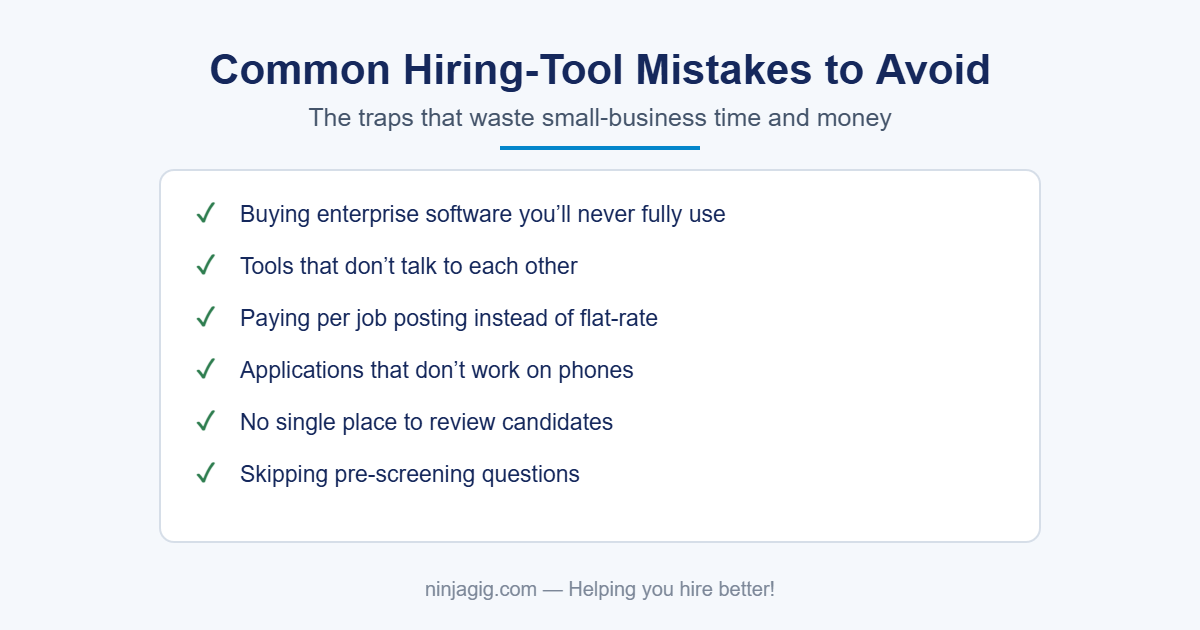
Common Mistakes & How to Avoid Them
Over-customizing workflows too early: Start with vendor-recommended configurations. Customize only after understanding how the system works and identifying genuine needs. Excessive customization complicates training and upgrades.
Ignoring mobile applicant experience: Over 60% of job seekers use mobile devices. Test your application process on smartphones. If candidates can’t easily apply from their phone, you’re losing qualified talent to competitors.
Failing to train hiring managers: Technology adoption fails when end users aren’t properly trained. Create role-specific training focusing on their daily tasks, not system administration. Record training sessions for future reference.
Skipping legal compliance checks: Employment law violations carry serious penalties. Ensure your tools support EEOC, FCRA, and local compliance requirements. Regular audits catch issues before they become lawsuits.
What NinjaGig Customers Say
What small business owners actually say about NinjaGig — more on our reviews page:
“I think the NinjaGig website and service is great! I’ve received multiple job applications through your site without even advertising! I would definitely recommend this to another small business owner, in fact I already have.”
— Kyle, Scribe Source
“We love how easy it is to use NinjaGig. It’s budget-friendly and works exactly as expected every single time.”
— Elena, Maple HR
Future Trends: AI, Automation & DEI in Small-Business Recruiting
Explainable AI screening & bias audits represent the next evolution in fair hiring. Modern AI tools not only screen resumes but explain their decisions, allowing recruiters to understand and adjust recommendations. Regular bias audits ensure algorithms don’t perpetuate discrimination.
Chatbot pre-screening and candidate nurturing will become standard for small businesses. These tools handle initial candidate questions 24/7, schedule interviews, and maintain engagement throughout the process, critical capabilities when competing for scarce talent.
Data-driven DEI dashboards help small businesses intentionally build diverse teams. Visual analytics show pipeline diversity at each stage, highlighting where bias might creep in. This transparency drives accountability and results.
Small businesses that embrace these technologies gain a competitive advantage by attracting younger, tech-savvy workers who expect modern hiring experiences. The key is choosing vendors committed to responsible AI development and transparent practices.
Conclusion & Action Steps
The evidence is overwhelming: adopt hiring automation or fall behind. Companies using automated tools hire significantly faster, spend substantially less per hire, and deliver superior candidate experiences. The technology has matured beyond the early adopter phase.
Your roadmap to improve the recruitment process starts with these steps: First, audit your current process to identify the biggest time wasters. Next, prioritize which automation features would deliver immediate impact. Then, evaluate platforms based on your specific needs and integration requirements. Finally, implement in phases. Start with resume parsing and email automation before expanding to assessments and onboarding.
Remember, successful automation enhances human capabilities rather than replacing them. Use technology to eliminate repetitive tasks so your team can focus on building relationships, selling your employer brand, and making nuanced hiring decisions. The future of recruiting blends artificial intelligence with human insight.
Key Takeaways & Action Checklist
The five essential tool categories of ATS, job boards, background checks, video interviewing, and digital onboarding form a complete hiring technology stack for small businesses. Integration between these tools multiplies their individual benefits, creating a seamless workflow from posting to the first day.
Your 7-Step Action Checklist:
☐ Audit your current hiring process and identify the top three pain points
☐ Calculate potential ROI using our downloadable calculator
☐ Demo 2-3 ATS platforms, prioritizing integration capabilities
☐ Test candidate experience by applying to your own jobs
☐ Start with a pilot program in one department
☐ Train all stakeholders before full rollout
☐ Schedule monthly reviews to optimize and expand usage
Download our complete “Small Business Hiring Tech Implementation Guide” (PDF) for detailed vendor comparisons, integration diagrams, and compliance checklists.
Ready to Transform Your Hiring?
Ready to cut your time-to-hire in half? Book a free 30-minute hiring-tech consultation with our experts today. We’ll analyze your current process, recommend the right tool combination, and create a custom implementation roadmap for your team.
For immediate action, download the “Small Business Hiring Tech Stack Calculator” (Excel & Google Sheets). Instantly estimate your ROI and compare top vendors side-by-side. This comprehensive tool includes cost comparisons, feature matrices, and integration compatibility guides, everything you need to make an informed decision.
Start with a free trial of an integrated ATS like NinjaGig, which posts to every major job board and manages all applicants in one dashboard. With over 22,000 small businesses trusting NinjaGig to process 1.4 million applications, you’ll join a proven platform designed specifically for teams like yours.
Want the whole toolkit in one tool? NinjaGig combines job posting, applicant tracking, and a custom hiring page in one flat-rate plan built for small businesses — see how it works.
Related reading: ATS vs Excel · The best job boards guide · How to choose an ATS