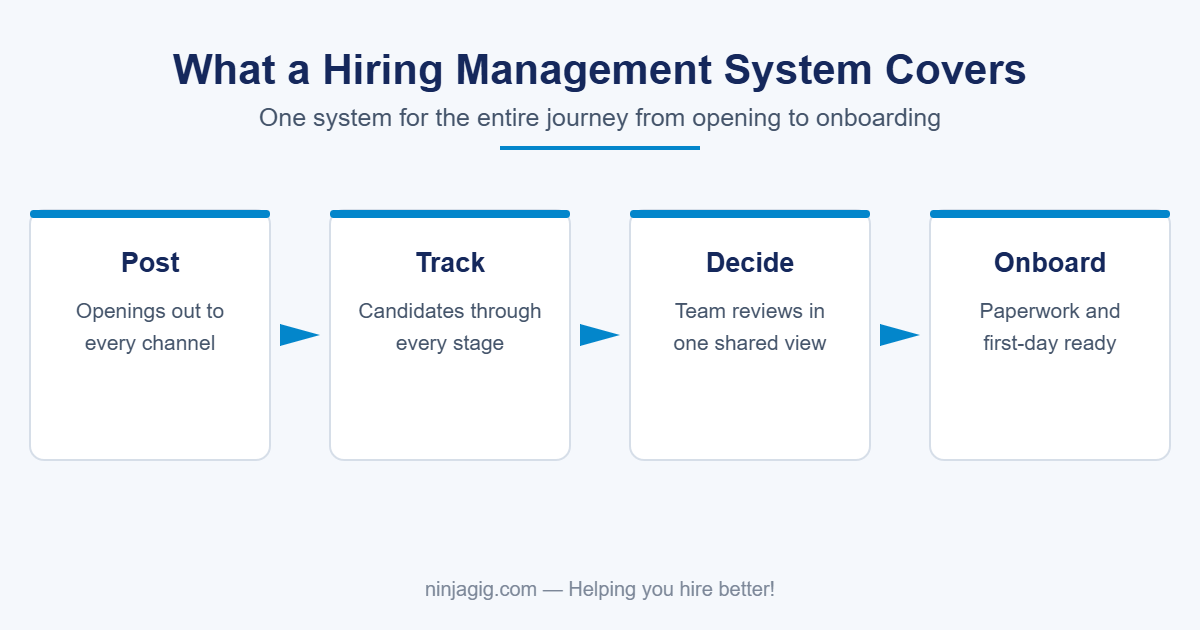

Hiring managers face a brutal reality: top talent gets snatched up fast, and manually posting to multiple job boards burns precious time. With 97.8% of Fortune 500 companies now using ATS technology, the message is clear: manual posting methods are dead weight in today’s competitive hiring landscape.
The right job board software transforms how you attract candidates by automating distribution across platforms like Indeed, LinkedIn, and Glassdoor while tracking every application source. This guide breaks down exactly what features matter most, compares the top 10 platforms, and shows you how to significantly reduce your time-to-hire.
You’ll learn which platforms deliver real ROI, how to evaluate vendors beyond marketing hype, and why integrated ATS solutions often outperform standalone job boards. Whether you’re posting 5 jobs or 500, this analysis will help you choose software that scales with your hiring needs.
What Is Job Board Software?
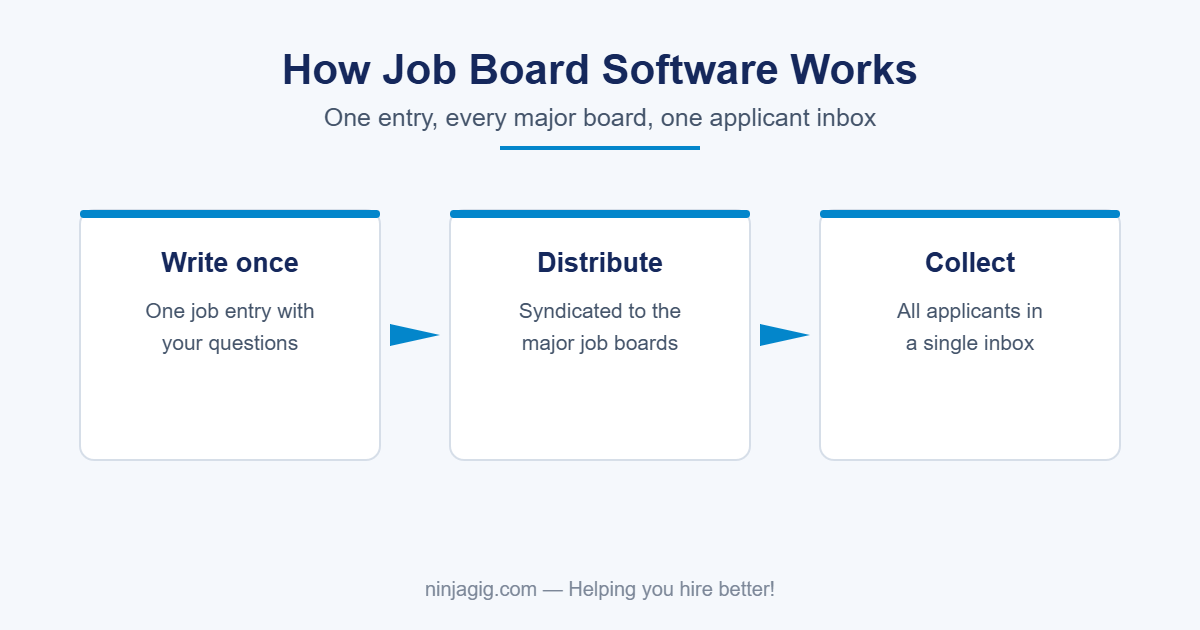
Job board software enables employers to post job openings across multiple online platforms simultaneously. At its core, this software acts as a distribution hub: you create a single job posting, and the system automatically pushes it to dozens or even thousands of job sites.
The evolution from single-site posting to integrated platforms has been dramatic. Early job boards required separate logins and manual posting to each site. Today’s solutions integrate directly with major boards, track applicant sources, and provide unified dashboards for managing candidates. Modern platforms like Manatal can distribute a single posting to over 2,500 job sites globally.
Here’s the critical distinction: job board software focuses on distribution and reach, while an applicant tracking system (ATS) manages the entire hiring workflow. Many modern ATS platforms now include job board distribution as a core feature, creating a unified solution that handles posting, tracking, screening, and hiring in one system. This integration eliminates the need for separate tools and reduces data silos between posting and hiring activities.
Why It Matters in the Current Labor Market
The numbers paint a stark picture: Indeed was named the leading source of hire by Breezy HR in their analysis of over 24 million job applications. Missing these critical channels means missing the majority of active job seekers. Yet manually posting to each platform eats up hours of productivity each week.
Employers face three critical challenges that job posting software directly addresses. First, reach: with candidates scattered across multiple platforms, single-channel posting severely limits your talent pool. Second, speed: top candidates remain on the market for just 10 days, making rapid posting and response essential. Third, data-driven decisions: without tracking which sources deliver quality hires, you’re flying blind with recruitment spend.
The business impact is measurable. Companies using integrated job board software report significant reductions in cost-per-hire through better source tracking and automated workflows. Time-to-fill drops when postings hit all major boards simultaneously. Perhaps most importantly, employer branding stays consistent across platforms, building trust with candidates who often research companies on multiple sites before applying.
Key Evaluation Criteria for Job Board Software
Candidate Reach
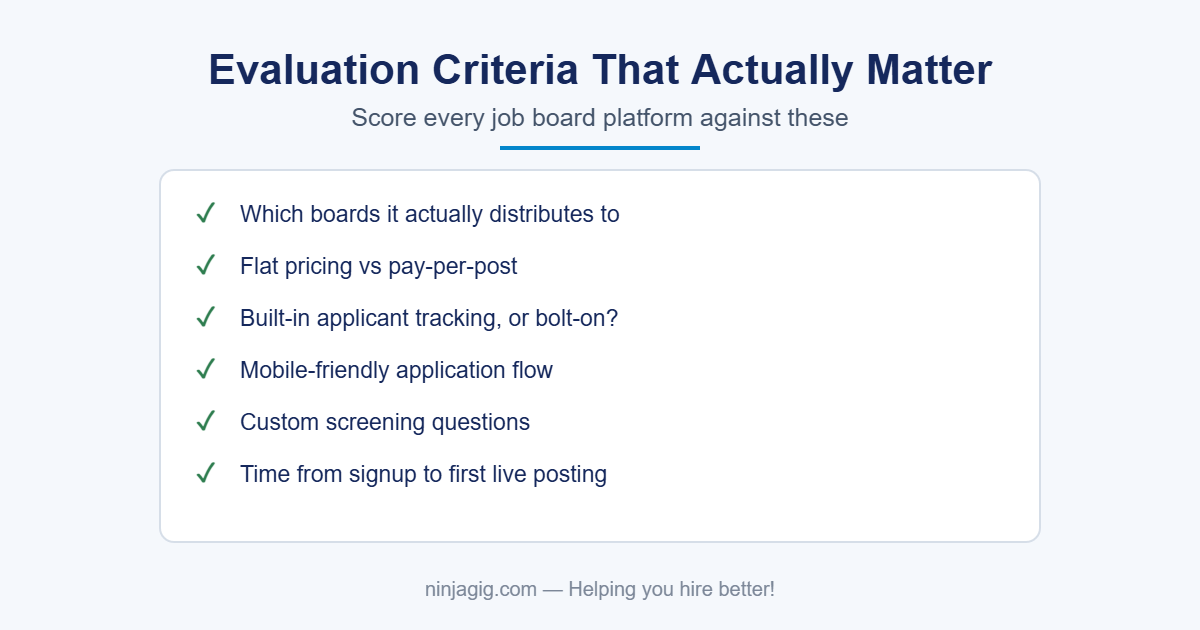
The number and quality of integrated job boards directly determine the size of your candidate pool. Leading platforms like Manatal publish to over 2,500 sites, including Indeed, Monster, CareerJet, and regional boards. This job board distribution matters because Indeed has consistently been recognized as a top source of hires across multiple studies.
Look beyond raw numbers to board quality and relevance. A platform syndicating to 5,000 obscure sites delivers less value than one connected to the top 50 boards where candidates actually search. Verify that your target boards are included and check whether premium board access costs extra.
Ease of Posting & Automation
One-click posting should be table stakes. Quality platforms let you create a single job ad that automatically syndicates across all connected boards. BambooHR exemplifies this: users simply check boxes for Indeed or Glassdoor during job creation, and the system handles distribution.
Advanced recruitment automation goes further. Breezy HR includes template libraries and smart field mapping that pre-fills board-specific requirements. NinjaGig takes automation seriously with unlimited postings for a flat fee: no counting credits or worrying about posting limits. The best systems also update postings automatically when you edit the master version.
Customization & Employer Branding
Generic job postings get lost in the noise. Top platforms enable branded career sites with custom domains, logos, and color schemes that reinforce your employer brand. Niceboard specializes in white-label solutions, letting companies launch custom job boards in minutes with full branding control.
NinjaGig pushes customization further with unique features: every job gets a custom TinyURL and QR code for easy sharing. This means your postings can live at memorable URLs like jobs.YourCompany.com/SalesManager rather than generic board addresses. These branded touchpoints build candidate trust and improve application rates.
Analytics & Reporting
Recruitment analytics separate guesswork from strategy. Essential metrics include applications per source, cost per application by channel, time-to-hire by posting source, and quality-of-hire ratings by board. Without this data, you’re spending blindly.
Integration software collects data from various job boards, providing insights into which platforms yield the best candidates. Modern ATS platforms offer custom reports and interactive visualizations that answer critical questions: Which boards deliver the most interviews? What’s our return on investment (ROI) per posting channel? Platforms like Greenhouse and Lever excel here with advanced analytics modules.
User Experience & Support
Complex software kills adoption. The interface should be intuitive enough for occasional users while powerful enough for recruiting teams. Look for visual pipeline management, drag-and-drop workflows, and mobile optimization for on-the-go hiring.
Quality support includes dedicated onboarding, video training libraries, and responsive customer success teams. Some vendors assign dedicated account managers for larger teams. Test the support experience during trials: slow response times during sales predict poor support post-purchase.
ATS Integration vs. Stand-Alone Job Boards
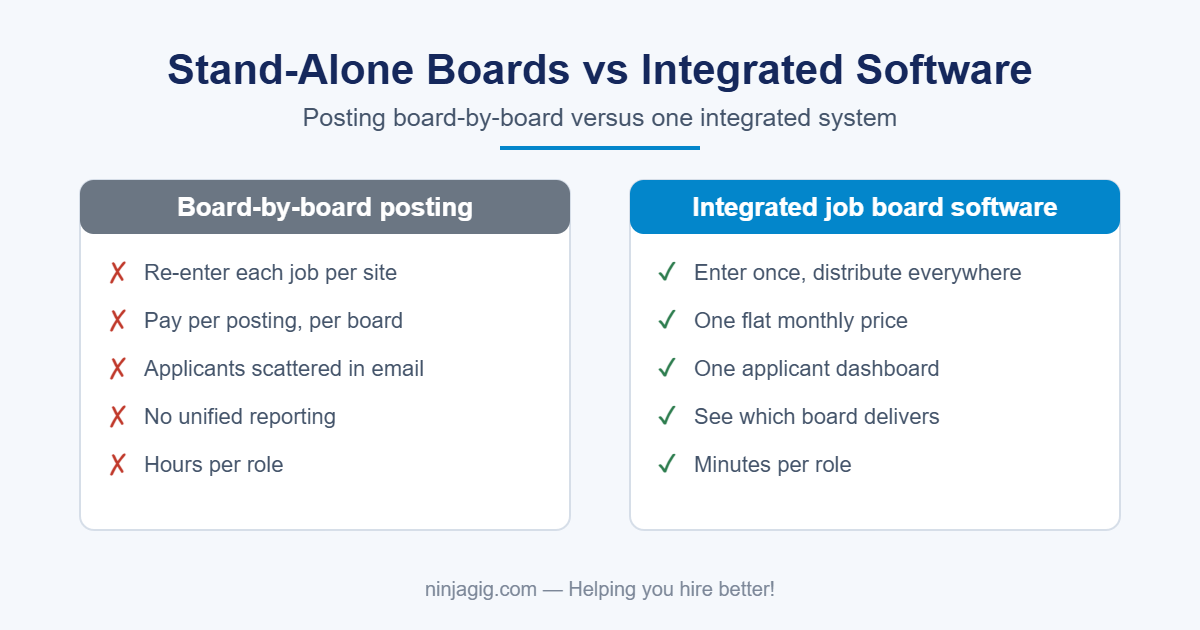
The recruiting technology landscape splits into two camps: standalone job boards and integrated ATS platforms. Standalone job boards are marketplaces where employers list openings: think Indeed, Monster, or niche industry boards. You post directly to each site, manage separate candidate pools, and manually transfer applicants to your hiring workflow.
Integrated ATS platforms flip this model. They centralize posting across multiple boards while managing the entire hiring workflow. Modern ATS solutions post jobs directly to popular boards through API connections, eliminating manual reposting. For example, Zoho Recruit’s free tier includes one active posting with upgrade options for premium board access.
Industry guidance strongly favors integration. Research shows companies using integrated ATS-job board systems hire faster than those using separate tools. The reason is simple: when posting, tracking, and hiring happen in one system, nothing falls through the cracks.
Use cases still exist for standalone boards: niche communities, local job fairs, or industry-specific talent pools. But for most hiring needs, an ATS with built-in board distribution delivers better results. Every modern ATS should integrate seamlessly into a complete recruiting machine, linking boards, screening, and onboarding.
The 10 Best Job Board Software Platforms
Manatal
Manatal dominates the high-volume recruiting space with syndication to over 2,500 job boards globally. The platform’s AI-powered recommendations help sort through massive applicant volumes by scoring candidates against job requirements. Key features include automated resume parsing, customizable pipelines, and social media enrichment that pulls additional candidate data from LinkedIn and other networks.
Ideal for companies hiring internationally or filling multiple positions simultaneously, Manatal shines with its broad reach. Pricing starts at $19 per user monthly for small teams, scaling to enterprise packages. Pros include exceptional board coverage and strong AI capabilities. The main downside: the interface can overwhelm new users, and customer support response times lag during peak hours.
NinjaGig
NinjaGig revolutionizes job posting economics with unlimited postings for a flat $49.95 monthly fee. The platform automatically syndicates to Indeed, Monster, ZipRecruiter, and Glassdoor: no manual reposting needed. Every job gets a custom URL and QR code, perfect for social sharing or print materials.
This platform targets small to medium businesses tired of per-post pricing models. The value proposition is unbeatable for companies posting multiple jobs monthly. Beyond cost savings, NinjaGig provides real-time analytics showing which boards drive applications. The only limitation: fewer bells and whistles than enterprise platforms, though most SMBs find the feature set more than sufficient.
BambooHR
BambooHR integrates job postings into a comprehensive HR suite, making it ideal for companies seeking unified HR and recruiting tools. One-click posting to Indeed and Glassdoor happens directly from the job creation workflow. The mobile-optimized application process reduces abandonment rates compared to desktop-only systems.
Standout features include automated offer letters, integrated background checks, and seamless transition from candidate to employee records. Pricing isn’t publicly listed, but it typically runs $8-10 per employee per month. While the HR features excel, pure recruiting functionality lacks the depth of dedicated ATS platforms.
Breezy HR
Breezy HR democratizes recruiting software with a generous free plan that includes LinkedIn and Indeed integration. The drag-and-drop pipeline interface makes candidate management visual and intuitive. Even free users get automated scheduling, scorecards, and basic reporting.
Paid tiers add video interviewing, advanced automation, and unlimited positions. The platform particularly suits growing startups and small businesses taking their first steps beyond spreadsheet recruiting. Pricing ranges from free to $29 per user, per month. The main limitation: power users may outgrow the feature set as recruiting complexity increases.
Zoho Recruit
Zoho Recruit offers the market’s most generous free tier: one active job posting forever with full ATS features. The AI-powered candidate screening saves hours by automatically ranking applicants based on matching requirements. Premium tiers unlock posting to Monster, LinkedIn, and other paid boards.
The pay-as-you-grow model particularly suits seasonal businesses or companies with fluctuating hiring needs. Integration with Zoho’s broader suite enables sophisticated workflow automation. Pricing starts at free, then scales to $25 per user per month for premium features. The downside: the interface feels dated compared to modern competitors.
Niceboard
Niceboard serves a unique niche: companies wanting their own white-label job board. Launch takes minutes with zero coding required. The platform handles payment processing, SEO optimization, and applicant management while maintaining your complete branding.
This solution fits industry associations, franchise networks, or companies building talent communities. Revenue-sharing options let you monetize external job postings. Pricing starts at $49 monthly for basic boards. The focused feature set means this supplements rather than replaces traditional ATS needs.
Workable
Workable balances sophistication with usability for mid-market companies. The sourcing tools excel with Boolean search capabilities and a Chrome extension for grabbing profiles from any website. One-click posting reaches 200+ boards, including local and niche sites.
Built-in templates for everything from job descriptions to offer letters accelerate hiring. Video interviewing and assessment tools integrate natively. Pricing begins at $149 per job per month, making it pricier than competitors but justified by its feature depth. The learning curve is steeper than simpler alternatives.
Greenhouse
Greenhouse sets the standard for enterprise recruiting with unmatched analytics and reporting. The diversity and inclusion module tracks demographic data throughout hiring to reduce bias. The marketplace ecosystem adds hundreds of pre-built integrations.
Structured interviewing tools and detailed scorecards improve hiring consistency. Advanced users leverage the API for custom integrations. Pricing requires direct consultation, but expect $6,000+ annually for small teams. This platform rewards companies committed to recruiting excellence, but it may overwhelm casual users.
Lever
Lever uniquely combines ATS and CRM functionality, enabling proactive candidate relationship management. Nurture campaigns keep passive candidates engaged in the long term. The collaborative interface shows all team interactions with candidates in a unified timeline.
Visual analytics dashboards provide instant insights without running reports. Chrome extension enables one-click candidate capture from any webpage. Enterprise pricing typically starts around $6,000 annually. The combined ATS-CRM approach requires process changes but delivers superior candidate engagement.
JazzHR
JazzHR makes enterprise features accessible to small businesses through aggressive pricing and customizable workflows. The platform includes unlimited users, even on its basic plans, a rarity in the industry. Job syndication reaches major boards with optional add-on packages for premium posting.
Text recruiting and automated scheduling reduce time-to-hire. Custom career pages maintain employer branding. Plans start at $49 monthly, scaling with features rather than users. While lacking the sophistication of pricier competitors, JazzHR delivers exceptional value for budget-conscious teams.
Pricing & Feature Comparison Snapshot
Job board software pricing models vary dramatically. Free tiers from Breezy HR and Zoho Recruit let you test the waters with basic features. Per-user pricing ($19-50 monthly) dominates mid-market solutions like Manatal and BambooHR. Per-job pricing ($149+ per posting) is available on sophisticated platforms like Workable. Flat-fee unlimited models like NinjaGig’s $49.95 monthly plan disrupt traditional pricing.
When calculating the total cost of ownership, factor in hidden expenses. Premium job board access often costs extra: Indeed Sponsored Jobs, LinkedIn Premium postings, and niche board fees add up quickly. Integration costs surprise many buyers; connecting existing HR systems may require professional services. Training and onboarding investment varies by platform complexity.
Consider scalability in your calculations. A solution perfect for 10 hires annually may break down at 100. Conversely, enterprise platforms include features you’ll never use when hiring occasionally. Match the pricing model to your hiring velocity and growth projections for optimal value.
What NinjaGig Customers Say
What employers using NinjaGig’s job board distribution say — more on our reviews page:
“Great service and very responsive support team. We were up and running in no time. Highly recommend it to any HR department.”
— Brian, Tech Lane
“NinjaGig simplified our entire hiring process. I can’t imagine going back to paper forms or email submissions. It’s a total game changer.”
— Jenna, Urban Core
Implementation Checklist & Best Practices
A successful job board software rollout requires preparation. Start with stakeholder alignment: get buy-in from hiring managers, recruiters, and IT before selecting a platform. Document your current process to identify specific pain points the new system must address.
Gather branding assets early: logos, color codes, brand guidelines, and career site copy. Create job template libraries with pre-approved descriptions, requirements, and benefit statements. This preparation prevents delays when you’re ready to post.
Set up tracking from day one. Define KPIs for time-to-hire, cost-per-hire, and source quality. Configure analytics dashboards before posting jobs: retroactive tracking rarely works well. Train all users on proper source attribution to ensure data accuracy.
Phase your rollout. Start with a single department or location to identify issues before organization-wide deployment. Document common questions and create internal FAQs. Celebrate early wins to build momentum and user adoption.
Future Trends in Job Board Technology
AI recruiting moves beyond buzzword status. Expect intelligent job matching that considers skills, culture fit, and growth potential, not just keyword matches. Chatbots will handle initial screening conversations, ask relevant questions, and schedule qualified candidates for human interviews. This isn’t replacing recruiters; it’s eliminating their mundane tasks.
Programmatic job advertising brings performance marketing principles to the recruiting process. Instead of flat-rate postings, smart platforms automatically adjust bid prices and placement based on application flow. Your budget shifts in real time to sources that deliver quality candidates. Early adopters report significant improvements in cost-per-quality-hire.
Skills-based hiring gains momentum as degree requirements prove poor predictors of performance. Future job board software will assess capabilities through integrated testing and portfolio reviews, not just resume keywords. DEI analytics have evolved from basic demographic tracking to sophisticated bias detection across job descriptions, screening processes, and interview feedback. These aren’t just compliance features; they’re competitive advantages for attracting diverse talent.
Conclusion & Key Takeaways
Choosing the right job board software comes down to matching the platform’s capabilities to your specific hiring needs. High-volume recruiters need broad distribution and AI screening. Small businesses benefit most from unlimited posting models and simple interfaces. Growing companies require scalable solutions that won’t break when hiring accelerates.
Remember the evaluation framework: reach (how many quality boards), automation (one-click posting and workflow efficiency), customization (branding and candidate experience), and analytics (source tracking and ROI measurement). The best platform for your organization balances these factors with your budget and technical requirements.
Your next step: shortlist 3-4 platforms that match your criteria and request demos. Test with real job postings during trials. Talk to current users about their experience beyond the honeymoon period. The right choice will transform your hiring from a bottleneck to a competitive advantage.
Ready to Transform Your Hiring Process?
Stop wasting time on manual job posting and start reaching 10× more qualified candidates. Book a free 30-minute strategy session with our hiring technology experts. We’ll audit your current recruitment process, identify bottlenecks, and recommend platforms that deliver immediate ROI.
During your personalized session, we’ll show you exactly which job board software matches your hiring volume, budget, and growth plans. No sales pressure, just expert guidance to help you make an informed decision. Schedule Your Free Strategy Session Now →
Shortcut: NinjaGig is job board software built for small businesses — unlimited postings distributed to the major boards, applicants in one dashboard, flat monthly price. See all features.
Related reading: Best customizable job board software (for branded, white-label boards) · The best job boards guide · Multi job board posting
Free Download: The Job Board Software Buyer’s Kit
Evaluating platforms? Download the free buyer’s kit — a scorecard for comparing vendors, 15 questions to ask on every demo, and a true-cost worksheet. No email required.