
A hiring management system transforms your recruitment from scattered chaos into strategic efficiency. Think of it as your recruitment command center. It’s a single platform that replaces the mess of spreadsheets, email threads, and sticky notes with a single intelligent hub that covers everything from workforce planning to candidate onboarding.
Unlike basic recruitment software that handles just applications, a comprehensive hiring management system orchestrates your entire talent acquisition workflow. It’s the difference between having a filing cabinet and having a strategic partner that actively helps you build better teams faster.
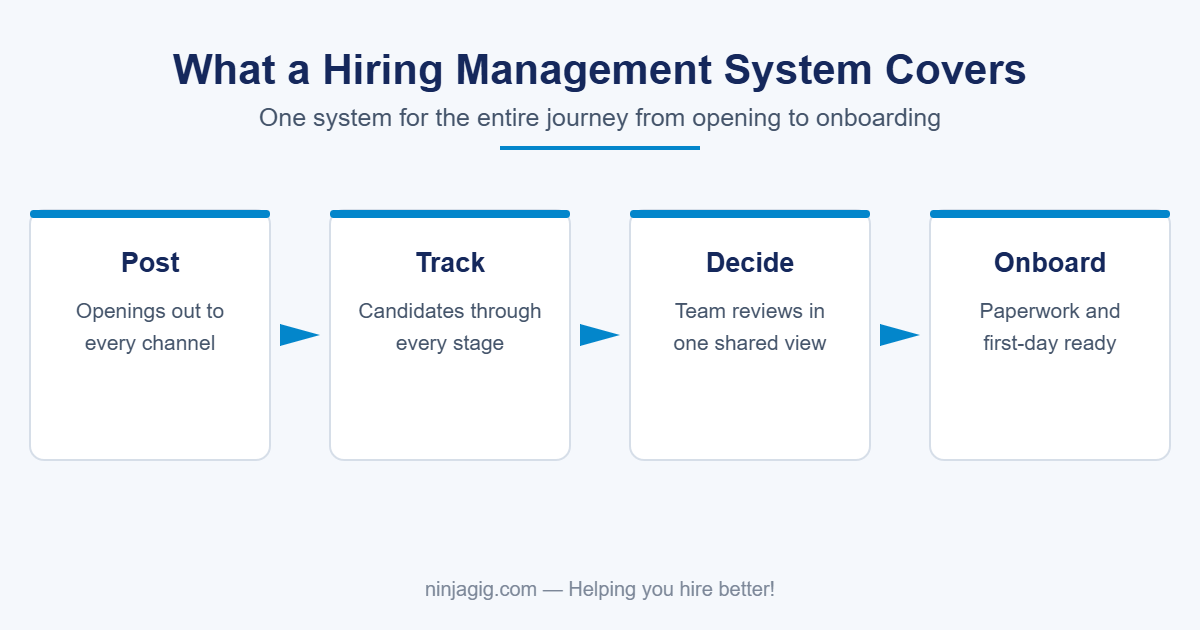
The core promise? A centralized hiring platform that doesn’t just store candidate data but actively drives your digital recruitment process forward. Modern systems connect job distribution, candidate screening, interview coordination, analytics, and compliance into one seamless experience. For human resource (HR) leaders drowning in manual processes, this isn’t just convenience but rather it’s competitive survival.
The reality is stark: companies using comprehensive hiring management systems report up to 60% reduction in time-to-hire and 94% improvement in overall hiring efficiency. Meanwhile, those clinging to fragmented tools lose top candidates to faster competitors and waste thousands on inefficient processes.
This guide breaks down exactly what a hiring management system delivers, how it differs from basic applicant tracking, and most importantly, how to choose and implement the right solution for your organization. Whether you’re scaling a startup or modernizing enterprise recruitment, you’ll learn the practical steps to transform hiring from your biggest headache into your strongest competitive advantage.
Hiring Management System vs. Applicant Tracking System (ATS)
Understanding the distinction between a hiring management system vs an applicant tracking system (ATS) is critical for making the right technology investment. While these terms often get used interchangeably, they represent fundamentally different approaches to recruitment technology.
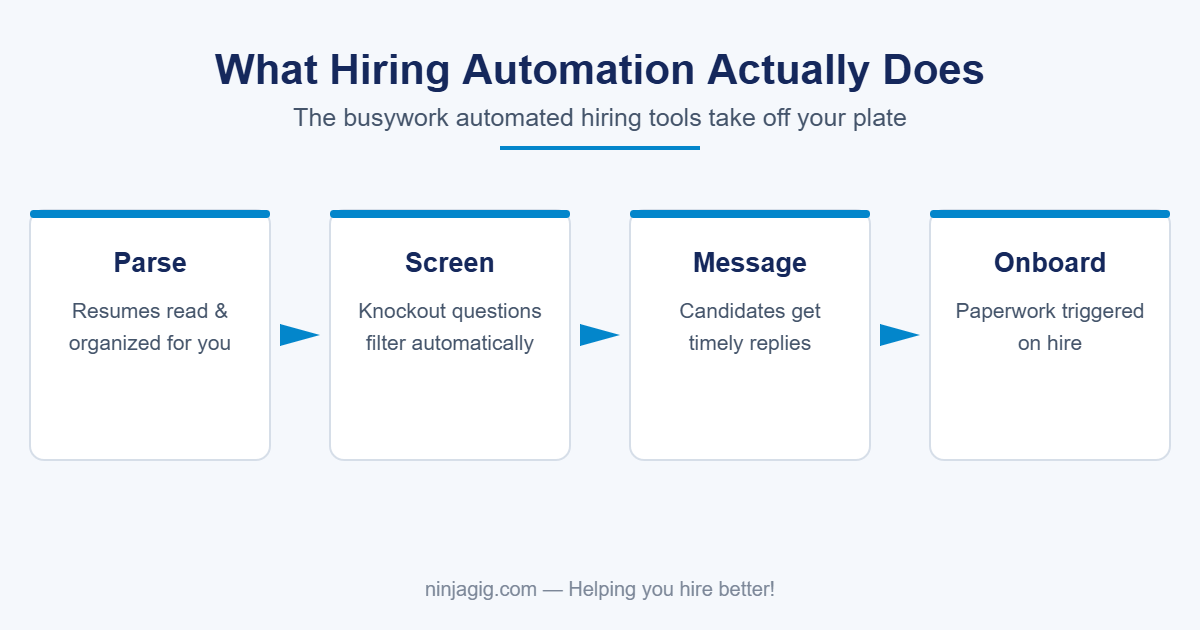
An applicant tracking system focuses specifically on the mechanics of recruiting: posting jobs, collecting applications, and moving candidates through your interview pipeline. Think of it as a sophisticated filing system that automates the flow of resumes from inbox to offer letter. Modern ATS features include resume parsing, job board distribution, and candidate status tracking, essentially digitizing what used to happen with paper applications and filing cabinets.
A hiring management system, by contrast, is end-to-end recruitment software that spans your entire talent acquisition strategy. While it includes all the core ATS functionality, it also adds strategic capabilities such as workforce planning, talent pooling, and advanced analytics, and often extends to onboarding and integration with human resource information systems (HRIS). It’s a full-cycle hiring tool that treats recruitment as an ongoing business process rather than just a series of job openings.
The overlap is substantial. Both systems will:
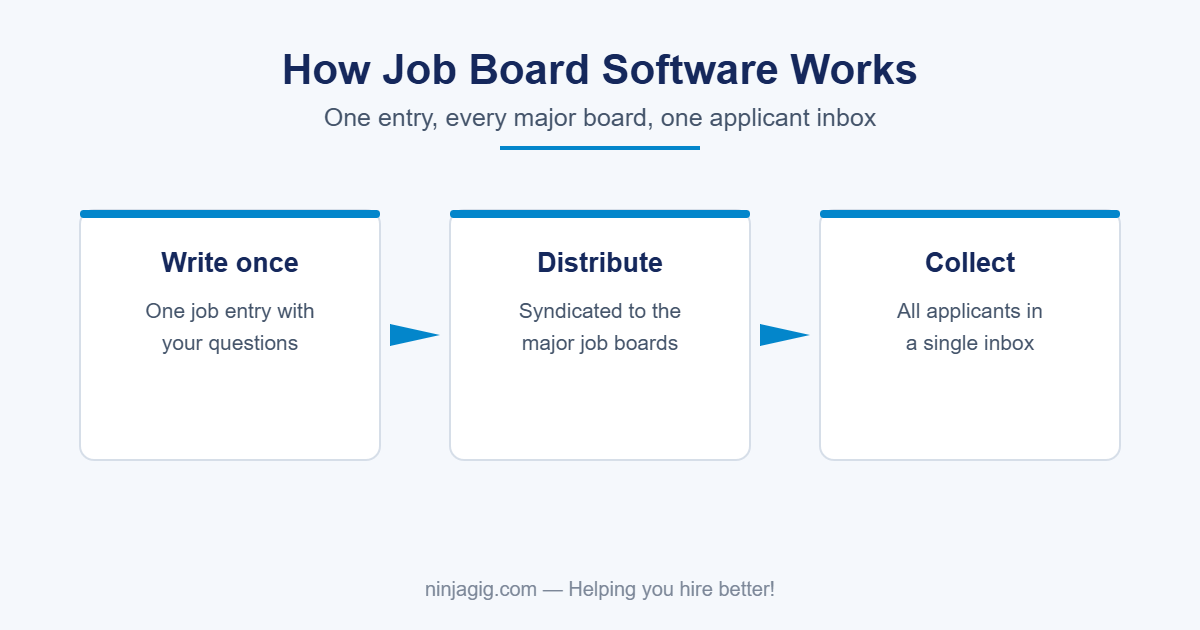
- Automate job postings to multiple boards simultaneously
- Centralize candidate data in searchable databases
- Track applicant status through customizable pipelines
- Facilitate team collaboration with shared notes and tasks
- Ensure compliance with built-in audit trails and reporting
Where ATS platforms truly excel is in streamlining the inbound hiring funnel. Consider that 97.8% of Fortune 500 companies rely on an ATS. A quality ATS can blast your job to 12+ boards instantly, parse hundreds of resumes automatically, and maintain perfect compliance records. For high-volume recruiting or companies focused primarily on efficiently filling open positions, an ATS delivers immediate value.
The applicant tracking system comparison becomes clearer when you examine specific use cases. An ATS shines when you need to:
- Process large volumes of applications quickly
- Maintain consistent communication with all candidates
- Generate EEO and compliance reports automatically
- Coordinate interviews across multiple team members
- Track source-of-hire and time-to-fill metrics
However, a full hiring management system becomes essential when your needs extend beyond filling individual positions. You need the broader platform when you’re building talent pipelines for future needs, conducting workforce planning, managing contingent workers alongside permanent hires, or integrating recruitment data with broader HR analytics.
Take NinjaGig, for example, of how modern platforms blur these lines. While technically an ATS, it includes management-level features such as real-time dashboards, team collaboration tools for up to 10 users, and strategic analytics, making it a complete hiring management system for SMBs. You get the core ATS benefits of automated job distribution, resume parsing, pipeline tracking, plus the visibility and control tools typically found in enterprise platforms.
The key insight? Don’t get hung up on labels. Focus on whether the platform delivers the capabilities you need. For many organizations, a robust ATS with strong management features (like NinjaGig) provides the perfect balance of functionality and simplicity. For others, only a comprehensive hiring management system will suffice. The right choice depends on your hiring volume, team structure, integration needs, and strategic ambitions.
Why Companies Need a Hiring Management System Today
The recruitment challenges facing modern organizations have reached a critical point. With 88% of employers worried about losing great candidates due to clunky systems, and the average job posting generating 250+ applications, manual processes simply cannot keep pace. A hiring management system isn’t a luxury anymore. It’s essential infrastructure for competitive talent acquisition.
The pressure to reduce time-to-hire has never been more intense. Top candidates remain on the market for just 10 days, while traditional hiring processes average 23 days or more. Every day of delay means your best prospects accept offers elsewhere. Companies using modern hiring management systems report cutting time-to-hire by up to 60%, transforming recruitment from a bottleneck into a competitive advantage.
Candidate experience has become a decisive factor in winning talent. Today’s job seekers expect the same seamless digital experience they get from consumer apps. They abandon applications that take more than 20 minutes, ghost employers who don’t respond promptly, and share negative experiences widely on social media. A hiring management system ensures consistent communication, mobile-friendly applications, and transparent process updates that keep candidates engaged.
Your talent acquisition strategy must evolve beyond posting and praying. Modern recruitment requires proactive pipeline building, data-driven decision making, and cross-functional collaboration. Without centralized systems, recruiters waste 14 hours per week on administrative tasks rather than on strategic activities such as relationship building and employer branding.
A comprehensive platform liberates your team to focus on what humans do best of evaluating fit, selling the opportunity, and building relationships.
Perhaps most critically, you need a scalable hiring process that grows with your organization. The spreadsheet system that worked for 10 hires breaks at 100. The email-based coordination that sufficed for one location fails across multiple sites. A hiring management system provides the infrastructure to scale efficiently, whether you’re doubling headcount, expanding globally, or managing seasonal hiring surges. It ensures consistent quality and compliance regardless of volume, protecting both candidate experience and your employer brand.
Core Features of Modern Hiring Management Systems
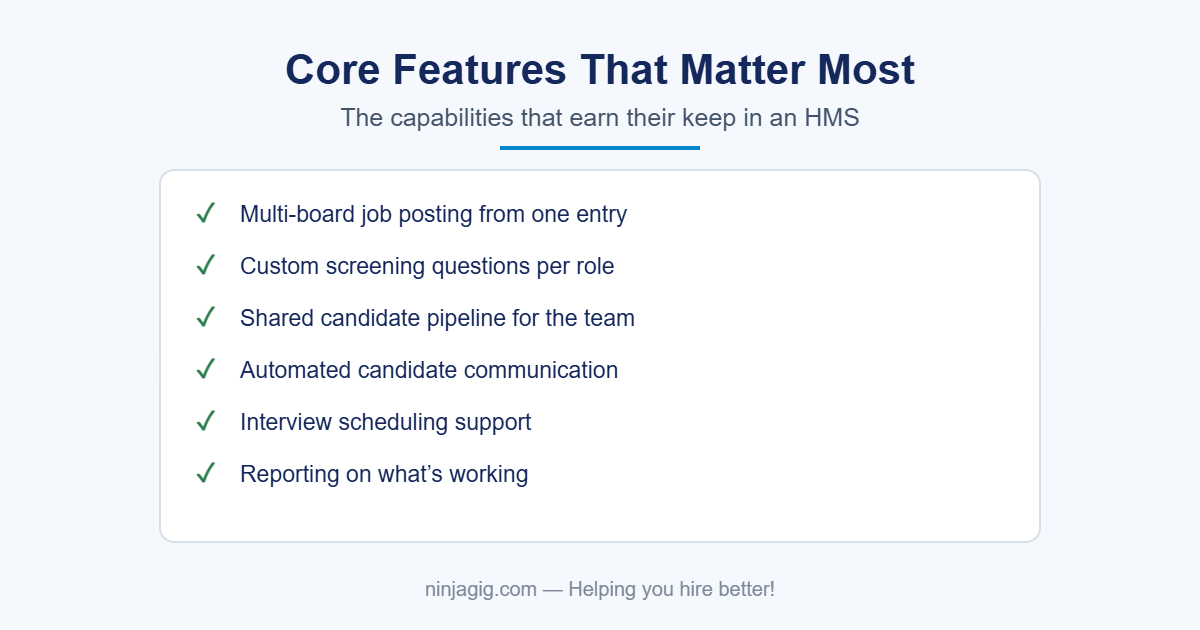
The power of a modern hiring management system lies in its integrated feature set. These are essential capabilities that transform how organizations attract, evaluate, and hire talent. Understanding these core features helps you evaluate platforms and build your requirements checklist.
Job Distribution & Employer Branding
Job board integrations form the foundation of effective talent sourcing. Leading platforms connect with 100+ job boards, from giants like Indeed and LinkedIn to niche industry sites. With one click, your opening appears everywhere your ideal candidates search. But modern systems go beyond simple posting, optimizing listings for each platform’s algorithm, tracking performance by source, and automatically refreshing postings to maintain visibility.
Employer branding tools ensure consistent messaging across all touchpoints. Customizable career sites showcase your culture through employee testimonials, videos, and targeted content for different candidate segments. Smart systems even personalize the candidate journey based on source, location, or job type, delivering relevant content that converts visitors into applicants.
Automated Resume Screening & Ranking
Resume parsing technology has evolved from simple keyword matching to intelligent document analysis. Modern parsers extract not just contact information and work history, but also understand context, identify skills from project descriptions, and even infer career progression patterns. This structured data powers advanced filtering and ranking algorithms.
Automated screening goes beyond keywords to holistically evaluate candidate fit. Knockout questions eliminate unqualified applicants immediately, while scoring algorithms rank remaining candidates based on weighted criteria. Some systems now incorporate AI that learns from your hiring decisions, continuously improving its recommendations. This automation handles the bulk of initial screening, so recruiters focus only on genuinely qualified candidates.
Interview Scheduling & Team Collaboration
Collaborative hiring features transform recruitment from a solo act into a team sport. Modern platforms provide shared workspaces where hiring managers, recruiters, and interviewers access candidate profiles, leave structured feedback, and track evaluation progress. Role-based permissions ensure data security while enabling transparency.
Interview scheduling automation eliminates the back-and-forth email nightmare. Candidates self-schedule through links that sync with team calendars, automatic reminders reduce no-shows, and rescheduling happens without recruiter intervention. Video interview integrations support remote hiring, while evaluation forms standardize feedback collection immediately after the interview.
Candidate pipeline management visualizes your entire hiring funnel. Kanban-style boards show candidate flow through stages, bottleneck alerts highlight process delays, and bulk actions let you message or move multiple candidates simultaneously. This visual approach ensures nothing falls through the cracks while providing instant status updates to stakeholders.
Analytics, Reporting & Compliance
The recruitment analytics dashboard transforms gut feelings into data-driven decisions. Real-time metrics track everything from source effectiveness to recruiter productivity. Time-to-hire breakdowns identify process bottlenecks, quality-of-hire metrics validate your selection criteria, and predictive analytics forecast future hiring needs based on historical patterns.
GDPR & EEO compliance features protect your organization from costly violations. Built-in consent management handles candidate data permissions, automated retention policies delete information per regulations, and audit trails document every action for legal protection. Equal Employment Opportunity (EEO) reporting tools automatically generate required government reports, track applicant flow data, and ensure fair hiring practices. For global organizations, multi-jurisdictional compliance features automatically adapt to local regulations.
Custom reporting capabilities let you slice data infinitely, by department, location, job type, or any combination. Scheduled reports keep executives informed without manual effort, while API access enables integration with broader business intelligence platforms. This transparency transforms recruitment from a black box into a measurable business process.
Advanced Capabilities: AI, Automation & Integrations
The latest generation of hiring management systems leverages cutting-edge technology to deliver capabilities that were once considered impossible. These are practical tools delivering measurable results today.
AI recruiting tools have evolved from buzzword to business essential. Machine learning algorithms now power smart candidate matching that goes beyond keyword searches to understand context, potential, and cultural fit. These systems analyze successful hires in your organization to identify patterns, then score new candidates based on the likelihood of success. Natural language processing reads between the lines of resumes and cover letters, surfacing qualified candidates who might use different terminology than your job posting.
Automation in hiring spans the entire recruitment lifecycle. Chatbots handle initial candidate questions 24/7, qualifying leads while you sleep. Automated reference checking sends questionnaires and collates responses without manual follow-up. Background check integrations trigger verifications automatically upon offer acceptance. Even offer letter generation and e-signature collection happen without leaving the platform. This automation eliminates repetitive tasks, allowing recruiters to focus on relationship building and strategic evaluation.
HRIS integration creates seamless data flow from candidate to employee. When you make a hire, their information is automatically transferred to your HR system. This integration extends bidirectionally: succession planning tools pull internal candidate data for promotion opportunities, while org chart changes trigger automated requisitions for backfill positions.
API connectivity opens unlimited possibilities for custom workflows. Forward-thinking organizations connect their hiring systems to Slack for real-time notifications, Tableau for advanced analytics, or even custom internal tools. Webhook capabilities enable real-time actions, automatically creating IT tickets when offers are accepted or triggering welcome packages from your facilities team. This extensibility transforms your hiring management system from a standalone tool into the connected hub of your talent operations.
The practical impact? Companies using AI-powered screening reporta 75% reduction in time spent reviewing resumes. Automation reduces the coordinator’s workload by 40%, while integrations eliminate 3-5 hours of data entry per hire. These are transformative efficiencies that let lean teams compete with enterprise recruiting departments.
ROI & Measurable Benefits of a Hiring Management System
The financial case for a hiring management system extends far beyond simple efficiency gains. When you examine the full impact on hiring ROI, the numbers become compelling for even the most skeptical CFO.
Cost-per-hire reduction starts with obvious savings. Automated job distribution eliminates posting fees across multiple boards, saving $300-$500 per opening. Reduced agency reliance (many companies cut agency spend by 50% or more) saves thousands per hire. But the real savings come from productivity gains. When recruiters handle 40% more requisitions with the same headcount, you avoid hiring additional staff. When hiring managers spend 60% less time on recruitment tasks, they have more time for revenue-generating activities.
Time-to-fill improvement metrics tell an equally powerful story. Companies report average reductions from 42 days to 17 days after implementing modern hiring systems. For a $ 75,000-per-year position, each day of vacancy costs roughly $300 in lost productivity. Cutting 25 days from your hiring cycle saves $7,500 in productivity alone, before considering the competitive advantage of landing top talent faster.
Quality-of-hire metrics reveal the greatest value. Organizations using data-driven selection tools report a 25% improvement in new-hire performance ratings and a 50% reduction in first-year turnover. Consider the full cost of a bad hire: recruiting expenses, training investment, lost productivity, team disruption, and replacement costs often total 150% of annual salary. Preventing just one poor hire per year justifies the entire system investment.
Hiring efficiency statistics paint a clear picture of transformation. Users report 70% less time spent on administrative tasks, 90% faster candidate response times, and 85% improvement in hiring manager satisfaction. These improvements represent fundamental changes in how recruitment operates. When every recruiter becomes 2-3x more productive, you don’t just save money, you gain the capacity to be more selective, more strategic, and more successful in attracting top talent.
The bottom line? Most organizations see full ROI within 4-6 months, with ongoing savings of $5,000-10,000 per hire. For a company making 100 hires annually, that’s $500,000 to $1 million in direct savings, plus immeasurable gains from better hires, faster scaling, and improved employer brand.
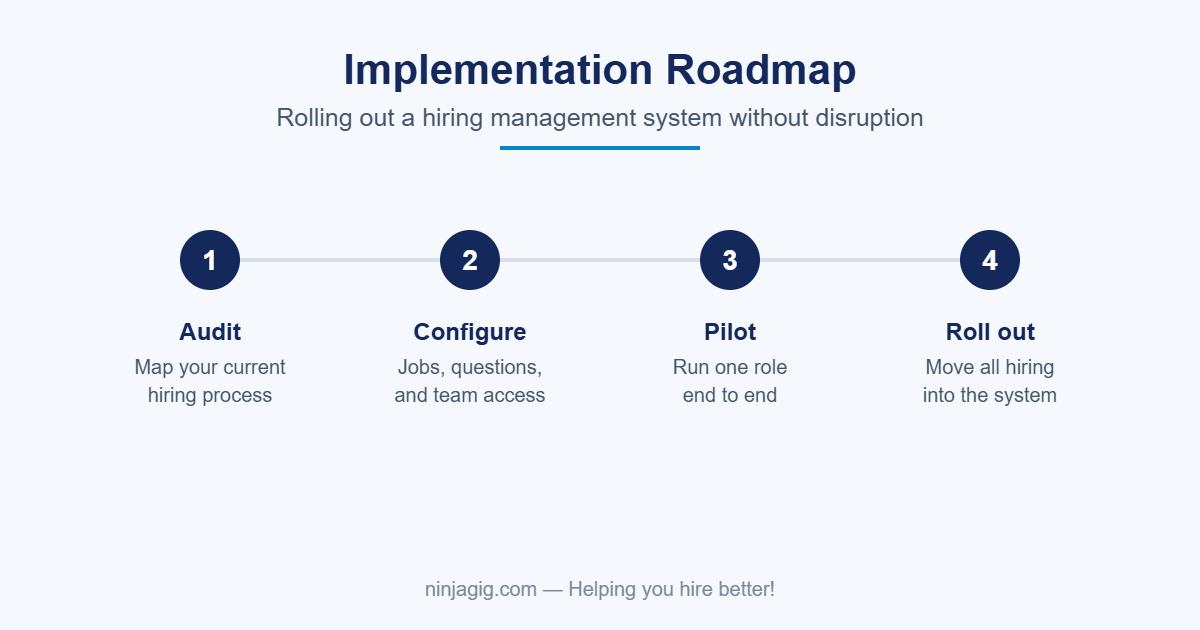
Implementation Roadmap & Change Management
Successful HMS implementation requires more than just technical deployment. It demands thoughtful change management and strategic rollout. The difference between implementations that transform recruitment and those that gather digital dust lies in the approach.
Start with stakeholder alignment and clear success metrics. Define what “good” looks like: 50% reduction in time-to-hire? 30% less recruiter overtime? Higher hiring manager satisfaction scores? Set baseline measurements before implementation to demonstrate progress. Build your implementation team early, including recruitment ops, IT, HR leadership, and critically, power users from the recruiting team who’ll champion adoption.
Data migration deserves special attention. Clean your existing data before migration to increase the likelihood of standardizing job titles, updating candidate records, and archiving obsolete information. Plan for migrating only active candidates and recent historical data initially. You can always import archives later, but starting clean accelerates adoption. Work with your vendor to map fields correctly and test the migration with a subset before the full transfer.
Change management in HR succeeds through involvement, not mandate. Run pilot programs with eager early adopters who’ll provide feedback and success stories. Their enthusiasm proves more convincing than any executive mandate. Address resistance directly. Recruiters often fear that technology will replace them, when in fact it liberates them to take on higher-value work. Show specifically how the system saves time on their most hated tasks.
Your user adoption strategy should emphasize quick wins. Start with basic features that deliver immediate value, automated job posting, simple pipeline tracking, and basic reporting. Master these before rolling out advanced capabilities. Create role-specific training paths: recruiters need different features than hiring managers, who need different features than executives. Short, focused sessions beat day-long training marathons.
Training and onboarding HR tech requires ongoing investment, not one-time events. Schedule weekly “power hours” where users share tips and tricks. Create internal documentation with your specific workflows and policies. Designate super-users in each team who become go-to resources. Most importantly, celebrate successes publicly. When someone cuts their time-to-hire in half, make sure everyone knows how they did it.
Timeline expectations matter.
- Week 1-2: Technical setup and data migration.
- Week 3-4: Core team training and pilot launch.
- Month 2: Gradual rollout to all users.
- Month 3: Advanced feature adoption.
- Month 4-6: Optimization and full adoption.
Plan for this staged approach rather than expecting an overnight transformation.
How to Evaluate & Select the Right Hiring Management System
Choosing your hiring management system ranks among the most impactful decisions you’ll make for recruitment operations. The right platform transforms your hiring capability; the wrong one becomes expensive shelfware. This hiring software checklist guides you through a systematic evaluation.
Start your vendor comparison with brutal honesty about needs versus wants. Must-haves might include: ATS functionality for your hiring volume, integration with existing HRIS, compliance features for your industry, and mobile accessibility. Nice-to-haves could include: AI screening, video interviewing, or advanced analytics. Score each requirement by importance and disqualify vendors missing critical features early.
Demo evaluation criteria separate good sales pitches from genuine solutions. During demos, insist on seeing your actual workflows, not generic examples. Bring real scenarios: “Show me how we’d manage our campus recruiting pipeline” or “Walk through our multi-location approval process.” Test user experience yourself. If the demo requires extensive explanation, imagine training dozens of users. Pay special attention to mobile experience, as managers increasingly review candidates on phones.
Create your vendor scorecard with weighted categories:
- Functionality fit (30%): Does it solve your specific problems?
- User experience (25%): Will your team actually use it?
- Integration capability (20%): Does it play nice with your tech stack?
- Vendor stability (15%): Will they exist in 3 years?
- Support quality (10%): Can you get help when needed?
Total cost of ownership extends beyond license fees. Calculate implementation costs, training time, integration expenses, and ongoing support. Factor in efficiency gains: if the system saves each recruiter 10 hours per week, that’s worth $25,000+ annually per recruiter. Compare this full ROI picture, not just sticker prices.
Reference checks reveal truth beyond marketing claims. Ask current customers about implementation challenges, actual vs. promised functionality, and support responsiveness. Specific questions get better answers: “How long did integration with your HRIS actually take?” beats “Are you happy?” Look for references similar to your organization; a platform perfect for an enterprise might overwhelm SMBs.
This buying guide process typically takes 60-90 days.
- Week 1-2: Define requirements and create vendor long list.
- Week 3-4: Initial demos and shortlisting to 3-5 vendors.
- Week 5-6: Deep-dive demos with stakeholders.
- Week 7-8: Technical evaluation and integration testing.
- Week 9-10: Reference checks and negotiation.
- Week 11-12: Final decision and contracting.
Rushing this process invariably leads to buyer’s remorse.
What NinjaGig Customers Say
How real teams describe running their hiring through NinjaGig — more on our reviews page:
“NinjaGig has been the perfect answer to our needs. It is very easy to set up and customize. We run a summer school program so we appreciate being able to ‘turn it off’ when our hiring is complete. Customer service has been outstanding.”
— Sue, Flintridge
“We love how easy it is to use NinjaGig. It’s budget-friendly and works exactly as expected every single time.”
— Elena, Maple HR
Frequently Asked Questions
These hiring system FAQs address the most common concerns from HR leaders evaluating recruitment technology:
What’s the difference between an ATS and a hiring management system?
An ATS focuses on tracking applicants through your hiring funnel, posting jobs, collecting resumes, and managing candidate flow. A hiring management system includes all ATS functionality, plus strategic features such as workforce planning and advanced analytics, and often extends into onboarding. Many modern platforms blur these lines, offering ATS core functionality with management-level features.
How long does implementation typically take?
Basic implementation takes 2-4 weeks for most SMBs, including data migration and initial training. Full adoption across all features typically requires 3-4 months. Enterprise implementations with complex integrations may take 6+ months. The key is to start simple and add capabilities gradually rather than trying to do everything at once.
Will our team actually adopt new recruitment technology?
These common ATS adoption questions have clear answers: Success depends on choosing user-friendly platforms and investing in effective change management. Systems with intuitive interfaces see 90%+ adoption rates. Keys include involving users in the selection process, providing role-specific training, celebrating early wins, and choosing platforms that save time on painful tasks.
What about data security and compliance?
Recruitment compliance FAQs reveal this as a top concern. Leading platforms include SOC 2 certification, GDPR compliance tools, and automated EEO reporting. Look for features like role-based permissions, audit trails, encrypted data storage, and automated retention policies. Quality vendors provide compliance documentation and regularly update security.
How do we calculate ROI for a hiring management system?
Calculate hard savings: reduced job board costs, lower agency fees, and avoided recruiter headcount. Add productivity gains: hours saved per hire multiplied by hourly costs. Include quality improvements: reduced turnover and bad hire costs. Most organizations see a 6-12 month payback with ongoing savings of $5,000-10,000 per hire.
Can we integrate with our existing HR systems?
Modern platforms offer pre-built integrations with major HRIS systems, as well as API access for custom connections. Verify specific integration capabilities during demos. Clean data migration typically requires 1-2 weeks of planning but saves months of duplicate entry later.
Actionable Checklist: Next Steps to Modernize Your Hiring
Transform your recruitment with this practical hiring checklist and recruitment action plan. These HR tech implementation steps provide a clear path forward:
Week 1: Assess Current State
- Calculate your actual time-to-hire and cost-per-hire baselines
- Survey recruiters and hiring managers about top pain points
- Document current tools and manual processes
- Identify integration requirements with existing systems
Week 2-3: Build Your Business Case
- Quantify potential savings from automation and efficiency
- Research vendor options matching your requirements
- Create evaluation criteria weighted by importance
- Secure budget approval and stakeholder buy-in
Week 4-6: Evaluate Solutions
- Schedule demos with 3-5 shortlisted vendors
- Test drive systems with real scenarios
- Check references from similar organizations
- Compare the total cost of ownership, not just license fees
Week 7-8: Make Your Decision
- Score vendors against your weighted criteria
- Negotiate contracts, including SLAs and support terms
- Plan implementation timeline with the selected vendor
- Assign the internal project team and champions
Week 9-12: Launch Successfully
- Start with a pilot group of power users
- Migrate data in phases, cleaning as you go
- Train teams in role-specific groups
- Track adoption metrics and celebrate quick wins
Remember: Perfect is the enemy of good. Start with core features that solve immediate pain points, then expand usage as teams gain comfort. The goal isn’t to use every feature; it’s to transform how you hire.
Ready to streamline recruiting, cut time-to-hire by 60%, and wow candidates? Book a free 30-minute HMS strategy session with our experts.
During your personalized consultation, we’ll analyze your current hiring challenges, demonstrate how modern hiring management systems solve them, and create a custom implementation roadmap for your organization. No generic pitches, just practical guidance tailored to your specific needs.
Download our exclusive “15-Point Hiring Management System Buyer’s Checklist”, a printable worksheet that helps you compare vendors, score features, and build a rock-solid business case. This isn’t another generic guide; it’s the exact framework our consultants use with enterprise clients, adapted for teams of all sizes.
Access the checklist (instant PDF download, email required).
Stop losing great candidates to outdated processes. Whether you choose NinjaGig or another solution, you’ll leave equipped to transform your hiring. The future of recruitment is here. Grab your competitive advantage today.
For most small businesses, the right HMS is the simple one: NinjaGig covers posting, tracking, screening, and team review at a flat monthly price — see it in action.
Related reading: What is an ATS? · Recruitment dashboards · Managing your ATS in small teams