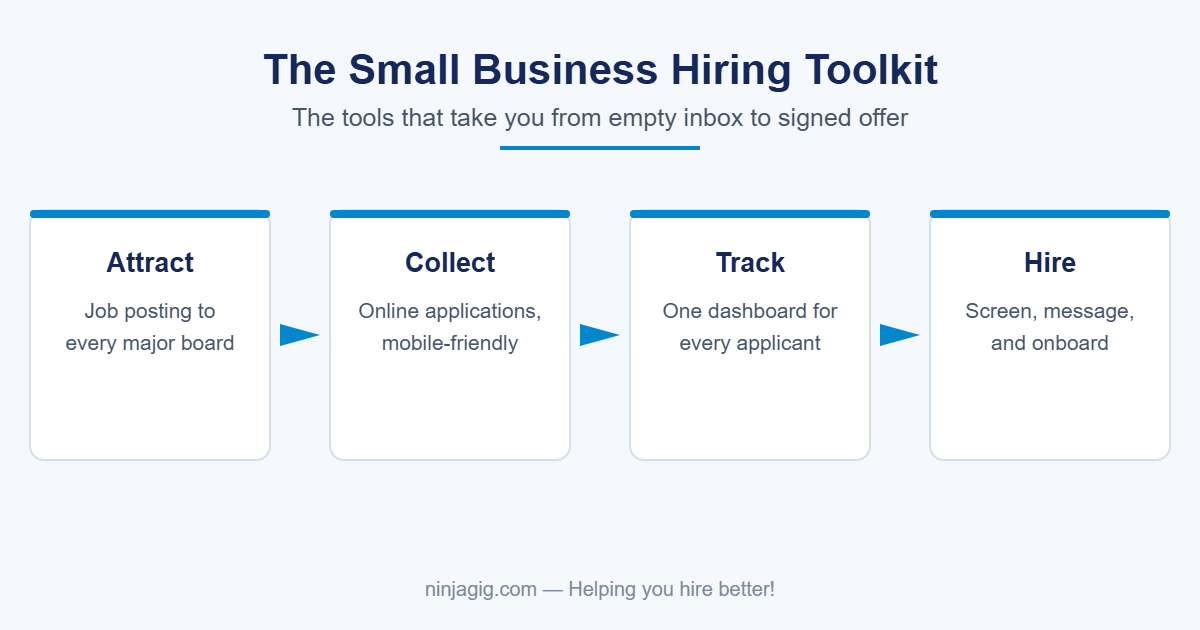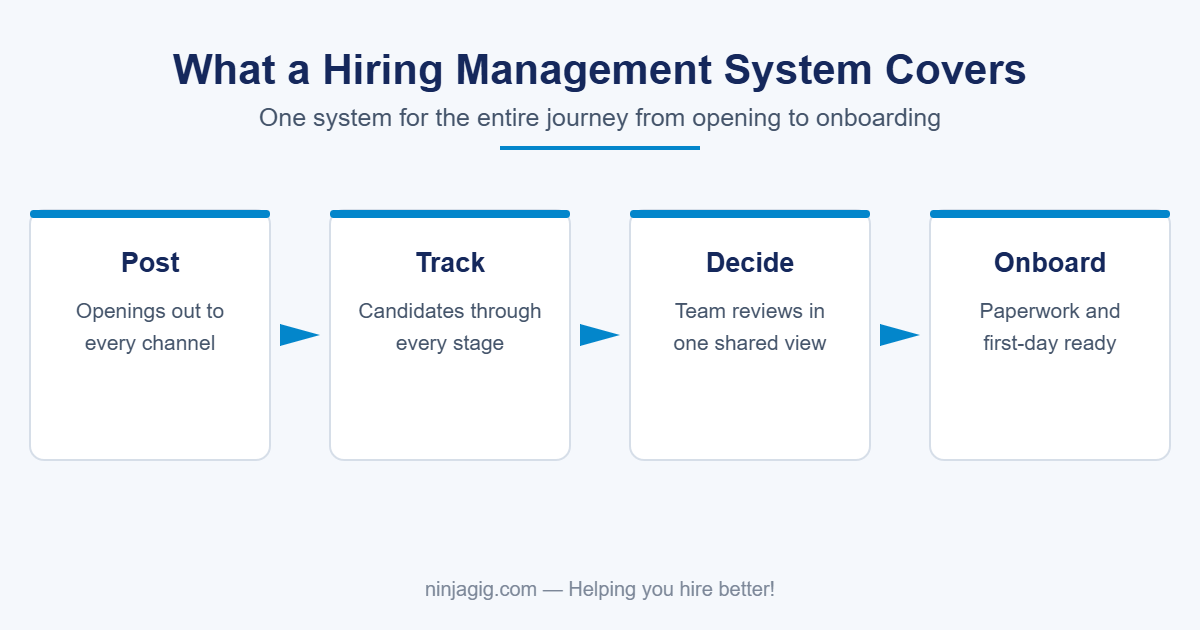

Recruiting teams are drowning in applications. The average corporate job posting attracts 250 resumes, yet only 4-6 candidates typically get interviewed. Manual screening burns hours of valuable time while top talent slips through the cracks or accepts competing offers. This is where automated hiring tools transform the game entirely.
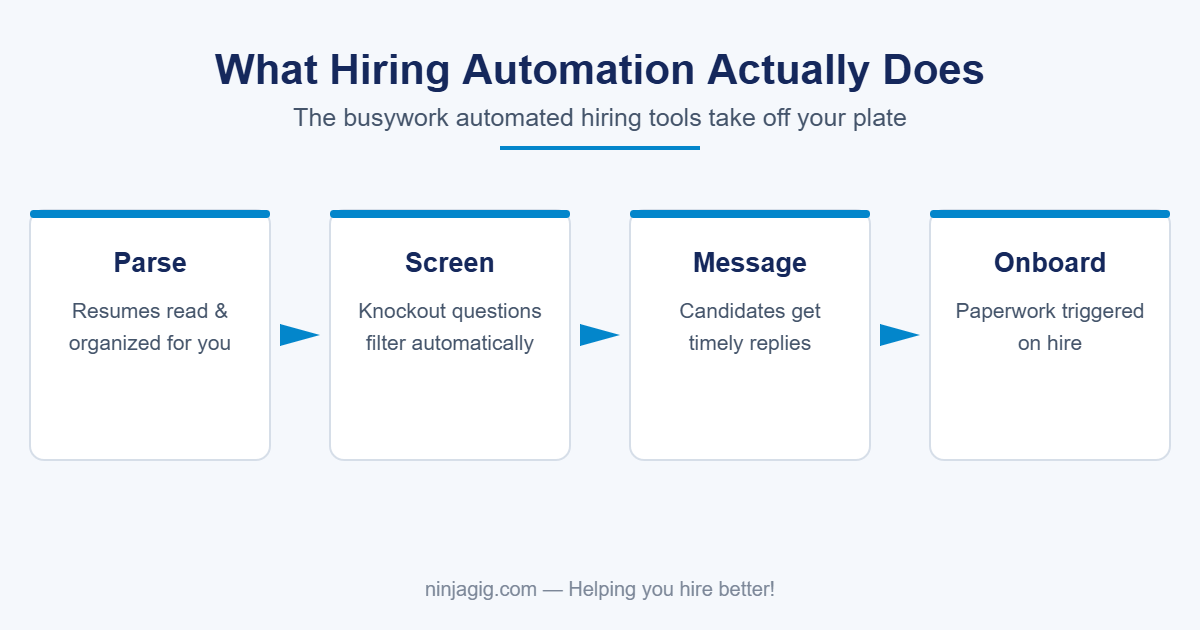
Unlike traditional applicant tracking systems that merely store resumes, modern recruiting automation actively handles repetitive tasks: parsing resumes in seconds, sending timely communications, filtering unqualified candidates, and even generating onboarding paperwork. These AI hiring software solutions deliver three critical benefits: dramatically faster hiring cycles (often a 50% reduction), lower costs, and significantly improved candidate experience through consistent, transparent communication.
The Evolution of Automated Hiring Tools
The journey from filing cabinets to AI-powered recruiting spans three distinct eras. In the 1990s and early 2000s, first-generation applicant tracking systems simply digitized paper resumes. These basic databases replaced physical storage but still required manual review of every application. The history of ATS shows that these early systems were glorified electronic filing cabinets. They were better than paper, but hardly revolutionary.
The mid-2000s saw the rise of cloud-based SaaS platforms that revolutionized accessibility and collaboration. Recruiters could finally access candidate data from anywhere, share notes with hiring managers in real-time, and post to multiple job boards simultaneously. This evolution of recruiting technology laid the groundwork for true automation.
The real breakthrough came with machine learning and natural language processing. Modern AI in recruitment doesn’t just store data, but it also understands it. Resume parsing evolved from basic keyword matching to sophisticated skill extraction. Chatbots began handling initial candidate queries. Predictive analytics started identifying which candidates were most likely to succeed in specific roles.
Today’s adoption numbers tell the story: 98% of Fortune 500 companies use ATS technology, with the majority incorporating advanced automation features. What started as simple digital storage has become an intelligent recruiting assistant that handles everything from initial screening to onboarding documentation.
Automated Resume Parsing & ATS Integration
Modern AI resume parsing represents the cornerstone of recruiting automation. Using natural language processing, these systems scan incoming resumes and extract structured data: skills, experience levels, education credentials, certifications, and work history. The technology has reached impressive maturity, with leading systems reducing screening time by 75-85%.
Here’s how it works in practice: A candidate submits their resume through your career site. The parsing engine immediately extracts relevant information and populates standardized fields in your applicant tracking system. Skills are categorized, experience is quantified, and education is verified against job requirements. Within seconds, the system ranks the candidate against your criteria.
Real-world results speak volumes. Unilever cut its time-to-hire by 75% after implementing AI-powered resume screening. Hilton achieved similar dramatic improvements, filling positions 90% faster after implementing AI-powered video interviewing. These aren’t isolated success stories. They represent the new normal for companies serious about screening automation.
Best practices for maximizing parsing effectiveness include: maintaining a clean skill taxonomy (standardize variations like “JS” and “JavaScript”), regularly updating your keyword library to reflect industry changes, setting up automatic alerts for high-match candidates, and integrating parsing data directly into your scoring algorithms. Remember, the goal isn’t to eliminate human judgment but to ensure recruiters spend time on the most promising candidates.
Email Automation & Candidate Messaging
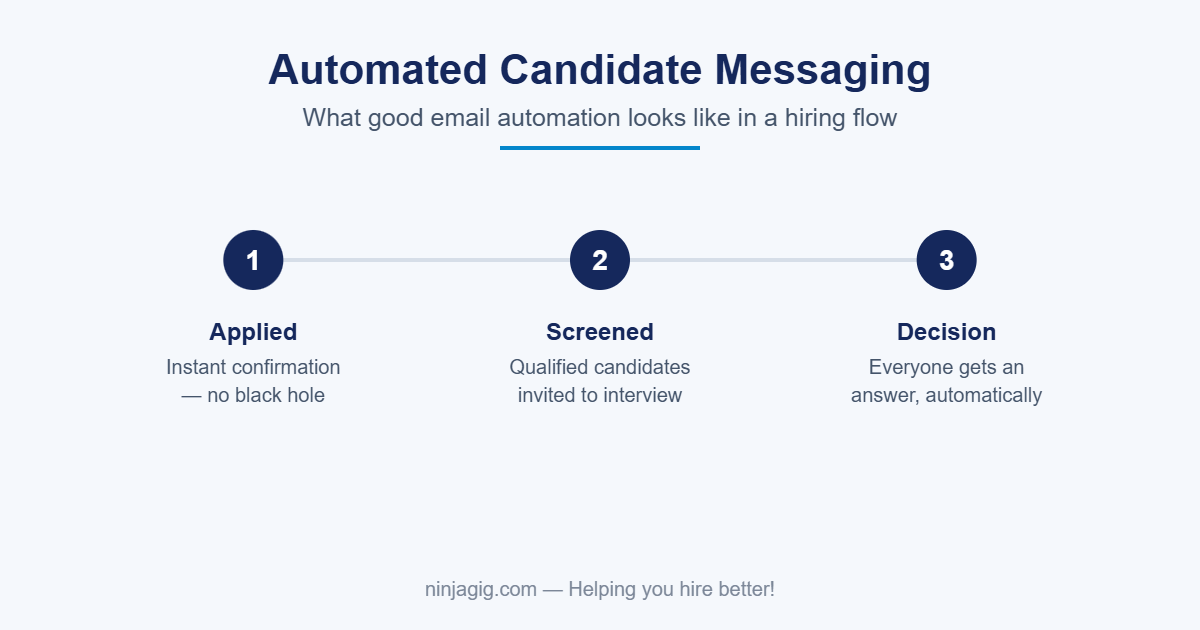
Recruitment email automation solves one of hiring’s most persistent problems: candidate ghosting. When applicants don’t hear back promptly, they assume they’ve been rejected and move on. Automated messaging ensures every candidate receives timely updates throughout their journey, from application confirmation to final decision.
Modern systems use two types of triggers. Time-based triggers send messages at predetermined intervals: application acknowledgment within minutes, status update after one week, follow-up if no action is taken. Event-based triggers respond to specific actions: interview scheduled, assessment completed, offer extended. These workflow templates ensure consistent communication without manual intervention.
The impact on candidate satisfaction is profound. Research shows that 81% of job seekers say continuous status updates would greatly improve their overall experience, yet traditional hiring often fails in this regard. While 94% of candidates want post-interview feedback, only 41% receive it. Automation closes this gap, significantly reducing candidate drop-off through improved transparency.
Effective candidate communication templates share key characteristics: personalized greetings using merge tags, specific next steps and timelines, a professional yet warm tone, mobile-optimized formatting, and clear contact information for questions. The best systems also support conditional logic, sending different messages based on assessment scores or interview outcomes.
Smart Pre-Screening Questions & Assessments
Not every applicant meets basic job requirements. Pre-screening questionnaires automatically filter out unqualified candidates, saving recruiters time. These aren’t complex assessments. They’re simple qualifying questions embedded in the application flow: “Do you have a valid driver’s license?” for delivery roles, “Can you lift 50 pounds?” for warehouse positions, or “Are you authorized to work in this country?” for compliance.
The system instantly scores responses and takes appropriate action. Candidates who don’t meet the must-have criteria receive polite rejection emails. Those who pass advance to the recruiter review. This approach can significantly improve screening efficiency in high-volume hiring scenarios.
Beyond efficiency, automated candidate assessments ensure fairness and compliance. Every applicant answers identical questions in the same order, eliminating unconscious bias from initial screening. The standardized process also creates clear audit trails for Equal Opportunity Employment (EEO) compliance. You can prove that every candidate received equal treatment.
Smart implementation means asking only truly disqualifying questions upfront. Save detailed assessments for later stages. Keep questions clear and objective. And always provide context. Explain why you’re asking and how the information will be used. This transparency helps candidates self-select appropriately while building trust in your process.
Workflow Triggers & Automated Onboarding
Hiring workflow automation extends beyond initial screening to encompass the entire candidate journey. Status-based triggers fire specific actions as candidates move through your pipeline. When a recruiter marks someone as “Phone Screen Passed,” the system automatically sends interview scheduling links. When hiring managers select “Offer Extended,” personalized offer letters are generated instantly.
The real efficiency gains come during onboarding. Traditional hiring requires manual creation of offer letters, employment agreements, tax forms, and policy acknowledgments. Modern onboarding software automates this entire process. Candidate information flows directly from the ATS into document templates. Forms like W-4s and I-9s pre-populate with known data. E-signature integration allows immediate document completion.
Consider this typical scenario: A candidate accepts your offer at 3 PM on Friday. Your offer letter automation immediately generates their employment agreement with the correct salary, start date, and role details. The system emails documents for e-signature, schedules their first-day orientation, creates their employee record in the HRIS, sends IT requests for equipment provisioning, and notifies their future manager with a new-hire summary. What traditionally took days of back-and-forth now happens in minutes.
The benefits extend beyond time savings. Automated workflows reduce errors (no more typos in offer letters), ensure compliance (every hire completes required paperwork), improve candidate experience (no anxious waiting for documents), and free HR teams to focus on strategic onboarding activities rather than paperwork processing.
Measuring ROI & Business Impact
The business case for automation rests on measurable returns. Key metrics tell the story: time-to-fill drops significantly, quality-of-hire scores increase through better candidate matching, recruiter capacity often doubles when administrative tasks disappear, and candidate satisfaction ratings improve substantially.
Let’s examine the financial impact. Consider a typical recruiter managing 20 open positions, spending 40% of their time on administrative tasks. Automation reclaims 16 hours weekly. That’s 832 hours annually. At an average recruiter cost of $75,000 plus benefits, those recovered hours represent substantial productivity gains. Factor in reduced time-to-fill (preventing lost revenue from vacant positions), decreased agency fees (filling more roles internally), and lower turnover costs (better candidate matching), and organizations can realize significant cost savings per recruiter per year.
Revenue impact proves equally compelling. A vacant sales position typically costs hundreds to thousands of dollars in lost revenue daily. Reducing time-to-fill by just one week generates substantial savings per hire. For a 100-person sales organization with 20% annual turnover, faster hiring translates into significant recovered revenue each year.
Building your own ROI calculator requires tracking: current time-to-fill by role type, average hours spent per hire on administrative tasks, the cost of vacancy for revenue-generating positions, the current source of hire and associated costs, and quality-of-hire metrics (performance ratings, retention rates). With this baseline data, you can project automation’s impact on your specific organization.
Elevating the Candidate Experience
Today’s job seekers expect consumer-grade experiences. They’re accustomed to instant confirmations from Amazon, real-time updates from Uber, and seamless interactions with their favorite apps. Traditional recruiting, with its black-hole applications and weeks of silence, feels antiquated by comparison.
Automation delivers the transparency candidates crave. Immediate application confirmations reduce anxiety. Status updates prevent endless wondering. Personalized portals show exactly where candidates stand in the process. Real-time updates significantly reduce application abandonment simply by keeping candidates informed.
Modern candidate experience goes beyond basic communication. AI chatbots answer common questions 24/7: “When will I hear back?” “What should I wear to the interview?” “What benefits do you offer?” These tools provide instant responses while capturing candidate engagement data. Highly engaged candidates who interact with chatbots or portals show significantly higher offer acceptance rates.
The employer brand impact is substantial. Candidates who report positive experiences, even when rejected, are more likely to apply again and recommend the company to others. In an era where Glassdoor reviews influence top talent, providing transparent, respectful applicant engagement through automation becomes a competitive necessity.
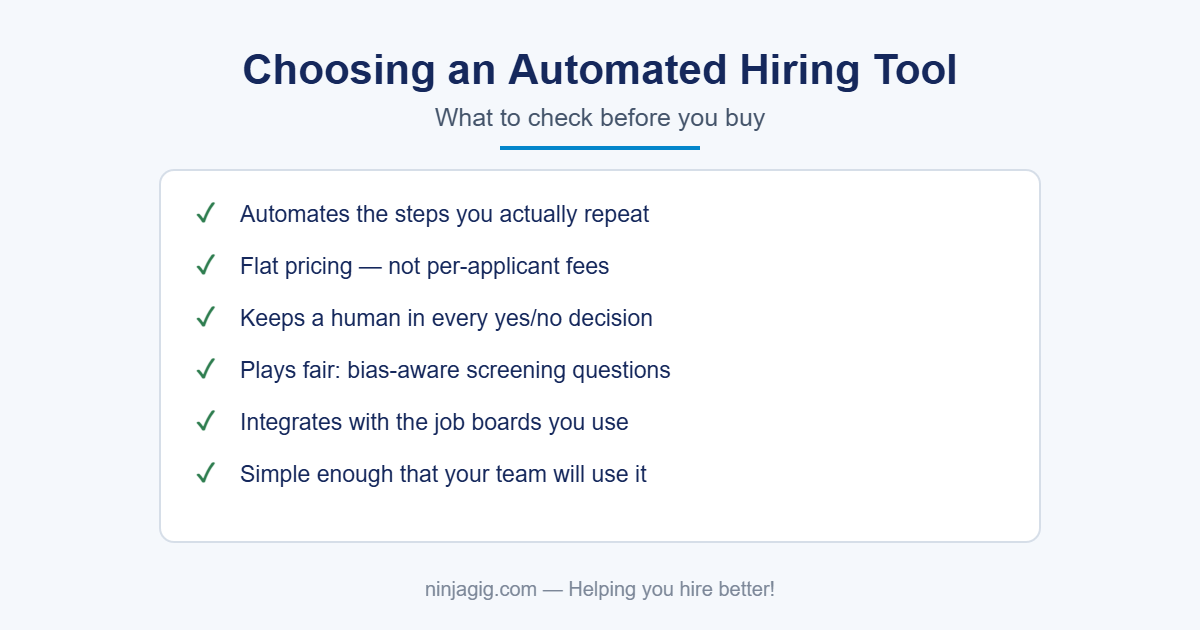
How to Choose the Right Automated Hiring Tool
Not all automation platforms are created equal. Evaluate hiring software based on your specific needs, but certain features prove universally critical. Your automation features checklist should include: robust resume parsing with high accuracy rates, flexible email automation with visual workflow builders, customizable pre-screening questionnaires, integrated assessment capabilities, and comprehensive onboarding document management.
Integration capabilities make or break implementation success. Your chosen ATS must connect seamlessly with the existing HRIS for employee data flow, payroll systems for new-hire setup, calendar applications for interview scheduling, communication tools like Slack or Teams, and job boards for posting distribution. Avoid platforms that create new silos. Automation should unify your tech stack, not fragment it.
Pricing models vary widely. Some charge per recruiter seat, others by employee count or job postings. Hidden costs often lurk in implementation fees, integration charges, and support packages. Calculate the total cost of ownership over three years, including training time. Remember, the cheapest option rarely delivers the best value.
Critical evaluation criteria include: vendor stability and track record (avoid startups without proven scale), data security certifications and compliance attestations, quality of customer support and implementation assistance, regular product updates and innovation roadmap, and genuine user reviews from similar-sized organizations.
What NinjaGig Customers Say
Feedback from teams using NinjaGig’s automation day to day — more on our reviews page:
“The dashboard is clean and intuitive. Posting jobs and reviewing candidates has never been this effortless.”
— Samantha, Fresh Co.
“Great service and very responsive support team. We were up and running in no time. Highly recommend it to any HR department.”
— Brian, Tech Lane
Compliance, Bias & Ethical Automation
With great automation comes great responsibility. AI hiring compliance requirements are evolving rapidly. The EU AI Act classifies recruiting systems as “high-risk,” requiring transparency and human oversight. New York City’s Local Law 144 mandates bias audits for automated employment decisions. Similar regulations are emerging across jurisdictions.
Ethical automation requires proactive bias mitigation. Start with inclusive job descriptions. Many platforms now flag gendered language or unnecessary requirements. Ensure your parsing algorithms don’t penalize non-traditional backgrounds. Regular audits should examine pass rates across demographic groups. If certain populations consistently score lower, investigate why.
Maintain clear audit trails for every automated decision. Document which criteria that triggered rejections. Preserve all candidate communications. Enable human review overrides when edge cases arise. Equal Employment Opportunity Compliance (EEOC) guidelines require that you prove your selection criteria are job-related and consistent with business necessity. Automation makes this easier by standardizing processes and capturing complete records.
Remember: automation should enhance human decision-making, not replace it. Use technology to surface qualified candidates from all backgrounds, then apply human judgment for final selections. This balanced approach maximizes both efficiency and fairness.
Future Trends in Hiring Automation
Recruiting trends 2025 point toward even more sophisticated automation. Generative AI HR applications are beginning to craft personalized outreach messages that reference specific candidate achievements. Instead of generic templates, imagine AI writing unique messages highlighting why each candidate’s background fits your specific role.
Predictive hiring analytics will soon forecast candidate success with remarkable accuracy. By analyzing millions of career trajectories, AI can identify which candidates are most likely to excel and remain long-term. Early adopters report significant improvements in quality-of-hire metrics using predictive scoring.
Video assessment technology is evolving beyond simple recording. New platforms analyze communication patterns, enthusiasm levels, and cultural fit indicators. Voice-activated interfaces will allow candidates to apply using smart speakers: “Alexa, apply to the marketing manager role at TechCorp.”
The convergence of automation and human judgment will deepen. Future platforms won’t just handle tasks. Instead, they’ll provide strategic recommendations: “Based on market analysis, consider adjusting this role’s requirements” or “Similar companies are offering higher salaries for this skillset.”
Conclusion & Action Steps
The evidence is overwhelming: adopt hiring automation or fall behind. Companies using automated tools hire significantly faster, reduce costs per hire, and deliver superior candidate experiences. The technology has matured beyond the early adopter phase.
Your roadmap to improve the recruitment process starts with these steps: First, audit your current process to identify the biggest time wasters. Next, prioritize which automation features would deliver immediate impact. Then, evaluate platforms based on your specific needs and integration requirements.
Ready to Transform Your Hiring?
Ready to slash your time-to-hire by 50%? Book a free 15-minute demo and see Ninja Gig’s automation in action. Watch live as resumes parse instantly, automated workflows trigger seamlessly, and onboarding documents generate with one click.
Download our exclusive Hiring Automation ROI Calculator. Input your current metrics and instantly project cost-per-hire savings. See exactly how much time and money automation could save your team. Real numbers, personalized to your organization. Get the calculator (email required)
Automation without the enterprise price tag: NinjaGig gives small businesses automated job posting, screening questions, and applicant management in one simple tool — start with a demo.
Related reading: How do applicant tracking systems work? · ATS candidate experience · Small business hiring tools