
The restaurant industry faces a staffing crisis unlike any other sector. With annual turnover rates ranging from 75% to 130%, restaurant operators are trapped in an endless cycle of recruiting, hiring, and training new staff. Quick-service restaurants experience the highest churn, with some replacing their entire workforce multiple times each year. This revolving door of employees drains profits, exhausts managers, and ultimately damages the customer experience.
The traditional hiring process simply cannot keep pace with this relentless demand. Paper applications, phone tag scheduling, and manual screening eat up precious hours that managers need for operations. Meanwhile, each unfilled position costs restaurants money in lost productivity, overtime expenses, and declining service quality. The solution lies in purpose-built restaurant hiring software that transforms how food service businesses attract, screen, and onboard hourly workers.
Modern restaurant applicant tracking systems slash time-to-hire from weeks to days, reduce cost-per-hire by automating repetitive tasks, and ensure every shift stays fully staffed. This guide explores how the right hiring technology can break the cycle of constant recruiting and help restaurants build stable, productive teams.
The True Cost of Restaurant Turnover
Restaurant staff turnover statistics paint a sobering picture of the industry’s workforce challenges. While the average turnover rate across all industries hovers around 47%, restaurants face dramatically higher churn. Full-service restaurants typically see 75% to 100% annual turnover, while quick-service establishments often exceed 130%. These numbers mean managers are constantly recruiting just to maintain basic staffing levels.
The financial impact of this turnover extends far beyond recruiting costs. According to industry research, the average cost of replacing an employee is $5,864 per person. But that’s just the beginning. Each vacant position costs restaurants money in lost productivity. When you factor in training time, uniforms, and administrative overhead, the total replacement cost for one hourly employee can be significant.
For a typical quick-service restaurant with 30 employees experiencing 130% turnover, that translates to recruiting 39 new workers annually. At an estimated $3,500 per replacement, the restaurant faces over $136,000 in direct turnover costs each year. This calculation doesn’t include the indirect costs: reduced service quality, overworked remaining staff, increased errors, and lost customers due to poor experiences.
The restaurant labor shortage compounds these challenges. With fewer qualified candidates available, positions stay open longer. Extended vacancies create a vicious cycle where existing staff become overworked and burned out, leading to more resignations. An understaffed kitchen’s impact goes beyond operational efficiency; it fundamentally undermines a restaurant’s ability to deliver consistent quality and service.
Customer satisfaction scores drop when restaurants operate short-handed. Orders take longer, mistakes increase, and the overall dining experience suffers. In an industry where reputation drives revenue, the cost of employee turnover extends to brand damage and lost future sales. Breaking this cycle requires a fundamental shift in how restaurants approach hiring.
What Is Restaurant Hiring Software?
Restaurant hiring software is a specialized applicant tracking system (ATS) designed specifically for the unique needs of food service businesses. Unlike generic human resources (HR) platforms built for corporate offices, a restaurant ATS addresses the challenges of high-volume, hourly hiring in fast-paced environments. These systems streamline every step of the recruitment process, from posting jobs to onboarding new hires.
At its core, restaurant-specific ATS technology includes modules for job distribution, application collection, candidate screening, interview scheduling, and digital onboarding. The software recognizes that restaurant hiring differs fundamentally from corporate recruiting. While office workers might tolerate lengthy application processes, hourly candidates expect quick, mobile-friendly interactions. Food service recruiting software accommodates these expectations with simplified workflows.
The best hourly hiring platforms integrate seamlessly with how restaurants actually operate. They support multi-location posting, enable manager-level access without additional fees, and handle the constant flow of applications that comes with high turnover. Quick service hiring tools prioritize speed and simplicity, allowing managers to post jobs, review candidates, and schedule interviews between rushes. This restaurant-first approach makes the difference between software that sits unused and technology that transforms hiring outcomes.
Why Generic ATS Platforms Fall Short
Enterprise HR suites and generic ATS platforms create more problems than they solve for restaurant operators. These systems, designed for corporate hiring cycles, impose per-job posting fees that quickly become prohibitive when you’re constantly recruiting. A restaurant posting 50 jobs annually could face thousands in posting charges alone with traditional platforms.
Generic ATS limitations become apparent in their application processes. Long, complex forms optimized for desktop computers alienate hourly workers who primarily use smartphones. When applications take 15 to 20 minutes to complete, dropout rates soar. Restaurant hiring challenges require mobile-first design, yet most enterprise systems barely function on small screens.
Communication represents another critical failure point. Corporate ATS platforms rely on email, while hourly workers prefer text messaging. Without integrated Short Message Service (SMS) capabilities, managers miss opportunities to engage candidates quickly. Poor mobile user experience (UX) compounds these problems in mobile job applications, frustrating both applicants and hiring managers.
Manager accessibility poses additional challenges. Enterprise systems often limit user licenses or charge per seat, preventing individual location managers from accessing the hiring pipeline. Compliance features such as I-9 and W-4 collection, which are essential for high-volume hourly hiring, are frequently missing or require expensive add-ons. This ATS comparison clearly shows why restaurants need purpose-built solutions rather than retrofitted corporate tools.
Core Features Built for Restaurants
Effective restaurant hiring features center on automation, speed, and scalability. The right platform eliminates manual tasks while providing unlimited access for multi-location operations. These automated recruiting systems must handle high application volumes without per-transaction fees that punish growth. Mobile recruiting tools ensure candidates can apply instantly from any device. Most importantly, the technology must be simple enough for busy managers to use between service periods. The following capabilities represent the essential foundation for modern restaurant recruitment.
Multi-Board Job Posting (One-Click)
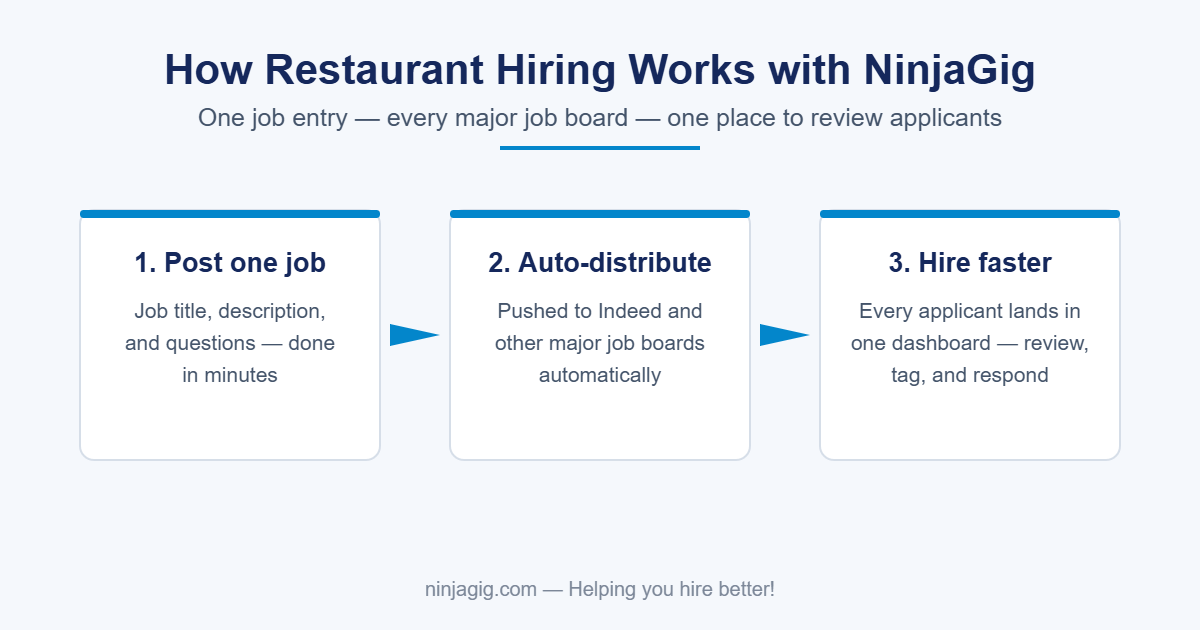
One-click job posting revolutionizes how restaurants advertise open positions. Instead of manually creating listings across multiple sites, managers post once, and the system automatically distributes them to Indeed, ZipRecruiter, Craigslist, social media platforms, and niche job boards. This capability to post to multiple job boards simultaneously exponentially expands reach.
The mathematics of multi-board posting is compelling. By instantly broadcasting restaurant job ads across dozens of platforms, you tap into diverse candidate pools. A single posting might reach thousands of potential applicants across different demographics and geographic areas.
Beyond expanded reach, automated distribution saves significant time. Manual posting to 10 job sites could take two hours; one-click posting accomplishes the same task in minutes. Built-in analytics track which sources generate quality applicants, allowing managers to optimize their recruiting strategy. This data-driven approach helps increase applicant flow while reducing time spent on administrative tasks.
Mobile-Friendly, Quick Applications
Mobile job application capability is non-negotiable in restaurant hiring. Research indicates that 74% of food service applications are completed via smartphone. Traditional desktop-oriented applications fail these candidates, leading to massive dropout rates. When online forms require more than six minutes to complete, half of the applicants abandon the process.
Text-to-apply functionality addresses this challenge directly. Candidates can initiate applications by texting a keyword to a short code, receiving a link to a mobile-optimized form. Quick Response (QR) codes posted in restaurant windows enable walk-in applicants to apply instantly. These restaurants hire via smartphone methods, capturing candidates at the moment of interest.
Chatbot-style applications further improve the candidate experience. Instead of static forms, conversational interfaces guide applicants through questions in a natural way. This approach can reduce application time from 15 minutes to 3 minutes. This dramatic improvement in completion rates translates directly to larger candidate pools and faster hiring.
Smart Pre-Screening Questions
Pre-screening restaurant applicants through targeted questions eliminates unqualified candidates before they consume manager time. Knockout questions address essential requirements like availability, transportation, and required certifications. For example, asking “Can you work Friday and Saturday nights?” immediately filters out candidates who are unavailable during peak periods.
Automated candidate filtering goes beyond simple yes/no questions. Scoring algorithms weigh responses to identify the best-fit applicants. A candidate with seven days of availability scores higher than someone with limited availability. Experience in similar restaurants adds points. This hiring automation ensures that managers review only pre-qualified candidates who meet the minimum requirements.
Compliance considerations integrate seamlessly into pre-screening. Questions about work authorization, age requirements for alcohol service, and food handler certifications ensure legal hiring practices. By addressing these factors upfront, restaurants avoid wasting time on candidates who cannot legally perform required duties. Smart pre-screening typically significantly reduces application review time.
Automated Interview Scheduling & Reminders
Automated interview scheduling eliminates the back-and-forth communication that delays hiring. Once managers identify promising candidates, the system sends available time slots via text or email. Candidates select convenient times, and calendar integration automatically blocks those times from the schedule. This restaurant interview software approach can substantially reduce scheduling time.
The impact on hiring speed is dramatic. Traditional phone tag scheduling often takes days; automated systems complete the process in hours. Being first to contact qualified candidates provides a competitive advantage in tight labor markets. As one HR executive noted, whoever reaches candidates first has the best chance of hiring them.
Automated reminders significantly reduce no-show interviews. Text messages sent 24 hours and 2 hours before scheduled interviews keep appointments top of mind. Strategic reminder sequences can significantly reduce no-shows. This reliability means managers spend less time waiting for candidates who never arrive, improving overall hiring efficiency.
Unlimited Hourly Job Postings
Unlimited job postings represent a fundamental requirement for high-turnover restaurants. While corporate recruiting might involve posting a few positions monthly, restaurants constantly advertise multiple openings. Flat fee recruiting software that includes unlimited postings aligns pricing with operational reality.
Consider a restaurant with 100% annual turnover across 30 positions. That’s a minimum of 30 job postings, not counting multiple posts for hard-to-fill roles. Traditional per-post pricing at $200 per listing would cost $6,000 annually for job ads alone. Unlimited posting models eliminate this variable cost, making budgeting predictable.
The freedom to post without penalty encourages proactive recruiting. Managers can maintain “always-on” hourly job ads for critical positions, building talent pipelines before urgent needs arise. This approach particularly benefits restaurants in competitive labor markets where the best candidates are hired quickly.
Multi-Location & Multi-Manager Access
Multi-location hiring demands decentralized control. Each restaurant location has unique staffing needs, schedules, and candidate pools. Effective franchise recruiting software provides individual managers with direct system access to handle their specific hiring needs without bottlenecks.
Manager self-service ATS capabilities transform hiring efficiency. Instead of routing all activities through corporate HR, location managers post jobs, review applications, and schedule interviews independently. This autonomy accelerates hiring while ensuring local market knowledge guides decisions. Most importantly, quality platforms include unlimited manager access without per-seat licensing fees.
Role-based permissions maintain control while enabling flexibility. Regional managers might oversee multiple locations, while shift supervisors only access their specific candidate pipelines. Consolidated reporting provides corporate visibility into hiring metrics across all locations. This balanced approach satisfies both operational efficiency and corporate oversight requirements.
Candidate Engagement & Compliance
Automated communication keeps candidates engaged throughout the hiring process. Strategic touchpoints via SMS and email prevent qualified candidates from accepting other offers while waiting. Welcome messages, status updates, and next-step notifications maintain momentum from application to first day.
Hiring compliance features protects restaurants from legal risks. Built-in Equal Employment Opportunity Commission (EEOC) reporting tracks demographic data for equal opportunity compliance. Digital I-9 onboarding eliminates paperwork while ensuring proper verification of work authorization. E-signature capability for W-4 forms and company policies creates audit trails for regulatory requirements.
Document storage centralizes all hiring-related paperwork in secure, accessible formats. When labor departments request hiring records, everything is instantly available. This organizational capability proves especially valuable for multi-location operations subject to various state and local regulations.
Return on Investment (ROI) & Business Benefits
The return on investment from restaurant hiring software manifests in multiple measurable ways. Faster fill times represent the most immediate benefit. Restaurants using automated hiring platforms report reducing time-to-hire from 10-14 days to 48-72 hours. This acceleration means fewer shifts operating short-staffed and less overtime paid to cover gaps.
Consider the math: if each vacant position costs money daily in lost productivity, reducing fill time by 7 days saves significantly per hire. For a restaurant hiring 40 people annually, the savings multiply. Add reduced overtime costs when fully staffed, and savings multiply quickly.
Reduce turnover costs by hiring better matches from the start. Pre-screening ensures candidates understand job requirements and schedule expectations before investing time in interviews. This alignment reduces early turnover, where new hires quit within 90 days. Better hiring practices can achieve substantial reductions in turnover.
Staff retention improvements compound financial benefits. When turnover drops from 100% to 70%, a 30-employee restaurant avoids 9 replacements annually. At $3,500 per replacement, that’s $31,500 in direct savings. Indirect benefits include improved service quality, higher customer satisfaction scores, and increased restaurant profitability through operational consistency.
Hiring ROI calculator models typically show break-even within 2-3 months. After that, savings flow directly to the bottom line. When compared with recruitment agency fees (often 15-25% of annual wages), in-house automated hiring delivers significant cost advantages while providing greater control over candidate quality.
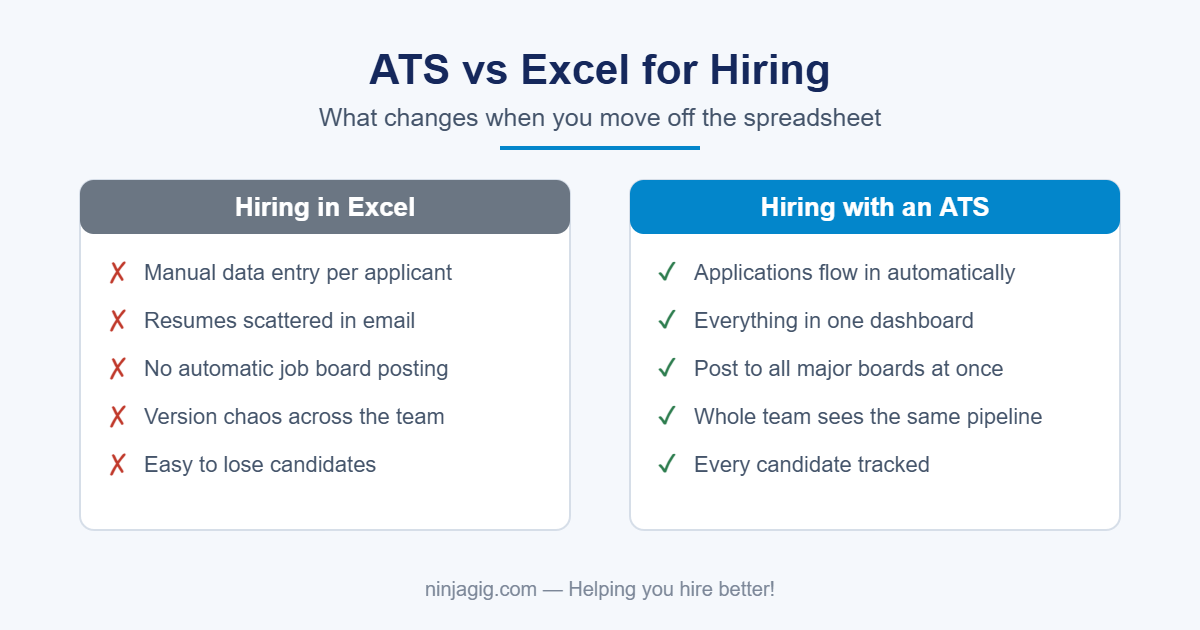
Comparison: Restaurant Hiring Software vs. Legacy Methods
Restaurant hiring comparison across different methods reveals stark efficiency differences:
- Manual hiring vs software speed: Paper applications and phone scheduling take days; automated systems work in hours
- Reach: Walk-ins and single job board posts attract dozens; multi-board posting reaches thousands
- Cost: Manual processes consume 10-15 manager hours per hire; automation reduces this to 2-3 hours
- Candidate experience: Paper forms and phone tag frustrate applicants; mobile-friendly systems engage them
- Scalability: Manual methods break down with volume; software handles unlimited applicants efficiently
This ATS feature checklist highlights the advantages of purpose-built restaurant platforms over generic solutions or manual processes. The right technology transforms hiring from a constant struggle to a streamlined operation.
Implementation & Best Practices
Successful ATS implementation begins with proper setup and configuration. Start by importing existing job templates and customizing them for your restaurant’s specific needs. Include clear job titles, accurate descriptions, and realistic requirements. Avoid over-qualifying positions; requiring extensive experience for entry-level roles unnecessarily shrinks your candidate pool.
Manager training ensures adoption and effectiveness. Schedule brief training sessions during slow periods, focusing on practical tasks like posting jobs and reviewing applications. Most restaurant onboarding software requires minimal technical knowledge. Emphasize time savings and demonstrate mobile capabilities that enable hiring during rushes.
Establish hiring key performance indicators (KPIs) to measure success: time-to-fill, cost-per-hire, application completion rates, and 90-day retention. Track these metrics from day one to demonstrate ROI. Best practices in recruiting include a weekly review of metrics and adjustment of strategies based on results. Set text messaging guidelines for professional yet friendly communication that resonates with hourly workers.
What NinjaGig Customers Say
Real feedback from businesses using NinjaGig for high-volume, hourly hiring — more on our reviews page:
“We are super impressed and thrilled with Ninja Gig. We compared your online job application software and two other tools and Ninja Gig was the perfect fit. Implementation was easy and we are excited to be in this for the long haul with you.”
— Matt, Seven Hospitality
“NinjaGig simplified our entire hiring process. I can’t imagine going back to paper forms or email submissions. It’s a total game changer.”
— Jenna, Urban Core
Frequently Asked Questions
What does restaurant hiring software typically cost?
ATS pricing questions often focus on hidden fees. Quality restaurant hiring platforms charge flat monthly rates ranging from $99-299 per location, including unlimited job postings and manager access. Beware of systems that charge per job post or per user, as these costs can escalate quickly with high turnover.
Does the software integrate with point-of-sale (POS) systems?
POS integration capabilities vary by platform. Some systems sync with popular restaurant POS systems for streamlined onboarding and scheduling. Ask vendors about specific integrations with your existing technology stack.
Are there regulations around text messaging candidates?
Yes, the Telephone Consumer Protection Act (TCPA) compliance requires candidate consent before sending recruitment texts. Quality platforms include opt-in mechanisms and automatically maintain compliance. Always verify that your chosen system handles consent management properly.
How secure is candidate data?
Data security concerns in recruiting are valid, given the sensitive information collected. Look for platforms that are SOC 2 compliant, use encryption at rest and in transit, and have clear data retention policies. General Data Protection Regulation (GDPR) compliance is essential if you operate internationally.
Can the system handle bilingual applications?
Many platforms support multilingual applications, particularly Spanish-English combinations common in restaurant hiring. This functionality significantly expands your candidate pool across diverse markets.
Ready to Hire Faster?
See the platform in action and transform your restaurant hiring process. Post your first job in under five minutes and start receiving qualified applicants today. Our specialized restaurant hiring software eliminates the chaos of constant recruiting with smart automation and unlimited job postings. Book a 15-minute demo or start your free 7-day trial now to experience the difference purpose-built hiring technology makes.
Ready to fix restaurant hiring for good? NinjaGig is restaurant-friendly hiring software used by pizza shops, delis, breweries, and multi-location franchises — unlimited job postings to every major job board, applicants in one dashboard, no long-term contract. See all features.
Related reading: What is an ATS? · Low-cost applicant tracking systems · The best job boards guide
Free Download: The 30-Day Restaurant Hiring Playbook
Want this whole plan as a printable checklist? Grab the free playbook — a week-by-week schedule with the 5-question interview, sourcing checklist, and first-shift onboarding list. No email required.